
Read the given statements and conclusions carefully. You have to take the given statements to be true even if they seem to be at variance from commonly known facts and decide which conclusion(s) logically follow(s) from the given statements. Statements: No horses are mirrors. Some lizards are horses. Conclusions: (I) Some horses are not lizards. (II) Some lizards are not mirrors.
Only conclusion (II) follows.
The correct answer is option 2 i.e. Only conclusion (II) follows.
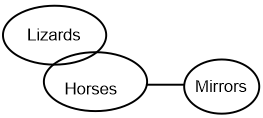
Conclusions:
(I) Some horses are not lizards. - Does not follow (because Some lizards are horses.)
(II) Some lizards are not mirrors. - Follows (because No horses are mirrors and Some lizards are horses.)
Similar Questions
Read the given statements and conclusions carefully. You have to take the given statements to be true even if they seem to be at variance from commonly known facts and decide which conclusion(s) logically follow(s) from the given statements.
Statements:
All clothes are rings.
No cloth is a bottle.
Conclusions:
(I) Some rings are bottles.
(II) Some rings are clothes.
Read the given statements and conclusions carefully. You have to take the given statements to be true even if they seem to be at variance from commonly known facts and decide which conclusion(s) logically follow(s) from the given statements.
Statements:
All engines are rockets.
All planes are rockets.
Conclusions:
(I) Some engines are planes.
(II) All planes are engines.
Read the given statements and conclusions carefully. You have to take the given statements to be true even if they seem to be at variance from commonly known facts and decide which conclusion(s) logically follow(s) from the given statements.
Statements:
Some snakes are lizards.
All roosters are lizards.
Conclusions:
(I) All lizards are roosters.
(II) No roosters are snakes.
Read the given statements and conclusions carefully. You have to take the given statements to be true even if they seem to be at variance from commonly known facts and decide which conclusion(s) logically follow(s) from the given statements.
Statements:
Some ribbons are balloons.
Some balloons are eagles.
Conclusions:
(I) All eagles are ribbons.
(II) No ribbons are eagles.
Read the given statements and conclusions carefully. You have to take the given statements to be true even if they seem to be at variance from commonly known facts and decide which conclusion(s) logically follow(s) from the given statements.
Statements:
Some trees are flowers.
All flowers are leaves.
Conclusions:
(I) All leaves are trees.
(II) All flowers are trees.
Decide which of the conclusions logically follow(s) from the information given in the statement.
Statements:
Poverty is increasing because politicians don’t understand poverty, nor do they know anything about the problems faced by the poor.
Conclusions:
- All politicians should be replaced.
- All politicians should be asked to live in poor conditions.
Consider the given statement to be true and decide which of the conclusion(s) logically follow(s) from the statement.
Statement:
Weight is also a force.
Conclusions:
1. The unit of weight is Newton.
2. The unit of weight is Kilogram.Which of the following options correctly describes the given statement?
Statement:
There are four rooks in a game of chess.Consider the given statement to be true and decide which of the given conclusions logically follow(s) from the statement.
Statement:
All work and no play makes jack a dull boy.
Conclusions:
1: To work is important.
2: One has to compromise work for play.
Consider the given statement to be true even if they seem to be at variance with the commonly known facts and decide which of the given conclusions logically follows from the given statement.
Statement :
This bowl has soup.
Conclusion :
I. The bowl has tomato soup
II. The soup is too hot.
Important Questions from Statements and Conclusions
In the following question below are given some statements followed by some conclusions based on those statements. Taking the given statements to be true even if they seem to be at variance from commonly known facts. Read all the conclusions and then decide which of the given conclusion logically follows the given statements.
Statements:
I. All A are B.
II. Some B are C.
Conclusions:
I. Some A are C.
II. Some A are not C.
III. Some A are B.
In the question one statement is given, followed by two conclusions, I and II. You have to consider the statements to be true even if it seems to be at variance from commonly known facts. You have to decide which of the given conclusions, if any, follows from the given statements.
Statement : 55% of Manisha's office colleagues went to watch the movie.
Conclusion I : Manisha went to watch the movie.
Conclusion II : Manisha did not go to watch the movie.
In the question two statements are given, followed by two conclusions, I and II. You have to consider the statements to be true even if it seems to be at variance from commonly known facts. You have to decide which of the given conclusions, if any, follows from the given statements.
Statement 1 : All schools are books.
Statement 2 : No books are papers.
Conclusion I : No schools are books.
Conclusion II : Some books are schools.
In the question below are given some statements followed by some conclusions based on those statements. Take the given statements to be true even if they seem to be different from commonly known facts. Read all the conclusions and then decide which of the given conclusions logically follows from the given statements.
Statements:
I. Some P are Q.
II. All P are N.
Conclusion:
I. All Q are N.
II. Some P are not Q.
In the question below are given some statements followed by some conclusions based on those statements. Take the given statements to be true even if they seem to be different from commonly known facts. Read all the conclusions and then decide which of the given conclusions logically follows from the given statements.
Statements:
I. Some P are T.
II. Some T are S.
III. No J is P.
Conclusion:
I. Some S are not J.
II. Some T are not J.
III. Some J are not T.



