
Problem Analysis: We are given a circle with diameter PQ and center O. A point R is on the circle such that $\angle RPO = 39^\circ$. We need to find the measure of $\angle RQP$. We will use properties of isosceles triangles and the angle subtended by a diameter.
Diameter Property in Circle
Since PQ is the diameter of the circle, the angle subtended by the diameter at any point on the circumference is $90^\circ$. Therefore, $\angle PRQ = 90^\circ$.
Isosceles Triangle RPO
Consider the triangle $\triangle RPO$. The sides OP and OR are both radii of the same circle. Hence, $OP = OR$. This makes $\triangle RPO$ an isosceles triangle.
In an isosceles triangle, the angles opposite the equal sides are equal. Given $\angle RPO = 39^\circ$, the angle opposite to OP, which is $\angle ORP$, must also be equal to $\angle RPO$.
So, $\angle ORP = \angle RPO = 39^\circ$.
Calculate Angle ORQ
We know that $\angle PRQ = \angle ORP + \angle ORQ$.
Substituting the known values:
$ 90^\circ = 39^\circ + \angle ORQ $
Solving for $\angle ORQ$:
$
\angle ORQ = 90^\circ - 39^\circ
$
$
\angle ORQ = 51^\circ
$
Isosceles Triangle RQO
Now consider the triangle $\triangle RQO$. The sides OQ and OR are both radii of the circle. Hence, $OQ = OR$. This makes $\triangle RQO$ an isosceles triangle.
The angles opposite the equal sides are equal. Therefore, the angle opposite to OR ($\angle OQR$, which is the same as $\angle RQP$) must be equal to the angle opposite to OQ ($\angle ORQ$).
So, $\angle RQP = \angle ORQ$.
Since we calculated $\angle ORQ = 51^\circ$, we have:
$ \angle RQP = 51^\circ $
Similar Questions
- The points A, B and C lie on a circle with centre O. The $\angle \text{ACB} = 47.5^{\circ}$. What is the $\angle \text{AOB}$ on the minor $\widehat{\text{AB}}$?
- $1^{\circ}$ of latitude is equal to ___ km approximately.
- The radius of a circle is equal to the diagonal of a square. If the area of the square is 32 sq units, then the area of the circle is:
- What is the area of the largest square that is inscribed in a semicircle of radius 10 cm?
- A wheel makes 1000 revolutions in covering a distance of 154 km. Find the radius (in metre) of the wheel.
- Two intersecting circles are said to be orthogonal if the angle between them is a/an _____.
A park is designed in the shape of a right-angled triangle, where the two shorter sides measure 13 m and 84 m. A circular track with a uniform width of 2 m is constructed such that its outer boundary coincides with the circumcircle of the triangular park. Determine the perimeter of the inner boundary of this circular track.
- From a point Q, the length of the tangent to a circle is 21cm and the distance of Q from the centre 'O' of the circle is 29cm. Find the radius of the circle.
- The angle of a sector is 30°. If its radius is 42 cm then the length of the arc of the sector is:
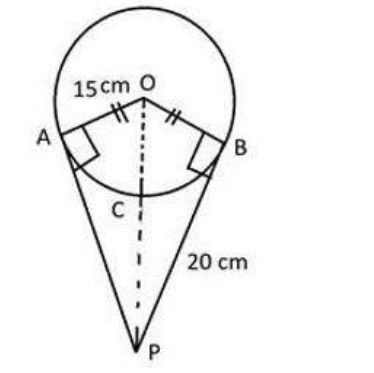
In the given figure, if PB = 20 cm and OA = 15 cm, then find the shortest distance between the circle and P.
Important Questions from Circles
The sum of the radius and diameter of a circle is 84 cm. What is the circumference of this circle?
The tangent at a point C of a circle and diameter AB when extended intersect at D, if ∠DCA = 110°, then ∠CBA is equal to
The equation of a circle with diameters are 2x - 3y + 12 = 0 and x + 4y - 5 = 0 and area of 154 sq. units is
The internal center of similitude of two circles $ (x - 1)^2 + (y - 3)^2 = 4 $ and $ (x + 5)^2 + (y - 9)^2 = 16 $ is
The inner circumference of a circular race track 14 cm wide is 440 cm. Find the radius of the outer circle.



