
Wheel Radius Calculation
The problem asks for the radius of a wheel given the number of revolutions it makes and the total distance covered. We need to find the radius in meters.
Distance Conversion
First, convert the total distance from kilometers (km) to meters (m):
Distance = $154 \text{ km} = 154 \times 1000 \text{ m} = 154000 \text{ m}$
Circumference Calculation
The distance covered in one revolution is equal to the circumference of the wheel.
Total revolutions = $1000$
Distance per revolution (Circumference) = Total Distance / Total Revolutions
Circumference = $\frac{154000 \text{ m}}{1000} = 154 \text{ m}$
Radius Determination
The formula for the circumference ($C$) of a circle (wheel) with radius ($r$) is $C = 2 \pi r$.
We know the circumference is $154$ m. We can use the value of $\pi \approx \frac{22}{7}$.
$154 = 2 \times \frac{22}{7} \times r$
$154 = \frac{44}{7} \times r$
To find the radius ($r$), rearrange the formula:
$r = 154 \div \frac{44}{7}$
$r = 154 \times \frac{7}{44}$
Simplify the calculation:
$r = \frac{154}{44} \times 7$
$r = \frac{14 \times 11}{4 \times 11} \times 7$
$r = \frac{14}{4} \times 7$
$r = \frac{7}{2} \times 7$
$r = \frac{49}{2}$
$r = 24.5 \text{ m}$
Final Answer Format
Convert the radius to a mixed fraction:
$r = 24.5 \text{ m} = 24 \frac{1}{2} \text{ m}$
Similar Questions
- PQ is a diameter of a circle whose centre is O. If a point R lies on the circle and $\angle RPO$ is $39^\circ$, then find the measure of $\angle RQP$.
- The points A, B and C lie on a circle with centre O. The $\angle \text{ACB} = 47.5^{\circ}$. What is the $\angle \text{AOB}$ on the minor $\widehat{\text{AB}}$?
- $1^{\circ}$ of latitude is equal to ___ km approximately.
- The radius of a circle is equal to the diagonal of a square. If the area of the square is 32 sq units, then the area of the circle is:
- What is the area of the largest square that is inscribed in a semicircle of radius 10 cm?
- Two intersecting circles are said to be orthogonal if the angle between them is a/an _____.
A park is designed in the shape of a right-angled triangle, where the two shorter sides measure 13 m and 84 m. A circular track with a uniform width of 2 m is constructed such that its outer boundary coincides with the circumcircle of the triangular park. Determine the perimeter of the inner boundary of this circular track.
- From a point Q, the length of the tangent to a circle is 21cm and the distance of Q from the centre 'O' of the circle is 29cm. Find the radius of the circle.
- The angle of a sector is 30°. If its radius is 42 cm then the length of the arc of the sector is:
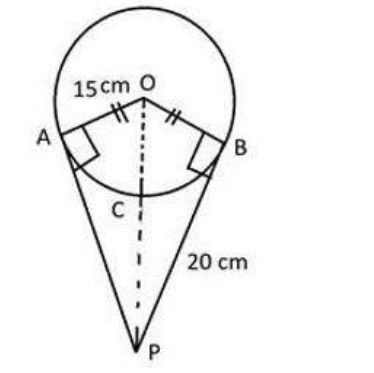
In the given figure, if PB = 20 cm and OA = 15 cm, then find the shortest distance between the circle and P.
Important Questions from Circles
The sum of the radius and diameter of a circle is 84 cm. What is the circumference of this circle?
The tangent at a point C of a circle and diameter AB when extended intersect at D, if ∠DCA = 110°, then ∠CBA is equal to
The equation of a circle with diameters are 2x - 3y + 12 = 0 and x + 4y - 5 = 0 and area of 154 sq. units is
The internal center of similitude of two circles $ (x - 1)^2 + (y - 3)^2 = 4 $ and $ (x + 5)^2 + (y - 9)^2 = 16 $ is
The inner circumference of a circular race track 14 cm wide is 440 cm. Find the radius of the outer circle.



