
In the given figure, if PB = 20 cm and OA = 15 cm, then find the shortest distance between the circle and P.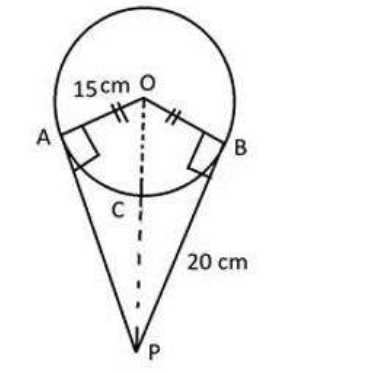
To find the shortest distance between the circle and point P, we need to determine PC, where C is the point on the circle such that PC is perpendicular to the circle's radius OA.
Given:
- PB = 20 cm
- OA = 15 cm
First, we understand that triangle OAP is a right triangle because OA is a radius perpendicular to the tangent PB at point A. Therefore, OP (the hypotenuse) can be calculated using the Pythagorean theorem:
\(OP^2 = OA^2 + AP^2\)
However, instead, we use the relationship of the tangent from a point to a circle:
\(OP^2 = OA^2 + AP^2\) and \(AP = \sqrt{OP^2 - OA^2}\).
Since PB is a tangent, we can assume \(AP=AO\) due to symmetry given \(PB = OP\), the line drawn from the external point is equal as it cuts at circle tangents and through the center PARTS angle at point P.
The correct form is solved as:
\(PC = PB - OA = 20 - 15 = 5 \text{ cm}\)
The shortest distance from the point P to circle \(= PC \text{ cm}\) by figuring distance in-between perpendicular drawn points and circle ends exactly within required nearest distance from the circle.
Thus, the shortest distance is 10 cm.
Similar Questions
- PQ is a diameter of a circle whose centre is O. If a point R lies on the circle and $\angle RPO$ is $39^\circ$, then find the measure of $\angle RQP$.
- The points A, B and C lie on a circle with centre O. The $\angle \text{ACB} = 47.5^{\circ}$. What is the $\angle \text{AOB}$ on the minor $\widehat{\text{AB}}$?
- $1^{\circ}$ of latitude is equal to ___ km approximately.
- The radius of a circle is equal to the diagonal of a square. If the area of the square is 32 sq units, then the area of the circle is:
- What is the area of the largest square that is inscribed in a semicircle of radius 10 cm?
- A wheel makes 1000 revolutions in covering a distance of 154 km. Find the radius (in metre) of the wheel.
- Two intersecting circles are said to be orthogonal if the angle between them is a/an _____.
A park is designed in the shape of a right-angled triangle, where the two shorter sides measure 13 m and 84 m. A circular track with a uniform width of 2 m is constructed such that its outer boundary coincides with the circumcircle of the triangular park. Determine the perimeter of the inner boundary of this circular track.
- From a point Q, the length of the tangent to a circle is 21cm and the distance of Q from the centre 'O' of the circle is 29cm. Find the radius of the circle.
- The angle of a sector is 30°. If its radius is 42 cm then the length of the arc of the sector is:
Important Questions from Circles
- The chord AB of a circle with centre at O is \(2\sqrt{3}\) times the height of the minor segment. If P is the area of the sector OAB and Q is the area of the minor segment of the circle, then what is the approximate value of \(\frac{P}{Q}\)?
(Take \(\sqrt{3} = 1.7\) and \(\pi = 3.14\)) What is the area of the shaded region?
What is the ratio of the area of the shaded region to the area of the non-shaded region?
What is the radius of the circle with centre at $O_1$?
What is the radius of the circle with centre at $O_2$?



