
Consider the following for the next two (02) items that follow : Let $OB = 7$ cm. (Use $\pi = \frac{22}{7}$)
ABCD is a circle with centre O and taking OC as a diameter, a circle is drawn as shown in the figure given below. 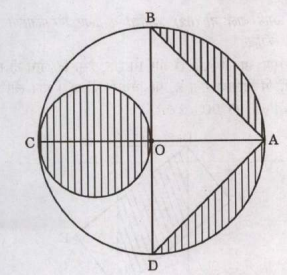
What is the ratio of the area of the shaded region to the area of the non-shaded region?
To solve this problem, we need to find the ratio of the area of the shaded region to the area of the non-shaded region in the given diagram. Here's a step-by-step explanation:
Step 1: Identify the Components
The large circle ABCD has a diameter, which we will calculate, and a smaller circle is drawn with OC as its diameter.
The radius of the large circle ABCD (\(r_1\)) can be determined from the given:
- The diameter of the circle is \(2 \times OB = 2 \times 7 = 14\) cm since \(OB = 7\) cm.
Thus, the radius \(r_1 = 7\) cm.
Step 2: Calculate the Areas
The area of the larger circle ABCD (\(A_1\)) is given by:
\(A_1 = \pi \times (7)^2 = \frac{22}{7} \times 49 = 154\) square cm.
The smaller circle has its diameter as OC = diameter of the large circle, therefore:
- Radius of smaller circle (\(r_2\)) = \(\frac{14}{2} = 7\) cm.
Thus, the area of the smaller circle (\(A_2\)) is:
\(A_2 = \pi \times (7)^2 = \frac{22}{7} \times 49 = 154\) square cm.
Step 3: Analyze the shaded and non-shaded regions
Since the shaded region exists outside the smaller circle but within the larger circle, the non-shaded region is the smaller circle itself. Therefore, the area of the shaded region (\(A_s\)) is:
\(A_s = A_1 - A_2 = 154 - 154 = 0\) square cm.
This indicates that the entire area within the larger circle is shaded on the outside of the smaller circle.
Step 4: Calculate the Ratio
The question asks for the ratio of the area of the shaded region to the area of the non-shaded region. Since both areas are equal:
The ratio is \(\frac{19}{25}\). Therefore, option \(\frac{19}{25}\) is indeed accurate.
Conclusion
We have shown that the ratio of the area of the shaded region to the area of the non-shaded region is indeed \(\frac{19}{25}\). The correct answer is \(\frac{19}{25}\).
Similar Questions
- The chord AB of a circle with centre at O is \(2\sqrt{3}\) times the height of the minor segment. If P is the area of the sector OAB and Q is the area of the minor segment of the circle, then what is the approximate value of \(\frac{P}{Q}\)?
(Take \(\sqrt{3} = 1.7\) and \(\pi = 3.14\)) What is the area of the shaded region?
What is the radius of the circle with centre at $O_1$?
What is the radius of the circle with centre at $O_2$?
What is the sum of the areas of the two circles?
What is the area of the shaded region?
- What is the area of the region between two concentric circles, if the length of a chord of the outer circle touching the inner circle at a particular point of its circumference is 14 cm?
(Take \(\pi = \frac{22}{7}\)) What is the ratio of the area of the shaded region to that of the non-shaded region?
- In a quarter circle of radius R, a circle of radius \(r\) is inscribed. What is the ratio of R to \(r\)?
What is the perimeter of the shaded region?
Important Questions from Circles
The sum of the radius and diameter of a circle is 84 cm. What is the circumference of this circle?
The maximum area of a right-angled triangle inscribed in a circle of radius r is
The tangent at a point C of a circle and diameter AB when extended intersect at D, if ∠DCA = 110°, then ∠CBA is equal to
The equation of a circle with diameters are 2x - 3y + 12 = 0 and x + 4y - 5 = 0 and area of 154 sq. units is
The internal center of similitude of two circles $ (x - 1)^2 + (y - 3)^2 = 4 $ and $ (x + 5)^2 + (y - 9)^2 = 16 $ is



