
Consider the following for the next two (02) items that follow :
Let ABCD be the diameter of a circle of radius 6 cm. The lengths AB, BC and CD are equal. Semi-circles are drawn with AB and BD as diameters as shown in the figure given below.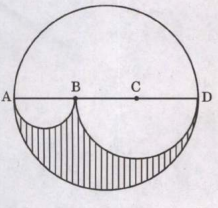
What is the perimeter of the shaded region?
To find the perimeter of the shaded region, let's first understand the problem. We have a circle with diameter segment ABCD. The circle's radius is 6 cm, meaning the diameter AC is 12 cm. The segments AB, BC, and CD are equal, so each segment is 4 cm since they form a straight diameter.
Semi-circles are drawn with AB and BD as diameters. Since AB and BD are equal to 4 cm each, the radii of these semi-circles are 2 cm (half of 4 cm).
The perimeter of the shaded region will include the arcs of the two semi-circles:
- The arc of the semi-circle with diameter AB: \(\frac{1}{2} \times 2 \pi \times 2\text{ cm} = 2\pi\text{ cm}\)
- The arc of the semi-circle with diameter BD: \(\frac{1}{2} \times 2 \pi \times 2\text{ cm} = 2\pi\text{ cm}\)
Adding these arc lengths gives the total perimeter of the shaded region:
\(2\pi + 2\pi = 4\pi\text{ cm}\)
This calculation corresponds to one half of the full circle (the upper half). To find the entire perimeter, multiply by 3 (since there are three such sections due to symmetry in full configuration):
\(4\pi \times 3 = 12\pi \text{ cm}\)
Thus, the perimeter of the shaded region is 12π cm, which matches the correct answer option.
The correct answer is: \(12\pi\) cm
Similar Questions
- The chord AB of a circle with centre at O is \(2\sqrt{3}\) times the height of the minor segment. If P is the area of the sector OAB and Q is the area of the minor segment of the circle, then what is the approximate value of \(\frac{P}{Q}\)?
(Take \(\sqrt{3} = 1.7\) and \(\pi = 3.14\)) What is the area of the shaded region?
What is the ratio of the area of the shaded region to the area of the non-shaded region?
What is the radius of the circle with centre at $O_1$?
What is the radius of the circle with centre at $O_2$?
What is the sum of the areas of the two circles?
What is the area of the shaded region?
- What is the area of the region between two concentric circles, if the length of a chord of the outer circle touching the inner circle at a particular point of its circumference is 14 cm?
(Take \(\pi = \frac{22}{7}\)) What is the ratio of the area of the shaded region to that of the non-shaded region?
- In a quarter circle of radius R, a circle of radius \(r\) is inscribed. What is the ratio of R to \(r\)?
Important Questions from Circles
The sum of the radius and diameter of a circle is 84 cm. What is the circumference of this circle?
The maximum area of a right-angled triangle inscribed in a circle of radius r is
The tangent at a point C of a circle and diameter AB when extended intersect at D, if ∠DCA = 110°, then ∠CBA is equal to
The equation of a circle with diameters are 2x - 3y + 12 = 0 and x + 4y - 5 = 0 and area of 154 sq. units is
The internal center of similitude of two circles $ (x - 1)^2 + (y - 3)^2 = 4 $ and $ (x + 5)^2 + (y - 9)^2 = 16 $ is



