(Note: The odd one out is not based on the number of consonants/vowels or their position in the letter-cluster.)
Identifying the Odd Letter-Cluster Pair
The task is to identify the letter-cluster pair that differs from the others based on a specific alphabetical relationship. The pattern is not related to vowels, consonants, or simple letter positions.
Letter-to-Number Mapping
We assign numerical values to letters based on their order in the English alphabet (A=1, Z=26).
| Letter | Position |
|---|---|
| A | 1 |
| C | 3 |
| D | 4 |
| H | 8 |
| I | 9 |
| J | 10 |
| M | 13 |
| N | 14 |
| O | 15 |
| P | 16 |
| S | 19 |
| T | 20 |
| X | 24 |
| Y | 25 |
Pattern: Cyclic Alphabetical Distance
The grouping is based on the cyclic distance between the letters of the first cluster and the letters of the second cluster.
For any two letters $L_1$ and $L_2$ with positions $P_1$ and $P_2$, the cyclic distance is calculated as $\min(|P_1 - P_2|, 26 - |P_1 - P_2|)$.
The common pattern identified is that the cyclic distance between the first letters of the pairs is 5, and the cyclic distance between the second letters of the pairs is 2.
Analysis of Each Pair
1. TM - OO
Letters: T(20), M(13) and O(15), O(15).
- Distance (T, O): $\min(|20 - 15|, 26 - |20 - 15|) = \min(5, 21) = 5$.
- Distance (M, O): $\min(|13 - 15|, 26 - |13 - 15|) = \min(2, 24) = 2$.
This pair follows the (5, 2) pattern.
2. CP - XS
Letters: C(3), P(16) and X(24), S(19).
- Distance (C, X): $\min(|3 - 24|, 26 - |3 - 24|) = \min(21, 5) = 5$.
- Distance (P, S): $\min(|16 - 19|, 26 - |16 - 19|) = \min(3, 23) = 3$.
This pair follows the (5, 3) pattern.
3. NH - IJ
Letters: N(14), H(8) and I(9), J(10).
- Distance (N, I): $\min(|14 - 9|, 26 - |14 - 9|) = \min(5, 21) = 5$.
- Distance (H, J): $\min(|8 - 10|, 26 - |8 - 10|) = \min(2, 24) = 2$.
This pair follows the (5, 2) pattern.
4. IY - DA
Letters: I(9), Y(25) and D(4), A(1).
- Distance (I, D): $\min(|9 - 4|, 26 - |9 - 4|) = \min(5, 21) = 5$.
- Distance (Y, A): $\min(|25 - 1|, 26 - |25 - 1|) = \min(24, 2) = 2$.
This pair follows the (5, 2) pattern.
Result
Three pairs (TM-OO, NH-IJ, IY-DA) follow the (5, 2) cyclic distance pattern. The pair CP-XS follows a (5, 3) pattern and is therefore the odd one out.
Similar Questions
- Based on the English alphabetical order, three of the following four letter-clusters are alike in a certain way and thus form a group. Which letter-cluster DOES NOT belong to that group?
(Note: The odd one out is not based on the number of consonants/vowels or their position in the letter-cluster.) - Based on the English alphabetical order, three of the following four letter-clusters are alike in a certain way and thus form a group. Which letter-cluster DOES NOT belong to that group?
(Note: The odd one out is not based on the number of consonants/vowels or their position in the letter-cluster.) - Four words have been listed, out of which three are alike in some manner and one is different. Select the odd one.
- Four geometric shapes have been listed, out of which three are alike in some manner and one is different. Select the odd one.
- Four parts of the human body are listed, out of which three are alike in some manner and one is different. Select the odd one.
Four words have been given, out of which three are alike in some manner and one is different. Select the odd one.
Valley, Plateau, Glacier, Hill
Four words have been given, out of which three are alike in some manner and one is different. Select the odd one.
Sword, Dagger, Spade, Knife
Four words have been given, out of which three are alike in some manner and one is different. Select the odd one.
Jaipur, Tinsukia, Dehradun, Kohima
Identify the letter-pair that does NOT belong to the following group.
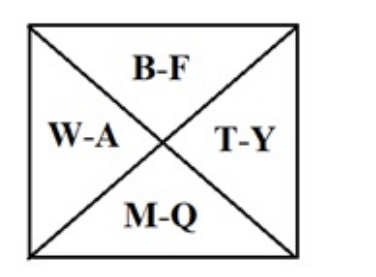
- Four terms have been given, out of which three are alike in some manner and one is different. Select the odd one.
Important Questions from Classification
Directions for the following 3 (three) items : consider the given information and answer the three items that follow.
A, B, C, D, E, F and G are Lecturers from different cities—Hyderabad, Delhi, Shillong, Kanpur, Chennai, Mumbai and Srinagar (not necessarily in the same order) who participated in a conference. Each one of them is specialized in a different subject, viz., Economics, Commerce, History, Sociology, Geography, Mathematics and Statistics (not necessarily in the same order).
Further 1. Lecturer from Kanpur is specialized in Geography
2. Lecturer D is from Shillong
3. Lecturer C from Delhi is specialized in Sociology
4. Lecturer B is specialized in neither History nor Mathematics
5. Lecturer A who is specialized in Economics does not belong to Hyderabad
6. Lecturer F who is specialized in Commerce belongs to Srinagar
7. Lecturer G who is specialized in Statistics belongs to Chennai
Who is specialized in Geography?
A, B, C, D, E, F and G are Lecturers from different cities—Hyderabad, Delhi, Shillong, Kanpur, Chennai, Mumbai and Srinagar (not necessarily in the same order) who participated in a conference. Each one of them is specialized in a different subject, viz., Economics, Commerce, History, Sociology, Geography, Mathematics and Statistics (not necessarily in the same order).
Further 1. Lecturer from Kanpur is specialized in Geography
2. Lecturer D is from Shillong
3. Lecturer C from Delhi is specialized in Sociology
4. Lecturer B is specialized in neither History nor Mathematics
5. Lecturer A who is specialized in Economics does not belong to Hyderabad
6. Lecturer F who is specialized in Commerce belongs to Srinagar
7. Lecturer G who is specialized in Statistics belongs to Chennai
To which city does the Lecturer specialized in Economics belong?
A, B, C, D, E, F and G are Lecturers from different cities—Hyderabad, Delhi, Shillong, Kanpur, Chennai, Mumbai and Srinagar (not necessarily in the same order) who participated in a conference. Each one of them is specialized in a different subject, viz., Economics, Commerce, History, Sociology, Geography, Mathematics and Statistics (not necessarily in the same order).
Further 1. Lecturer from Kanpur is specialized in Geography
2. Lecturer D is from Shillong
3. Lecturer C from Delhi is specialized in Sociology
4. Lecturer B is specialized in neither History nor Mathematics
5. Lecturer A who is specialized in Economics does not belong to Hyderabad
6. Lecturer F who is specialized in Commerce belongs to Srinagar
7. Lecturer G who is specialized in Statistics belongs to Chennai
Who of the following belongs to Hyderabad?
In a school, there are five teachers A, B, C, D and E. A and B teach Hindi and English. C and B teach English and Geography. D and A teach Mathematics and Hindi. E and B teach History and French. Who teaches maximum numb, of subjects?
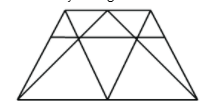
How many triangles are there in the given figure?