
In the above mentioned figure, how much is the voltage around partial loop cefd and how much is the voltage around loop cefdc ?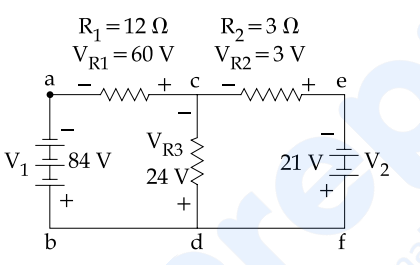
24V ; 0V
The two answers come from two different questions, and the trick is to notice that only the second names a closed path.
The closed loop first — c → e → f → d → c. The final letter returns to the starting point, so this is a complete circuit and Kirchhoff's voltage law applies without qualification:
\(\sum_{\text{closed loop}}V=0\)
The sum of the rises and drops around any closed path in any circuit is always zero — no arithmetic is needed, and no knowledge of the element values. That disposes of one half of every option.
The partial path — c → e → f → d. This one stops at d without returning to c, so it is not a loop at all but a journey between two points. Its total must therefore equal the potential difference between the endpoints:
\(V_{cefd}=V_{c}-V_{d}\)
And \(V_{c}-V_{d}\) is simply the voltage across the element joining c and d directly — the 24 V across R3.
So the partial path gives 24 V and the closed loop gives 0 V — option 1.
| Path | Closed? | Result | Reason |
|---|---|---|---|
| c-e-f-d | No | 24 V | Equals Vc − Vd, the drop across R3 |
| c-e-f-d-c | Yes | 0 V | KVL — always zero |
Why the two must be consistent. Completing the partial path by adding the final step d → c contributes \(V_{d}-V_{c}=-24\ \text{V}\), and
\(24+(-24)=0\ \checkmark\)
which is exactly KVL. That also shows why option 4's −24 V is merely the same path traversed in the opposite direction, c → d rather than d → c — the sign depends entirely on the direction chosen, so the labelling in the figure decides it.
The physical content of KVL is conservation of energy: carrying a unit charge around a closed path and returning it to its starting point must involve no net work, since the electrostatic potential is a single-valued function of position. Between two different points, by contrast, the work done is generally non-zero and is precisely the potential difference — and it does not matter which route is taken, which is why the long way round through e and f gives the same 24 V as the direct branch.
Hence, the partial loop gives 24 V and the complete loop gives 0 V.
Similar Questions
For the circuit given below, which are the correct two equations of Mesh current ?
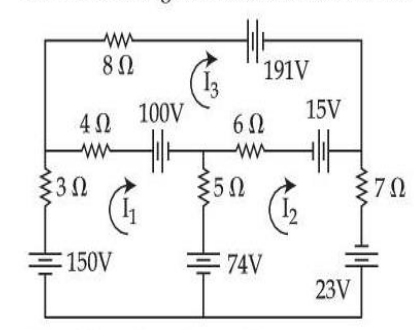
(A) 12I1 – 5I2 – 4I3 = –24
(B) 5I1 + 18I2 + 6I3 = –112
(C) –4I1 – 6I2 + 18I3 = –106
(D) 2I1 + 3I2 – 7I3 = 106
(E) –5I1 + 24I2 – 6I3 = 116Choose the most appropriate answer from the options given below :
Consider a two-mesh network as shown in the figure :
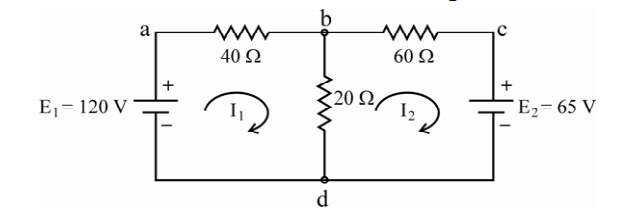
The values of I1 and Ibd and I2 are computed as
(a) I1 = 1.885 amps, I2 = 0.341 amps
(b) I1 = 1.885 amps, Ibd = 2.23 amps
(c) I2 = –0.341 amps, Ibd = 1.885 amps
(d) I2 = –0.341 amps, Ibd = 2.23 amps
Which of the above computations are correct ?
Assertion (A) : It is convenient to write loop equations for a network containing voltage source but no current source.
Reason (R) : If the current sources are present, then these must be first converted into their equivalent voltage sources.
Select your answer using the codes given below.
Important Questions from Mesh Analysis
Which of the following laws is applied for mesh analysis of the network?
For the circuit given below, which are the correct two equations of Mesh current ?
(A) 12I1 – 5I2 – 4I3 = –24
(B) 5I1 + 18I2 + 6I3 = –112
(C) –4I1 – 6I2 + 18I3 = –106
(D) 2I1 + 3I2 – 7I3 = 106
(E) –5I1 + 24I2 – 6I3 = 116Choose the most appropriate answer from the options given below :
Consider a two-mesh network as shown in the figure :
The values of I1 and Ibd and I2 are computed as
(a) I1 = 1.885 amps, I2 = 0.341 amps
(b) I1 = 1.885 amps, Ibd = 2.23 amps
(c) I2 = –0.341 amps, Ibd = 1.885 amps
(d) I2 = –0.341 amps, Ibd = 2.23 amps
Which of the above computations are correct ?
Assertion (A) : It is convenient to write loop equations for a network containing voltage source but no current source.
Reason (R) : If the current sources are present, then these must be first converted into their equivalent voltage sources.
Select your answer using the codes given below.
A _________ is a part of a network that lies between two junctions.



