
Consider a two-mesh network as shown in the figure : The values of I1 and Ibd and I2 are computed as (a) I1 = 1.885 amps, I2 = 0.341 amps (b) I1 = 1.885 amps, Ibd = 2.23 amps (c) I2 = –0.341 amps, Ibd = 1.885 amps (d) I2 = –0.341 amps, Ibd = 2.23 amps Which of the above computations are correct ?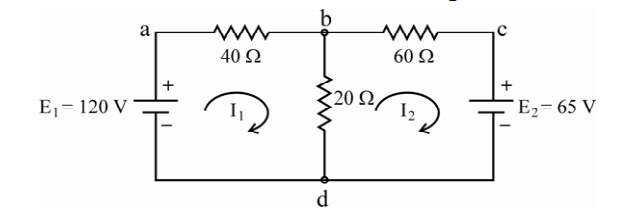
(b) and (d)
Set up mesh analysis. Both mesh currents are drawn clockwise, so in the shared 20 Ω branch they oppose each other and the branch current is their difference:
\(I_{bd}=I_1-I_2\)
Left mesh (KVL clockwise).
\(-120+40I_1+20(I_1-I_2)=0\)
\(60I_1-20I_2=120\)
Right mesh (KVL clockwise).
\(20(I_2-I_1)+60I_2+65=0\)
\(-20I_1+80I_2=-65\)
Solve the pair. From the first equation \(I_1=2+\dfrac{I_2}{3}\). Substituting:
\(-20\left(2+\dfrac{I_2}{3}\right)+80I_2=-65\)
\(-40-6.667I_2+80I_2=-65 \Rightarrow 73.33I_2=-25\)
\(I_2=-0.341\ \text{A}, \qquad I_1=2-0.114=1.885\ \text{A}\)
The branch current.
\(I_{bd}=I_1-I_2=1.885-(-0.341)=2.23\ \text{A}\)
Match against the statements. (b) gives I1 = 1.885 A and Ibd = 2.23 A ✓; (d) gives I2 = −0.341 A and Ibd = 2.23 A ✓. Statement (a) has I2 positive and (c) confuses Ibd with I1, so both fail.
What the negative sign means. I2 coming out negative simply says the actual current in the right mesh flows anticlockwise, opposite to the direction assumed. The 65 V source opposes the 120 V source around the loop, so it is pushed backwards. The assumed direction never affects the physics — it only fixes the sign convention, which is why the two currents then add in the shared branch to give 2.23 A rather than subtracting.
Check by power balance. Voltage at node b is \(20\times2.23=44.6\ \text{V}\); then \((120-44.6)/40=1.885\ \text{A}\) ✓ and \((65-44.6)/60=0.34\ \text{A}\) feeding in from the right ✓.
Hence, the correct computations are (b) and (d).
Similar Questions
For the circuit given below, which are the correct two equations of Mesh current ?
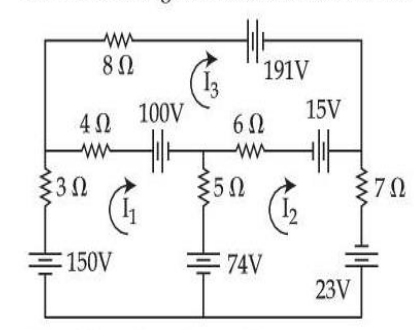
(A) 12I1 – 5I2 – 4I3 = –24
(B) 5I1 + 18I2 + 6I3 = –112
(C) –4I1 – 6I2 + 18I3 = –106
(D) 2I1 + 3I2 – 7I3 = 106
(E) –5I1 + 24I2 – 6I3 = 116Choose the most appropriate answer from the options given below :
Assertion (A) : It is convenient to write loop equations for a network containing voltage source but no current source.
Reason (R) : If the current sources are present, then these must be first converted into their equivalent voltage sources.
Select your answer using the codes given below.
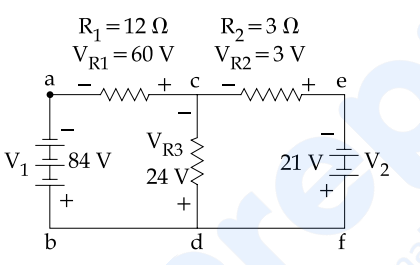
In the above mentioned figure, how much is the voltage around partial loop cefd and how much is the voltage around loop cefdc ?
Important Questions from Mesh Analysis
Which of the following laws is applied for mesh analysis of the network?
For the circuit given below, which are the correct two equations of Mesh current ?
(A) 12I1 – 5I2 – 4I3 = –24
(B) 5I1 + 18I2 + 6I3 = –112
(C) –4I1 – 6I2 + 18I3 = –106
(D) 2I1 + 3I2 – 7I3 = 106
(E) –5I1 + 24I2 – 6I3 = 116Choose the most appropriate answer from the options given below :
Assertion (A) : It is convenient to write loop equations for a network containing voltage source but no current source.
Reason (R) : If the current sources are present, then these must be first converted into their equivalent voltage sources.
Select your answer using the codes given below.
In the above mentioned figure, how much is the voltage around partial loop cefd and how much is the voltage around loop cefdc ?
A _________ is a part of a network that lies between two junctions.



