
Which of the following laws is applied for mesh analysis of the network?
Kirchhoff’s voltage law
Understanding Mesh Analysis
Mesh analysis is a technique used to solve electrical circuits, particularly planar circuits, by applying Kirchhoff's laws. In mesh analysis, we define mesh currents in each loop of the circuit and write equations based on these currents. A mesh is defined as a loop that does not contain any other loops within it.
Kirchhoff's Laws and Network Analysis
There are two fundamental Kirchhoff's laws used in circuit analysis:
- Kirchhoff's Current Law (KCL): This law states that the algebraic sum of currents entering a node (or junction) is equal to the algebraic sum of currents leaving that node. Essentially, it's based on the conservation of charge. The sum of currents at a node is zero ($\sum I = 0$). KCL is primarily used in nodal analysis.
- Kirchhoff's Voltage Law (KVL): This law states that the algebraic sum of all the voltage drops and rises around any closed loop in a circuit is equal to zero. It is based on the conservation of energy. The sum of voltages around a closed loop is zero ($\sum V = 0$).
Kirchhoff's first law and Kirchhoff's junction rule are essentially alternative names for Kirchhoff's Current Law (KCL).
Law Applied in Mesh Analysis
Mesh analysis involves traversing each mesh (loop) in the circuit and summing the voltage drops and rises encountered along the path, setting the sum equal to zero. This process directly applies Kirchhoff's Voltage Law (KVL).
For each mesh, a KVL equation is written in terms of the defined mesh currents and the circuit component values (resistances, voltages, etc.). This results in a system of linear equations, which can then be solved simultaneously to find the unknown mesh currents.
Therefore, the fundamental law applied when performing mesh analysis on a network is Kirchhoff's Voltage Law.
Important Questions from Mesh Analysis
For the circuit given below, which are the correct two equations of Mesh current ?
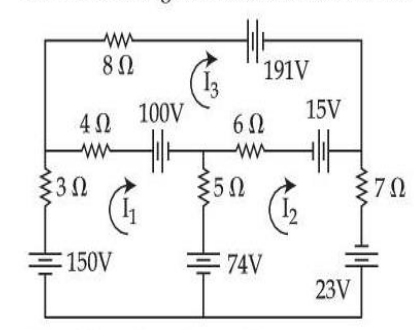
(A) 12I1 – 5I2 – 4I3 = –24
(B) 5I1 + 18I2 + 6I3 = –112
(C) –4I1 – 6I2 + 18I3 = –106
(D) 2I1 + 3I2 – 7I3 = 106
(E) –5I1 + 24I2 – 6I3 = 116Choose the most appropriate answer from the options given below :
Consider a two-mesh network as shown in the figure :
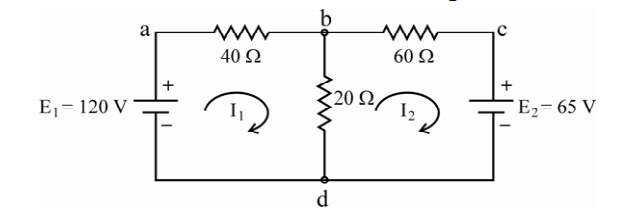
The values of I1 and Ibd and I2 are computed as
(a) I1 = 1.885 amps, I2 = 0.341 amps
(b) I1 = 1.885 amps, Ibd = 2.23 amps
(c) I2 = –0.341 amps, Ibd = 1.885 amps
(d) I2 = –0.341 amps, Ibd = 2.23 amps
Which of the above computations are correct ?
Assertion (A) : It is convenient to write loop equations for a network containing voltage source but no current source.
Reason (R) : If the current sources are present, then these must be first converted into their equivalent voltage sources.
Select your answer using the codes given below.
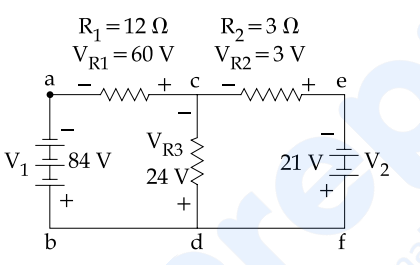
In the above mentioned figure, how much is the voltage around partial loop cefd and how much is the voltage around loop cefdc ?
A _________ is a part of a network that lies between two junctions.


