
For the circuit given below, which are the correct two equations of Mesh current ? (A) 12I1 – 5I2 – 4I3 = –24 Choose the most appropriate answer from the options given below :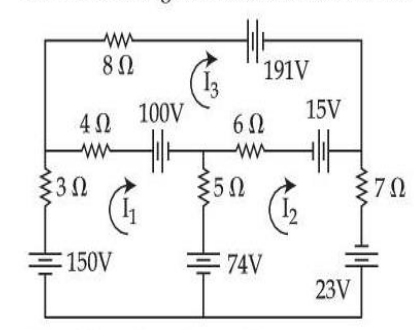
(B) 5I1 + 18I2 + 6I3 = –112
(C) –4I1 – 6I2 + 18I3 = –106
(D) 2I1 + 3I2 – 7I3 = 106
(E) –5I1 + 24I2 – 6I3 = 116
(A) and (C) Only
Mesh equations written for a network of ordinary resistors have a rigid structural signature, and checking it identifies the valid pair without solving the circuit.
For a planar network containing only resistors and sources, the mesh equations take the form
\([R][I]=[V]\)
where the resistance matrix obeys three rules:
| Rule | Statement |
|---|---|
| Diagonal | The sum of all resistances in that mesh — always positive |
| Off-diagonal | Minus the resistance shared with the other mesh — always negative when all mesh currents are taken in the same sense |
| Symmetry | \(R_{jk}=R_{kj}\) for a reciprocal network |
Applying the sign rule. Statements (A) and (C) both have a positive diagonal coefficient with negative off-diagonal terms:
\(12I_{1}-5I_{2}-4I_{3}=-24\)
\(-4I_{1}-6I_{2}+18I_{3}=-106\)
Statements (B) and (E), by contrast, carry positive off-diagonal coefficients — \(+5I_{1}\) and \(+6I_{3}\) in (B), \(+24I_{2}\) against a positive \(-5I_{1}\) mixture in (E) — which cannot arise when all three mesh currents circulate in the same direction. Statement (D) has a diagonal term of 7 for a mesh whose resistances plainly exceed that, so it is not a mesh equation at all.
The symmetry check confirms the pair. In (A) the coefficient of \(I_{3}\) is −4, and in (C) the coefficient of \(I_{1}\) is also −4. That equality is exactly the reciprocity condition \(R_{13}=R_{31}\), and it confirms that (A) and (C) belong to the same consistent set. None of the other statements pairs symmetrically with either of them.
Reading the resistances back out. From (A), mesh 1 contains resistances totalling 12 Ω and shares 5 Ω with mesh 2 and 4 Ω with mesh 3 — consistent with the 3 Ω, 4 Ω and 5 Ω elements in the figure. From (C), mesh 3 totals 18 Ω and shares 4 Ω and 6 Ω — consistent with the 8 Ω, 4 Ω and 6 Ω elements. The two equations therefore describe the same network.
Why the right-hand sides are negative is simply the sign convention: the algebraic sum of source rises around each mesh is taken to the right, and the several sources oppose one another.
Hence, the correct pair is (A) and (C).
Similar Questions
Consider a two-mesh network as shown in the figure :
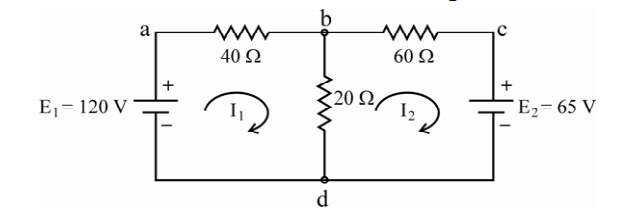
The values of I1 and Ibd and I2 are computed as
(a) I1 = 1.885 amps, I2 = 0.341 amps
(b) I1 = 1.885 amps, Ibd = 2.23 amps
(c) I2 = –0.341 amps, Ibd = 1.885 amps
(d) I2 = –0.341 amps, Ibd = 2.23 amps
Which of the above computations are correct ?
Assertion (A) : It is convenient to write loop equations for a network containing voltage source but no current source.
Reason (R) : If the current sources are present, then these must be first converted into their equivalent voltage sources.
Select your answer using the codes given below.
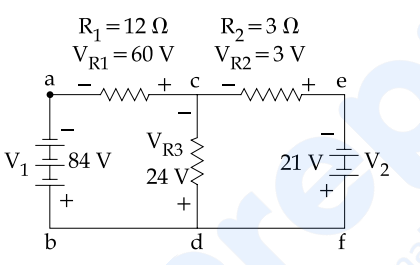
In the above mentioned figure, how much is the voltage around partial loop cefd and how much is the voltage around loop cefdc ?
Important Questions from Mesh Analysis
Which of the following laws is applied for mesh analysis of the network?
Consider a two-mesh network as shown in the figure :
The values of I1 and Ibd and I2 are computed as
(a) I1 = 1.885 amps, I2 = 0.341 amps
(b) I1 = 1.885 amps, Ibd = 2.23 amps
(c) I2 = –0.341 amps, Ibd = 1.885 amps
(d) I2 = –0.341 amps, Ibd = 2.23 amps
Which of the above computations are correct ?
Assertion (A) : It is convenient to write loop equations for a network containing voltage source but no current source.
Reason (R) : If the current sources are present, then these must be first converted into their equivalent voltage sources.
Select your answer using the codes given below.
In the above mentioned figure, how much is the voltage around partial loop cefd and how much is the voltage around loop cefdc ?
A _________ is a part of a network that lies between two junctions.



