
A _________ is a part of a network that lies between two junctions.
branch
Understanding Network Branches and Junctions
In the study of electrical circuits and networks, specific terms are used to describe different parts of the network structure. Understanding these terms is crucial for analyzing circuits using laws like Kirchhoff's voltage and current laws. The question asks for the term that describes a part of a network lying between two junctions. Let's look at the common terms related to network topology:- Node: A node is a point in a network where two or more circuit elements are connected. It is also commonly referred to as a junction. All points along a continuous wire or conductor without any circuit element in between constitute a single node.
- Branch: A branch represents a single circuit element (like a resistor, capacitor, inductor, voltage source, or current source) or a combination of elements that are connected between two nodes (junctions). Essentially, a branch is the path connecting two junction points.
- Loop: A loop is any closed path in a network that starts from a node, passes through various elements and nodes, and returns to the starting node without traversing any node or element more than once (except the starting node).
- Mesh: A mesh is a special type of loop. It is defined as a loop that does not contain any other loops within it. Meshes are fundamental for mesh analysis.
Important Questions from Mesh Analysis
Which of the following laws is applied for mesh analysis of the network?
For the circuit given below, which are the correct two equations of Mesh current ?
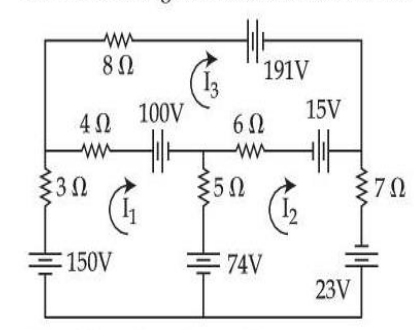
(A) 12I1 – 5I2 – 4I3 = –24
(B) 5I1 + 18I2 + 6I3 = –112
(C) –4I1 – 6I2 + 18I3 = –106
(D) 2I1 + 3I2 – 7I3 = 106
(E) –5I1 + 24I2 – 6I3 = 116Choose the most appropriate answer from the options given below :
Consider a two-mesh network as shown in the figure :
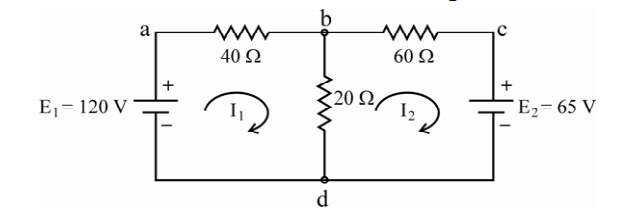
The values of I1 and Ibd and I2 are computed as
(a) I1 = 1.885 amps, I2 = 0.341 amps
(b) I1 = 1.885 amps, Ibd = 2.23 amps
(c) I2 = –0.341 amps, Ibd = 1.885 amps
(d) I2 = –0.341 amps, Ibd = 2.23 amps
Which of the above computations are correct ?
Assertion (A) : It is convenient to write loop equations for a network containing voltage source but no current source.
Reason (R) : If the current sources are present, then these must be first converted into their equivalent voltage sources.
Select your answer using the codes given below.
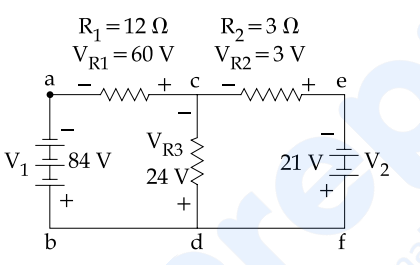
In the above mentioned figure, how much is the voltage around partial loop cefd and how much is the voltage around loop cefdc ?


