In a stable conformer of the following compound :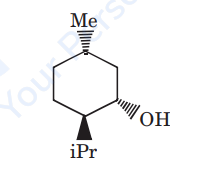
Equatorial - iPr, -CH3, -OH groups
The stem carries a drawn cyclohexane structure; the four options are text and are reproduced in full above.
A substituted cyclohexane sits in a chair conformation and flips between two chairs. Every substituent that is axial in one chair becomes equatorial in the other, so the stable conformer is the one that places the bulkiest groups equatorial.
The reason axial is disfavoured is 1,3-diaxial strain: an axial substituent points straight up alongside the axial hydrogens on carbons 3 and 5, and the resulting steric clash costs energy. That cost is measured by the A value, and it rises sharply with bulk:
-OH about 0.9 kcal mol-1, -CH3 about 1.7 kcal mol-1, -iPr about 2.2 kcal mol-1 (and tert-butyl about 4.9, large enough to lock a ring completely).
So isopropyl has the strongest preference for the equatorial position, methyl the next, and hydroxyl the weakest — the OH group is small and can also relieve strain by hydrogen bonding.
The best conformer is the one with all three groups equatorial, provided the stereochemistry drawn permits it. Whether it does depends on the relative configuration: substituents on adjacent carbons can both be equatorial only if they are trans, while on carbons 1 and 3 they must be cis. When the configuration allows all three to go equatorial simultaneously, that arrangement is unambiguously the most stable, since it removes every 1,3-diaxial interaction at once.
Per the official final answer key the answer is option (A) — iPr, CH3 and OH all equatorial.
Similar Questions
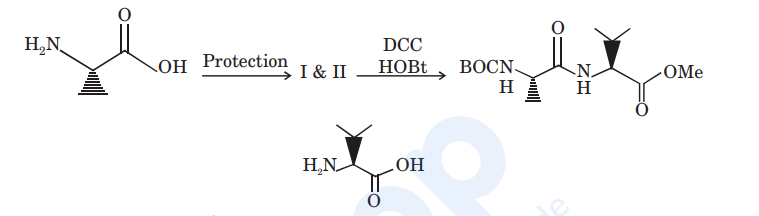
Complete the following reaction by suggesting the appropriate substrates (I & II) :
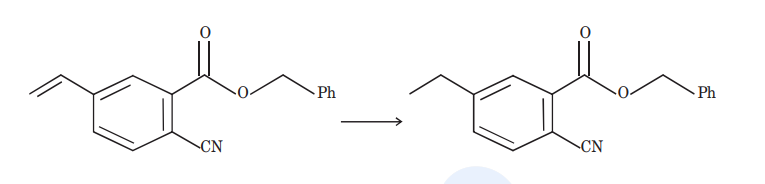
Suggest most suitable conditions for the following selective conversion :
What major product is isolated from the following reaction :
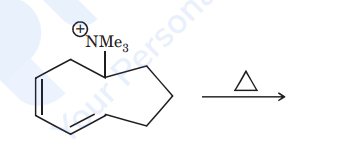
Predict stereochemical outcome of the following reaction :
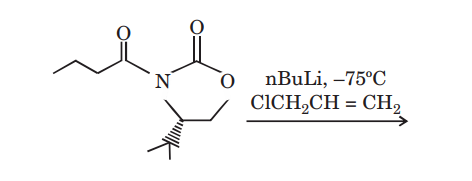
The major product of the following reaction is :
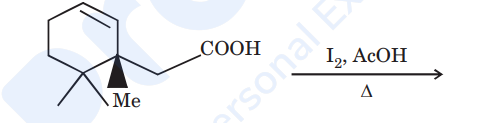
Predict the major product of the following reaction :
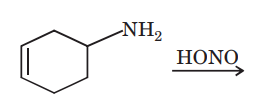
The major product of the following reaction is :
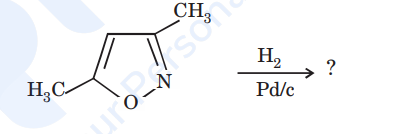
The major product of the following reaction is :
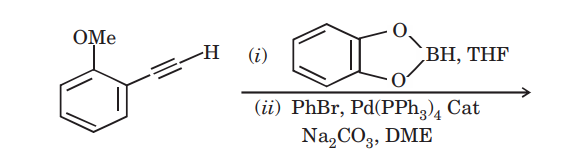
The major product formed in the following reaction is :
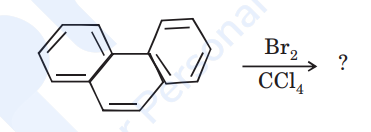
The major product formed in the following reaction is :
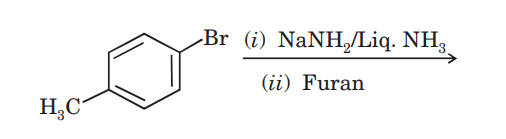
Important Questions from Chemistry in Everyday Life
Which of the following is a greenhouse gas?
I. Methane
II. Nitrous oxide
The gas which turns lime water milky is:
Liquefied Petroleum Gas (LPG) is mainly a mixture of:
Among the following, the conducting form of carbon is
Which of the following is NOT a Fossil Fuel?