Suggest most suitable conditions for the following selective conversion :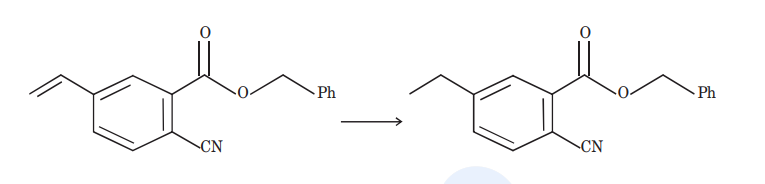
H2, RhCl[PPh3]3 (Catalyst)
The stem carries drawn structures; the four options are text and are reproduced in full above.
The word that governs the whole question is selective. The substrate contains several reducible groups — a carbon-carbon double bond, a nitrile and a carbonyl — and only the alkene is to be touched. So the answer is whichever catalyst is the most chemoselective, not simply the most active.
RhCl(PPh3)3, Wilkinson's catalyst, is the answer. It is a homogeneous catalyst that works by coordinating the alkene to rhodium before delivering both hydrogens in a syn fashion. Because the substrate must bind at the metal centre, the reaction is sensitive to steric bulk and, crucially, Wilkinson's catalyst does not reduce nitriles, ketones, esters, nitro groups or aromatic rings under normal conditions. It hydrogenates alkenes and leaves the rest of the molecule intact, which is exactly the selectivity demanded.
The other three are heterogeneous catalysts and are all far less discriminating.
Pd-C is a general-purpose hydrogenation catalyst; it reduces alkenes readily but will also hydrogenolyse benzylic groups, which is a real risk when a phenyl-substituted centre is present.
PtO2, Adams' catalyst, is more vigorous still and will reduce carbonyl groups and even aromatic rings under moderate pressure.
Raney nickel is the least selective of all — it is in fact the classic reagent for reducing a nitrile to a primary amine, and it also desulphurises. Using it here would destroy the CN group the question wants preserved.
Hence the appropriate conditions are H2 with RhCl[PPh3]3.
Similar Questions
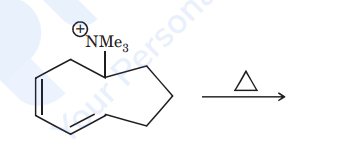
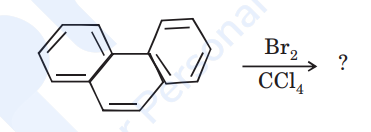
What major product is isolated from the following reaction :
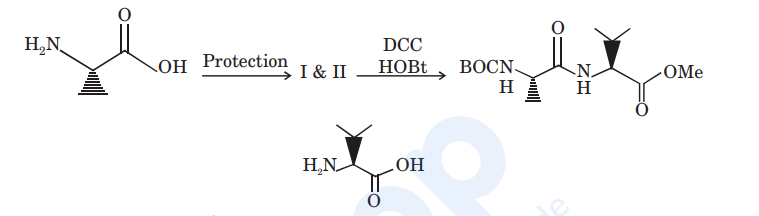
Complete the following reaction by suggesting the appropriate substrates (I & II) :
Predict the major product of the following reaction :
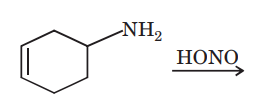
The major product formed in the following reaction is :
Predict the major product of the following reactions based on HSAB principle :

The major product of the following reaction is :
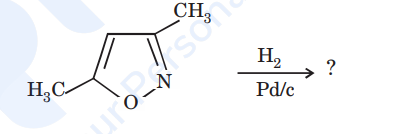
Predict the major product of the following reaction :
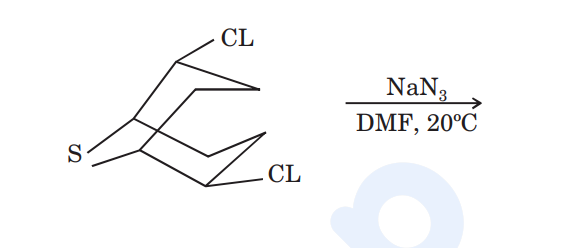
The major product of the following reaction is :
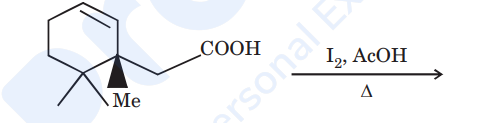
The major product of the following reaction is :
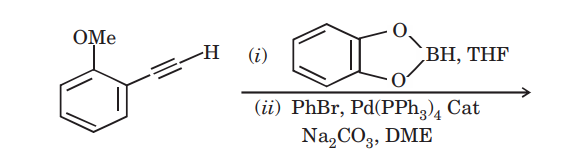
The major product formed in the following reaction is :
Important Questions from Chemistry in Everyday Life
Which of the following is a greenhouse gas?
I. Methane
II. Nitrous oxide
Which one of the following is used in soda-acid fire extinguishers?
The separation of two immiscible liquids can be done based on the difference in their_______.
Orange juice contains ______ acid due to which it tastes sour.
Impure water can be made pure