Complete the following reaction by suggesting the appropriate substrates (I & II) :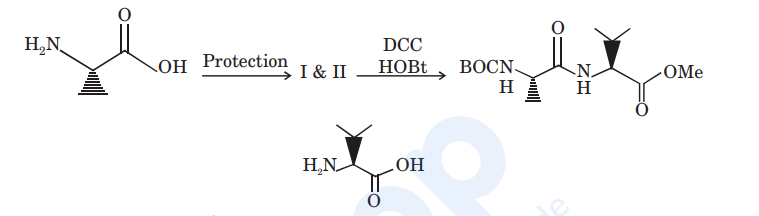
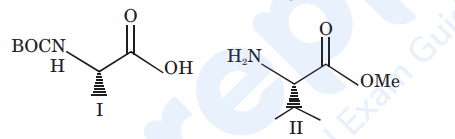
This question is built on drawn structures, so the options cannot be reproduced as text. The chemistry it tests is set out below.
This is a standard peptide coupling, and the logic is entirely about orthogonal protection. To join two amino acids in a defined direction you must leave exactly one free amine and one free acid, and block everything else.
Substrate I must be the amino acid whose amine is protected as its tert-butyl carbamate (BOC), leaving its carboxylic acid free to be activated.
Substrate II must be the partner whose carboxyl is protected as the methyl ester (OMe), leaving its amine free to act as the nucleophile.
DCC (dicyclohexylcarbodiimide) activates the free acid of I as an O-acylisourea, and HOBt (1-hydroxybenzotriazole) intercepts that intermediate to give the less reactive but more selective HOBt active ester. HOBt's purpose is practical and important: it suppresses racemisation at the activated α-carbon and prevents rearrangement to the unreactive N-acylurea by-product.
The free amine of II then attacks the active ester to form the amide bond, giving the BOC-protected dipeptide methyl ester shown as the product.
So the correct option is the pair in which the BOC sits on the amine of one fragment and the OMe ester on the acid of the other — any option protecting the same terminus twice, or leaving both amines free, would not deliver a single defined dipeptide.
Per the official final answer key the answer is option (A).
Similar Questions
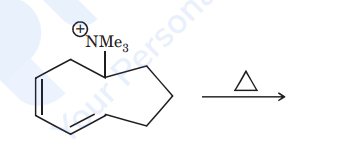
What major product is isolated from the following reaction :
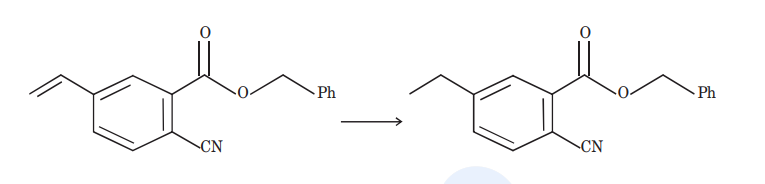
Suggest most suitable conditions for the following selective conversion :
Predict the major product of the following reaction :
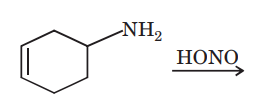
The major product formed in the following reaction is :
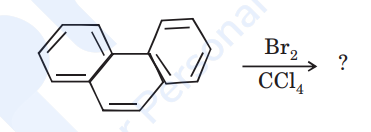
Predict the major product of the following reactions based on HSAB principle :

The major product of the following reaction is :
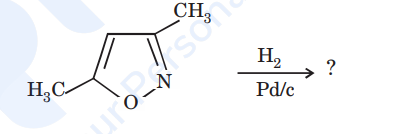
Predict the major product of the following reaction :
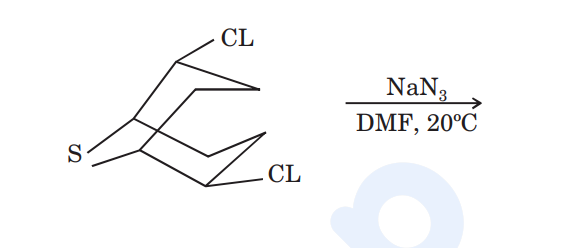
The major product of the following reaction is :
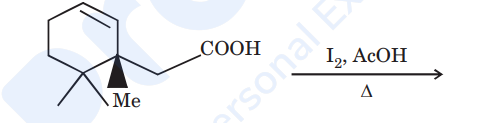
The major product of the following reaction is :
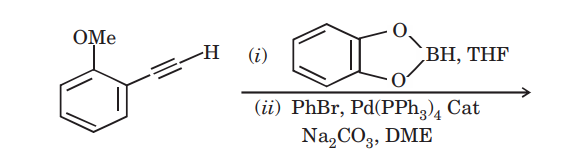
The major product formed in the following reaction is :
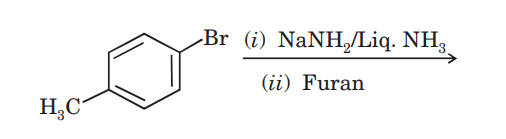
Important Questions from Chemistry in Everyday Life
Which of the following is a greenhouse gas?
I. Methane
II. Nitrous oxide
Which one of the following is used in soda-acid fire extinguishers?
The separation of two immiscible liquids can be done based on the difference in their_______.
Orange juice contains ______ acid due to which it tastes sour.
Impure water can be made pure