
Predict the major product of the following reactions based on HSAB principle :
This question is built on drawn structures, so the options cannot be reproduced as text. The principle it tests is set out below.
An α,β-unsaturated carbonyl offers a nucleophile two electrophilic sites, and Hard-Soft Acid-Base theory decides which one is attacked.
The carbonyl carbon is the hard site: the C=O bond is strongly polarised, so this position carries a large partial positive charge and reacts under charge control. Attack here is 1,2-addition.
The β carbon is the soft site: it has the largest coefficient in the LUMO, and reaction there is under orbital control. Attack here is 1,4-addition, or conjugate addition, and after tautomerisation gives the saturated carbonyl compound.
Reaction I — MeMgBr. A Grignard reagent is a hard carbon nucleophile: the carbanion is small, highly charged and not polarisable. Hard prefers hard, so it attacks the carbonyl carbon and, after aqueous work-up, gives the allylic tertiary alcohol from 1,2-addition.
Reaction II — PhCH2SH with KOH. Base generates the benzyl thiolate. Sulphur is large and highly polarisable, making thiolate a textbook soft nucleophile. Soft prefers soft, so it adds at the β carbon, and the product is the β-thioether ketone from 1,4-addition — the carbonyl surviving intact.
So the correct option is the one pairing a 1,2-addition alcohol for I with a β-benzylthio ketone for II. The same contrast is why organolithiums give 1,2-addition while organocuprates, being softer, give 1,4-addition.
Per the official final answer key the answer is option (B).
Similar Questions
What major product is isolated from the following reaction :
Suggest most suitable conditions for the following selective conversion :
Complete the following reaction by suggesting the appropriate substrates (I & II) :
Predict the major product of the following reaction :
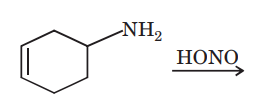
The major product formed in the following reaction is :
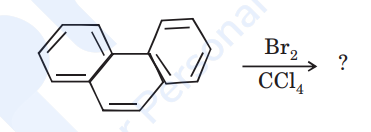
The major product of the following reaction is :
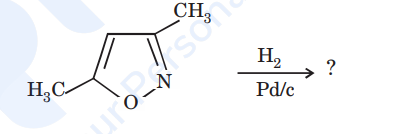
Predict the major product of the following reaction :
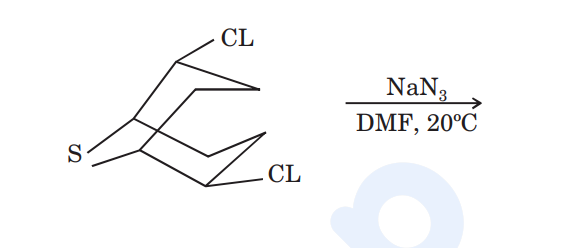
The major product of the following reaction is :
The major product of the following reaction is :
The major product formed in the following reaction is :
Important Questions from Chemistry in Everyday Life
Which of the following is a greenhouse gas?
I. Methane
II. Nitrous oxide
Which one of the following is used in soda-acid fire extinguishers?
The separation of two immiscible liquids can be done based on the difference in their_______.
Orange juice contains ______ acid due to which it tastes sour.
Impure water can be made pure



