The major product formed in the following reaction is :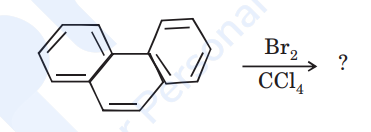
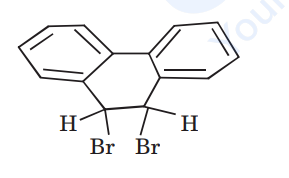
This question is built on drawn structures, so the options cannot be reproduced as text. The chemistry it tests is set out below.
Br2 in CCl4 is the classic condition for electrophilic addition to an alkene. The solvent matters: carbon tetrachloride is non-polar and non-nucleophilic, so it cannot compete for the intermediate, and the reaction is run in the dark to avoid the radical substitution pathway that light would trigger.
The mechanism has two stages. The alkene π electrons attack bromine, and as the Br-Br bond breaks the resulting cation is not a simple carbocation but a bridged, three-membered bromonium ion. Bromide is expelled in the same step.
The bromide ion then opens that bridge by attacking a carbon from the back face, since the front face is blocked by the bromine already bridging. This enforces anti addition: the two bromine atoms end up on opposite faces of the former double bond.
The stereochemical consequence is what the options usually test. Addition to a cyclic alkene gives the trans-1,2-dibromide, and addition to an acyclic alkene gives a specific pair of enantiomers or a meso compound depending on the substitution pattern — never a mixture of syn and anti products.
The bromonium intermediate also explains why no rearrangement occurs: the positive charge is delocalised over the bridge rather than localised on a single carbon, so hydride and alkyl shifts do not take place.
Per the official final answer key the answer is option (A).
Similar Questions
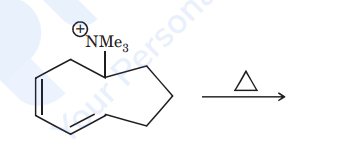
What major product is isolated from the following reaction :
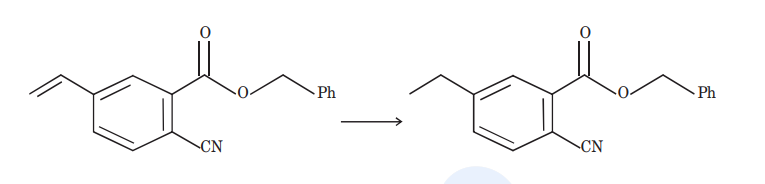
Suggest most suitable conditions for the following selective conversion :
Complete the following reaction by suggesting the appropriate substrates (I & II) :
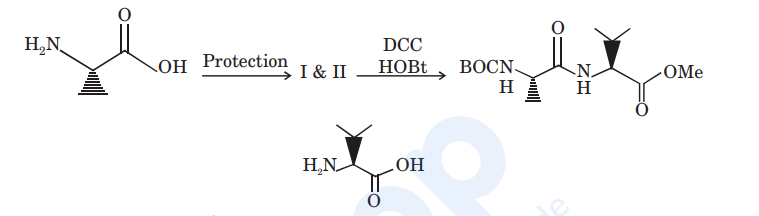
Predict the major product of the following reaction :
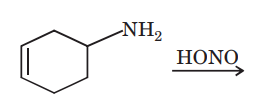
Predict the major product of the following reactions based on HSAB principle :

The major product of the following reaction is :
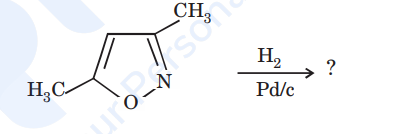
Predict the major product of the following reaction :
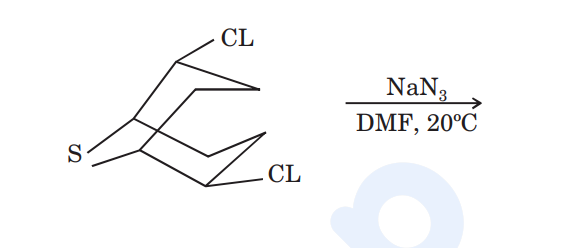
The major product of the following reaction is :
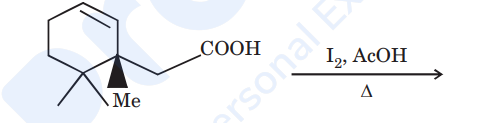
The major product of the following reaction is :
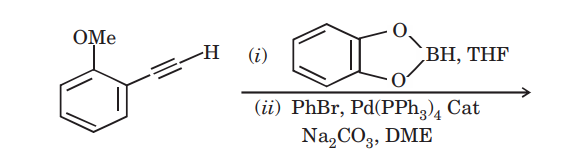
The major product formed in the following reaction is :
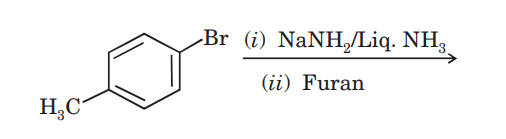
Important Questions from Chemistry in Everyday Life
Which of the following is a greenhouse gas?
I. Methane
II. Nitrous oxide
Which one of the following is used in soda-acid fire extinguishers?
The separation of two immiscible liquids can be done based on the difference in their_______.
Orange juice contains ______ acid due to which it tastes sour.
Impure water can be made pure