
Predict the major product of the following reaction :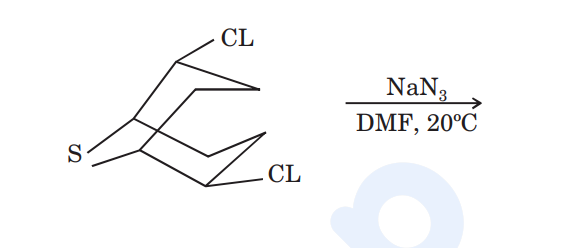
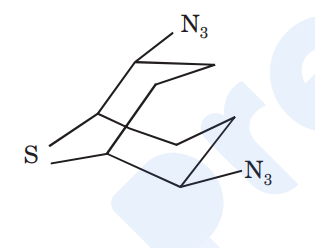
This question is built on drawn structures, so the options cannot be reproduced as text. The chemistry it tests is set out below.
Every element of the conditions points to a clean SN2 substitution, carried out at both chlorine-bearing carbons.
The nucleophile. Azide, N3-, is small, linear and highly polarisable — one of the best SN2 nucleophiles known. It is also a weak base, so it substitutes rather than promoting elimination.
The solvent. DMF is a polar aprotic solvent. It solvates the sodium cation well but leaves the azide anion relatively bare and therefore highly reactive, since there is no hydrogen bonding to shield it. Choosing DMF rather than a protic solvent such as ethanol is a deliberate signal that SN2 is intended.
The temperature. 20°C is mild, which again favours substitution over the elimination that heating would encourage.
Because the substrate carries two C-Cl bonds and azide is used in excess, both are displaced, giving the bis-azide. Each substitution proceeds with inversion of configuration through the usual backside attack, so the stereochemistry at each centre is cleanly inverted.
Organic azides prepared this way are versatile intermediates: they can be reduced to primary amines by Staudinger reaction or hydrogenation, or used directly in copper-catalysed azide-alkyne cycloaddition to build triazoles.
Per the official final answer key the answer is option (A).
Similar Questions
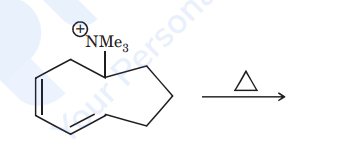
What major product is isolated from the following reaction :
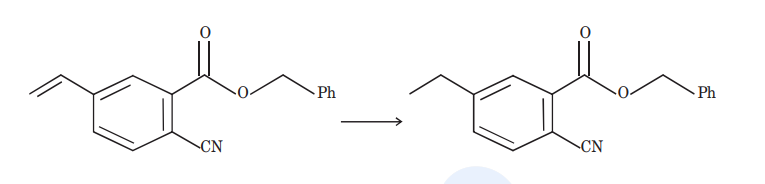
Suggest most suitable conditions for the following selective conversion :
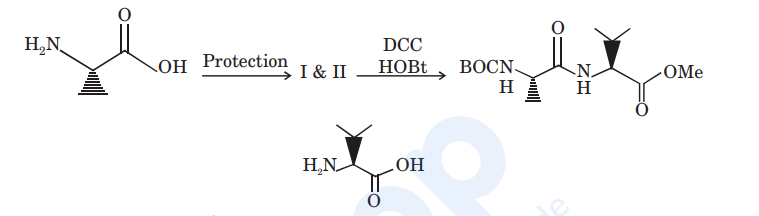
Complete the following reaction by suggesting the appropriate substrates (I & II) :
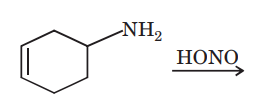
Predict the major product of the following reaction :
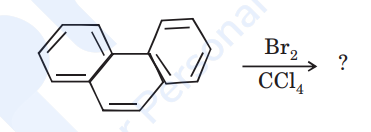
The major product formed in the following reaction is :
Predict the major product of the following reactions based on HSAB principle :

The major product of the following reaction is :
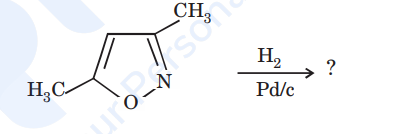
The major product of the following reaction is :
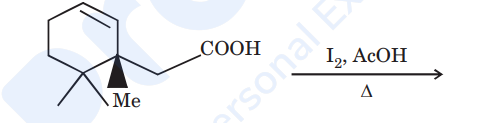
The major product of the following reaction is :
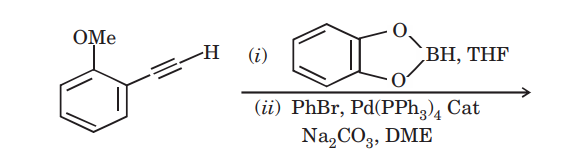
The major product formed in the following reaction is :
Important Questions from Chemistry in Everyday Life
Which of the following is a greenhouse gas?
I. Methane
II. Nitrous oxide
Which one of the following is used in soda-acid fire extinguishers?
The separation of two immiscible liquids can be done based on the difference in their_______.
Orange juice contains ______ acid due to which it tastes sour.
Impure water can be made pure



