Physics: Planetary Motion in Solar System
Understanding Planetary Time Period
The question asks for the relationship between the time period of revolution ($T$) of a planet and the radius ($R$) of its circular orbit within a solar system. This relationship is governed by Kepler's Laws of Planetary Motion.Applying Kepler's Third Law
Kepler's Third Law states that the square of the time period of revolution ($T^2$) is directly proportional to the cube of the semi-major axis of the orbit ($a^3$). For a circular orbit, the semi-major axis is equal to the radius ($R$). Therefore, the law can be expressed as:$ T^2 \propto R^3 $
Derivation for Circular Orbit
1. Force Balance: In a circular orbit, the gravitational force exerted by the central star (mass $M$) on the planet (mass $m$) provides the necessary centripetal force.$ \frac{G M m}{R^2} = \frac{m v^2}{R} $
Where $G$ is the gravitational constant and $v$ is the orbital velocity. 2. Orbital Velocity: Simplifying the force balance gives $ v^2 = \frac{G M}{R} $. 3. Time Period Formula: The time period $T$ is the circumference ($2\pi R$) divided by the velocity ($v$).$ T = \frac{2\pi R}{v} $
Squaring both sides:$ T^2 = \frac{4\pi^2 R^2}{v^2} $
4. Substituting $v^2$: Substitute $ v^2 = \frac{G M}{R} $ into the equation for $T^2$:$ T^2 = \frac{4\pi^2 R^2}{(G M / R)} = \frac{4\pi^2 R^3}{G M} $
5. Proportionality: Since $ \frac{4\pi^2}{G M} $ is constant for a given solar system, we get:$ T^2 \propto R^3 $
Final Relationship
Taking the square root of both sides of the proportionality $ T^2 \propto R^3 $, we find the relationship for the time period $T$:$ T \propto \sqrt{R^3} $
$ T \propto R^{3/2} $
Therefore, the time period of revolution of a planet is proportional to $ R^{3/2} $.Similar Questions
- The magnitude and direction of the acceleration produced in a body of mass $5 \text{ kg}$ when two mutually perpendicular forces $8 \text{ N}$ and $6 \text{ N}$ act on it, are respectively :
- A box of mass $15 \text{ kg}$ is kept on the floor of a stationary trolley. The coefficient of static friction between the box and the trolley is $0.12$. Keeping the box in stationary state over the trolley, the maximum acceleration with which the trolley can be moved horizontally is : ($g = 10 \text{ m/s}^2$)
- The amount of work done to raise a mass 'm' from the surface of the Earth to a height equal to the radius of the Earth 'R', will be :
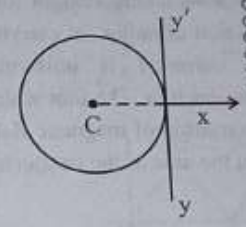
A thin wire of length 'L' and linear mass density 'm' is bent into a circular ring (in x-y plane) with centre 'C' as shown in figure. The moment of inertia of the ring about an axis yy' (tangent in the plane) will be :
- When a ruler falls vertically, 5 different persons catch it with different reaction times. ($g = 9.8 \text{ m s}^{-2}$)
A. Person A has reaction time of $0.20 \text{ s}$.
B. Person B has reaction time of $0.22 \text{ s}$.
C. Person C has reaction time of $0.18 \text{ s}$.
D. Person D has reaction time of $0.19 \text{ s}$.
E. Person E has reaction time of $0.21 \text{ s}$.
What is the correct order of the distance travelled by the ruler for each person ? - The angular speed of a flywheel is increased from $600 \text{ rpm}$ to $1200 \text{ rpm}$ in $10 \text{ s}$. The number of revolutions completed by the flywheel during this time is :
- Consider a particle moving along a straight line, whose position as a function of time is given by $s(t) = \alpha t^2 - \beta t + \gamma$, where $\alpha = 1\text{ ms}^{-2}$, $\beta = 6\text{ ms}^{-1}$ and $\gamma = 5\text{ m}$. The average speed of the particle, in $\text{ms}^{-1}$, from $t = 0$ to $t = 6\text{ s}$ is :
- A particle of mass M moves along a horizontal x axis from $x=0$ to $x=L$. The coefficient of kinetic friction varies as a function of $x$ as $\mu_k(x) = \mu_0 - \alpha x$, where $\mu_0$, $\alpha$ are constants of appropriate dimensions, so that $\mu_k(L) = 0$. The total work done by the frictional force during the motion is $n \mu_0 M g L$, where g is the acceleration due to gravity. The value of $n$ is :
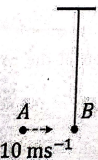
Bob B of mass $m$ at rest is hanging vertically from the ceiling via a massless string of length $10\text{ m}$, as shown in the figure. Point mass A of mass $m$ travelling horizontally with speed $10\text{ ms}^{-1}$ hits bob B elastically. The bob B rises $h$ meter after the collision. Taking the acceleration due to gravity $g = 10\text{ ms}^{-2}$ and neglecting the size of the bob, the value of $h$ is :
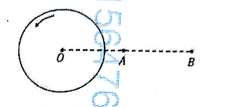
A thin horizontal disc is rotating about a vertical axis passing through its fixed centre O. Its angular momentum is $L_A$ and $L_B$ computed about points A and B, respectively, with $OB = 2 \times OA$. The value of $\frac{L_A}{L_B}$ is :
Important Questions from Mechanics
- When both jaws of vernier callipers touch each other, zero mark of the vernier scale is right to zero mark of main scale, $4^{\text{th}}$ mark on vernier scale coincides with certain mark on the main scale. While measuring the length of a cylinder, observer observes $15$ divisions on main scale and $5^{\text{th}}$ division of vernier scale coincides with a main scale division. Measured length of cylinder is ________mm.
(Least count of Vernier calliper = $0.1 \text{ mm}$) - Water drops fall from a tap on the floor, $5 \text{ m}$ below, at regular intervals of time, the first drop strikes the floor when the sixth drop begins to fall. The height at which the fourth drop will be from ground, at the instant when the first drop strikes the ground is ________m.
($g = 10 \text{ m/s}^2$) - Two wires $A$ and $B$ made of different materials of lengths $6.0 \text{ cm}$ and $5.4 \text{ cm}$, respectively and area of cross sections $3.0 \times 10^{-5} \text{ m}^2$ and $4.5 \times 10^{-5} \text{ m}^2$, respectively are stretched by the same magnitude under a given load. The ratio of the Young's modulus of $A$ to that of $B$ is $x : 3$. The value of $x$ is________.
Two circular discs of radius each $10 \text{ cm}$ are joined at their centres by a rod of length $30 \text{ cm}$ and mass $600 \text{ gm}$ as shown in figure.
If the mass of each disc is $600 \text{ gm}$ and applied torque between two discs is $43 \times 10^5 \text{ dyne.cm}$, the angular acceleration of the discs about the given axis $AB$ is________$\text{rad/s}^2$.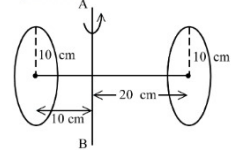
- A particle of mass $m$ falls from rest through a resistive medium having resistive force, $F = -kv$, where $v$ is the velocity of the particle and $k$ is a constant. Which of the following graphs represents velocity ($v$) versus time ($t$)?