
Analyzing Particle Motion with Resistive Force
The problem involves a particle of mass $m$ falling under gravity and encountering a resistive force $F_r = -kv$, where $v$ is the velocity and $k$ is a constant. The negative sign indicates the force opposes the velocity (upwards if falling downwards).
Deriving the Equation of Motion
Using Newton's second law, the net force $F_{net}$ acting on the particle is:
$F_{net} = F_g + F_r$Taking the downward direction as positive, the gravitational force $F_g = mg$. The equation becomes:
$ma = mg - kv$Since acceleration $a = \frac{dv}{dt}$, we have the differential equation:
$m \frac{dv}{dt} = mg - kv$Rearranging gives:
$\frac{dv}{dt} = g - \frac{k}{m}v$Solving for Velocity vs. Time
This is a first-order linear differential equation. We can solve it by separation of variables or integrating factors. The initial condition is that the particle starts from rest, so $v(0) = 0$.
The solution to this differential equation with the initial condition $v(0)=0$ is:
$v(t) = \frac{mg}{k} \left( 1 - e^{-\frac{k}{m}t} \right)$Let $V_T = \frac{mg}{k}$. This is the terminal velocity. The equation is:
$v(t) = V_T \left( 1 - e^{-\frac{k}{m}t} \right)$Interpreting the Velocity-Time Graph
Key characteristics of the velocity-time graph based on the equation $v(t) = V_T (1 - e^{-\frac{k}{m}t})$:
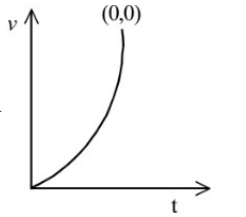
- Initial Velocity ($t=0$): $v(0) = V_T (1 - e^0) = V_T (1 - 1) = 0$. The graph starts at the origin (0,0).
- Terminal Velocity ($t \to \infty$): As time increases, $e^{-\frac{k}{m}t}$ approaches 0. Thus, $v(t)$ approaches $V_T$. The graph asymptotically approaches a horizontal line at $v = V_T$.
- Slope (Acceleration): The derivative $\frac{dv}{dt} = g e^{-\frac{k}{m}t}$. At $t=0$, the slope is $g$ (maximum initial acceleration). As $t$ increases, the slope decreases, approaching 0 as velocity approaches $V_T$.
The graph should show velocity increasing from zero, with its rate of increase (slope) decreasing over time, eventually leveling off at the terminal velocity $V_T$. This describes an exponential curve rising from the origin.
Conclusion
Comparing these characteristics with the given options:
- Option 1 shows decreasing velocity.
- Option 2 shows velocity increasing from zero exponentially towards a constant value (terminal velocity), with a decreasing slope. This matches our derived equation and characteristics.
- Option 3 shows a linear increase in velocity ($v=gt$), implying constant acceleration and no resistance.
- Option 4 shows velocity decreasing linearly.
Therefore, the graph representing velocity versus time is the one showing exponential increase towards a terminal velocity.
Similar Questions
- When both jaws of vernier callipers touch each other, zero mark of the vernier scale is right to zero mark of main scale, $4^{\text{th}}$ mark on vernier scale coincides with certain mark on the main scale. While measuring the length of a cylinder, observer observes $15$ divisions on main scale and $5^{\text{th}}$ division of vernier scale coincides with a main scale division. Measured length of cylinder is ________mm.
(Least count of Vernier calliper = $0.1 \text{ mm}$) - Water drops fall from a tap on the floor, $5 \text{ m}$ below, at regular intervals of time, the first drop strikes the floor when the sixth drop begins to fall. The height at which the fourth drop will be from ground, at the instant when the first drop strikes the ground is ________m.
($g = 10 \text{ m/s}^2$) - Two wires $A$ and $B$ made of different materials of lengths $6.0 \text{ cm}$ and $5.4 \text{ cm}$, respectively and area of cross sections $3.0 \times 10^{-5} \text{ m}^2$ and $4.5 \times 10^{-5} \text{ m}^2$, respectively are stretched by the same magnitude under a given load. The ratio of the Young's modulus of $A$ to that of $B$ is $x : 3$. The value of $x$ is________.
Two circular discs of radius each $10 \text{ cm}$ are joined at their centres by a rod of length $30 \text{ cm}$ and mass $600 \text{ gm}$ as shown in figure.
If the mass of each disc is $600 \text{ gm}$ and applied torque between two discs is $43 \times 10^5 \text{ dyne.cm}$, the angular acceleration of the discs about the given axis $AB$ is________$\text{rad/s}^2$.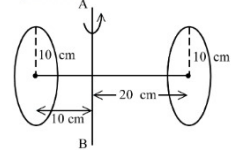
- A block of mass $5 \text{ kg}$ is moving on an inclined plane which makes an angle of $30^\circ$ with the horizontal. Friction coefficient between the block and inclined plane surface is $\frac{\sqrt{3}}{2}$. The force to be applied on the block so that the block will move down without acceleration is ________$\text{N}$.
($g = 10 \text{ m/s}^2$). - A solid sphere of radius $10 \text{ cm}$ is rotating about an axis which is at a distance $15 \text{ cm}$ from its centre. The radius of gyration about this axis is $\sqrt{n}\text{ cm}$. The value of $n$ is
- A projectile is thrown upward at an angle $60^\circ$ with the horizontal. The speed of the projectile is 20 m/s when its direction of motion is $45^\circ$ with the horizontal. The initial speed of the projectile is _________ m/s.
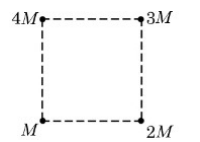
Net gravitational force at the center of a square is found to be $F_1$ when four particles having mass $M, 2M, 3M$ and $4M$ are placed at the four corners of the square as shown in figure and it is $F_2$ when the positions of $3M$ and $4M$ are interchanged. The ratio $\frac{F_1}{F_2}$ is $\frac{\alpha}{\sqrt{5}}$. The value of $\alpha$ is _________.
- The escape velocity from a spherical planet A is 10 km/s. The escape velocity from another planet B whose density and radius are 10% of those of planet A, is _________ m/s.
- Match the LIST-I with LIST-II
List-I List-II A. Spring constant I. $[\text{M L}^2 \text{ T}^{-2} \text{ K}^{-1}]$ B. Thermal conductivity II. $[\text{M L}^0 \text{ T}^{-2}]$ C. Boltzmann constant III. $[\text{M L}^2 \text{ T}^{-3} \text{ A}^{-2}]$ D. Inductive reactance IV. $[\text{M L T}^{-3} \text{ K}^{-1}]$
Choose the correct answer from the options given below:
Important Questions from Mechanics
- When both jaws of vernier callipers touch each other, zero mark of the vernier scale is right to zero mark of main scale, $4^{\text{th}}$ mark on vernier scale coincides with certain mark on the main scale. While measuring the length of a cylinder, observer observes $15$ divisions on main scale and $5^{\text{th}}$ division of vernier scale coincides with a main scale division. Measured length of cylinder is ________mm.
(Least count of Vernier calliper = $0.1 \text{ mm}$) - Water drops fall from a tap on the floor, $5 \text{ m}$ below, at regular intervals of time, the first drop strikes the floor when the sixth drop begins to fall. The height at which the fourth drop will be from ground, at the instant when the first drop strikes the ground is ________m.
($g = 10 \text{ m/s}^2$) - Two wires $A$ and $B$ made of different materials of lengths $6.0 \text{ cm}$ and $5.4 \text{ cm}$, respectively and area of cross sections $3.0 \times 10^{-5} \text{ m}^2$ and $4.5 \times 10^{-5} \text{ m}^2$, respectively are stretched by the same magnitude under a given load. The ratio of the Young's modulus of $A$ to that of $B$ is $x : 3$. The value of $x$ is________.
Two circular discs of radius each $10 \text{ cm}$ are joined at their centres by a rod of length $30 \text{ cm}$ and mass $600 \text{ gm}$ as shown in figure.
If the mass of each disc is $600 \text{ gm}$ and applied torque between two discs is $43 \times 10^5 \text{ dyne.cm}$, the angular acceleration of the discs about the given axis $AB$ is________$\text{rad/s}^2$.- A block of mass $5 \text{ kg}$ is moving on an inclined plane which makes an angle of $30^\circ$ with the horizontal. Friction coefficient between the block and inclined plane surface is $\frac{\sqrt{3}}{2}$. The force to be applied on the block so that the block will move down without acceleration is ________$\text{N}$.
($g = 10 \text{ m/s}^2$).


