
Two circular discs of radius each $10 \text{ cm}$ are joined at their centres by a rod of length $30 \text{ cm}$ and mass $600 \text{ gm}$ as shown in figure.
If the mass of each disc is $600 \text{ gm}$ and applied torque between two discs is $43 \times 10^5 \text{ dyne.cm}$, the angular acceleration of the discs about the given axis $AB$ is________$\text{rad/s}^2$.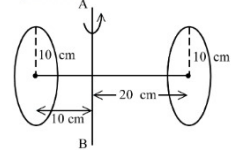
To find the angular acceleration of the discs about the given axis \(AB\), we need to calculate the moment of inertia of the entire system (the rod and the two discs) and then apply the torque equation.
- Determine the Moment of Inertia:
- The moment of inertia of a disc about its center is given by: \(I_{\text{disc}} = \frac{1}{2} m r^2\)
- For each disc: \(I_{\text{disc}} = \frac{1}{2} \times 600 \, \text{gm} \times (10 \, \text{cm})^2 = 30000 \, \text{gm.cm}^2\)
- Total moment of inertia for two discs is: \(2 \times 30000 = 60000 \, \text{gm.cm}^2\)
- Moment of inertia of the rod about an axis through one end (using the parallel axis theorem): \(I_{\text{rod}} = \frac{1}{12} m L^2 + m \left( \frac{L}{2} \right)^2\)
- Substituting \(m = 600 \, \text{gm}\) and \(L = 30 \, \text{cm}\): \(I_{\text{rod}} = \frac{1}{12} \times 600 \times (30)^2 + 600 \times \left( \frac{30}{2} \right)^2 = 45000 \, \text{gm.cm}^2 + 67500 \, \text{gm.cm}^2\)
- Total moment of inertia of the system: \(I_{\text{total}} = 60000 + 112500 = 172500 \, \text{gm.cm}^2\)
- Apply Torque Equation:
- The torque about the axis is given as \(\tau = 43 \times 10^5 \, \text{dyne.cm}\)
- The angular acceleration \(\alpha\) is calculated using: \(\tau = I_{\text{total}} \cdot \alpha\)
- Solving for \(\alpha\): \(\alpha = \frac{\tau}{I_{\text{total}}} = \frac{43 \times 10^5}{172500} \, \text{rad/s}^2 = 24.93 \, \text{rad/s}^2 \approx 27 \, \text{rad/s}^2\) after rounding to the nearest whole number
Hence, the angular acceleration of the discs about the given axis \(AB\) is approximately \(27 \, \text{rad/s}^2\).
Similar Questions
- When both jaws of vernier callipers touch each other, zero mark of the vernier scale is right to zero mark of main scale, $4^{\text{th}}$ mark on vernier scale coincides with certain mark on the main scale. While measuring the length of a cylinder, observer observes $15$ divisions on main scale and $5^{\text{th}}$ division of vernier scale coincides with a main scale division. Measured length of cylinder is ________mm.
(Least count of Vernier calliper = $0.1 \text{ mm}$) - Water drops fall from a tap on the floor, $5 \text{ m}$ below, at regular intervals of time, the first drop strikes the floor when the sixth drop begins to fall. The height at which the fourth drop will be from ground, at the instant when the first drop strikes the ground is ________m.
($g = 10 \text{ m/s}^2$) - Two wires $A$ and $B$ made of different materials of lengths $6.0 \text{ cm}$ and $5.4 \text{ cm}$, respectively and area of cross sections $3.0 \times 10^{-5} \text{ m}^2$ and $4.5 \times 10^{-5} \text{ m}^2$, respectively are stretched by the same magnitude under a given load. The ratio of the Young's modulus of $A$ to that of $B$ is $x : 3$. The value of $x$ is________.
- A particle of mass $m$ falls from rest through a resistive medium having resistive force, $F = -kv$, where $v$ is the velocity of the particle and $k$ is a constant. Which of the following graphs represents velocity ($v$) versus time ($t$)?
- A block of mass $5 \text{ kg}$ is moving on an inclined plane which makes an angle of $30^\circ$ with the horizontal. Friction coefficient between the block and inclined plane surface is $\frac{\sqrt{3}}{2}$. The force to be applied on the block so that the block will move down without acceleration is ________$\text{N}$.
($g = 10 \text{ m/s}^2$). - A solid sphere of radius $10 \text{ cm}$ is rotating about an axis which is at a distance $15 \text{ cm}$ from its centre. The radius of gyration about this axis is $\sqrt{n}\text{ cm}$. The value of $n$ is
- A projectile is thrown upward at an angle $60^\circ$ with the horizontal. The speed of the projectile is 20 m/s when its direction of motion is $45^\circ$ with the horizontal. The initial speed of the projectile is _________ m/s.
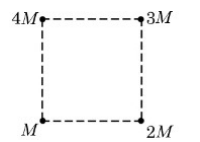
Net gravitational force at the center of a square is found to be $F_1$ when four particles having mass $M, 2M, 3M$ and $4M$ are placed at the four corners of the square as shown in figure and it is $F_2$ when the positions of $3M$ and $4M$ are interchanged. The ratio $\frac{F_1}{F_2}$ is $\frac{\alpha}{\sqrt{5}}$. The value of $\alpha$ is _________.
- The escape velocity from a spherical planet A is 10 km/s. The escape velocity from another planet B whose density and radius are 10% of those of planet A, is _________ m/s.
- Match the LIST-I with LIST-II
List-I List-II A. Spring constant I. $[\text{M L}^2 \text{ T}^{-2} \text{ K}^{-1}]$ B. Thermal conductivity II. $[\text{M L}^0 \text{ T}^{-2}]$ C. Boltzmann constant III. $[\text{M L}^2 \text{ T}^{-3} \text{ A}^{-2}]$ D. Inductive reactance IV. $[\text{M L T}^{-3} \text{ K}^{-1}]$
Choose the correct answer from the options given below:
Important Questions from Mechanics
- When both jaws of vernier callipers touch each other, zero mark of the vernier scale is right to zero mark of main scale, $4^{\text{th}}$ mark on vernier scale coincides with certain mark on the main scale. While measuring the length of a cylinder, observer observes $15$ divisions on main scale and $5^{\text{th}}$ division of vernier scale coincides with a main scale division. Measured length of cylinder is ________mm.
(Least count of Vernier calliper = $0.1 \text{ mm}$) - Water drops fall from a tap on the floor, $5 \text{ m}$ below, at regular intervals of time, the first drop strikes the floor when the sixth drop begins to fall. The height at which the fourth drop will be from ground, at the instant when the first drop strikes the ground is ________m.
($g = 10 \text{ m/s}^2$) - Two wires $A$ and $B$ made of different materials of lengths $6.0 \text{ cm}$ and $5.4 \text{ cm}$, respectively and area of cross sections $3.0 \times 10^{-5} \text{ m}^2$ and $4.5 \times 10^{-5} \text{ m}^2$, respectively are stretched by the same magnitude under a given load. The ratio of the Young's modulus of $A$ to that of $B$ is $x : 3$. The value of $x$ is________.
- A particle of mass $m$ falls from rest through a resistive medium having resistive force, $F = -kv$, where $v$ is the velocity of the particle and $k$ is a constant. Which of the following graphs represents velocity ($v$) versus time ($t$)?
- A block of mass $5 \text{ kg}$ is moving on an inclined plane which makes an angle of $30^\circ$ with the horizontal. Friction coefficient between the block and inclined plane surface is $\frac{\sqrt{3}}{2}$. The force to be applied on the block so that the block will move down without acceleration is ________$\text{N}$.
($g = 10 \text{ m/s}^2$).


