
Given below are two statements:
Statement I: The dipole moment of R-CN is greater than R-NC and R-NC can undergo hydrolysis under acidic medium to produce 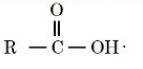
Statement II: R-CN hydrolyses under acidic medium to produce a compound which on treatment with $\text{SOCl}_2$, followed by the addition of $\text{NH}_3$ gives another compound(x). This compound (x) on treatment with $\text{NaOCl/NaOH}$ gives a product, that on treatment with $\text{CHCl}_3\text{/KOH/}\Delta$ produces R-NC
In the light of the above statements, choose the correct answer from the options given below
Let's analyze the statements one by one to identify which statement is correct.
Statement I: The dipole moment of R-CN is greater than R-NC and R-NC can undergo hydrolysis under acidic medium to produce \(R-\text{COOH}\).
Analysis:
- The dipole moment of the nitrile group \(R-\text{CN}\) is generally greater than that of the isonitrile group \(R-\text{NC}\) because the nitrogen atom in nitriles (R-CN) contributes more significantly to the dipole due to better resonance and linear structure.
- However, R-NC (isonitrile) typically does not hydrolyze to produce carboxylic acid. Therefore, this part of the statement is inaccurate.
Conclusion for Statement I: False, because R-NC does not produce carboxylic acid upon hydrolysis under acidic conditions.
Statement II: R-CN hydrolyses under acidic medium to produce a compound which on treatment with \(\text{SOCl}_2\), followed by the addition of \(\text{NH}_3\) gives another compound (x). This compound (x) on treatment with \(\text{NaOCl/NaOH}\) gives a product, that on treatment with \(\text{CHCl}_3/\text{KOH}/\Delta\) produces R-NC.
Analysis:
- R-CN hydrolyzes to form the corresponding carboxylic acid \(R-\text{COOH}\).
- Treatment with \(\text{SOCl}_2\) converts the carboxylic acid to an acid chloride \(R-\text{COCl}\).
- Addition of \(\text{NH}_3\) converts the acid chloride to an amide \(R-\text{CONH}_2\).
- Treatment of the amide with \(\text{NaOCl/NaOH}\) results in the Hofmann rearrangement, forming an isocyanate that quickly rearranges to amine.
- The formation of R-NC involves a reaction between the amine and chloroform in an alkaline medium.
Conclusion for Statement II: True, as the procedure described is a viable synthetic pathway from nitrile to isonitrile.
Final Answer: Statement I is false but Statement II is true.
Similar Questions
- In Dumas method for estimation of nitrogen, 0.50 g of an organic compound gave 70 mL of nitrogen collected at 300 K and 715 mm pressure. The percentage of nitrogen in the organic compound is ______ %.
(Aqueous tension at 300 K is 15 mm). - Given below are two statements:
Statement I: Cross aldol condensation between two different aldehydes will always produce four different products.
Statement II: When semicarbazide reacts with a mixture of benzaldehyde and acetophenone under optimum pH, it forms a condensation product with acetophenone only.
In the light of the above statements, choose the correct answer from the options given below - $0.25 \text{ g}$ of an organic compound "A" containing carbon, hydrogen and oxygen was analysed using the combustion method. There was an increase in mass of $\text{CaCl}_2$ tube and potash tube at the end of the experiment. The amount was found to be $0.15 \text{ g}$ and $0.1837 \text{ g}$, respectively. The percentage of oxygen in compound A is ______ %. (Nearest integer)
(Given: molar mass in $\text{g mol}^{-1}$ $\text{H} : 1, \text{C} : 12, \text{O} : 16$) - Grignard reagent $\text{RMgBr (P)}$ reacts with water and forms a gas $\text{(Q)}$. One gram of Q occupies $1.4 \text{ dm}^3$ at STP. (P) on reaction with dry ice in dry ether followed by $\text{H}_3\text{O}^+$ forms a compound $\text{(Z)}$. 0.1 mole of $\text{(Z)}$ will weigh _________ g. (Nearest integer)
- Given below are four compounds :
(a) n-propyl choride
(b) iso-propyl chloride
(c) sec-butyl chloride
(d) neo-pentyl chloride
Percentage of carbon in the one which exhibits optical isomerism is : - The correct statements are :
A. Activation energy for enzyme catalysed hydrolysis of sucrose is lower than that of acid catalysed hydrolysis.
B. During denaturation, secondary and tertiary structures of a protein are destroyed but primary structure remains intact.
C. Nucleotides are joined together by glycosidic linkage between $\text{C}_1$ and $\text{C}_4$ carbons of the pentose sugar.
D. Quaternary structure of proteins represents overall folding of the polypeptide chain.
Choose the correct answer from the options given below : - By usual analysis, $1.00\text{ g}$ of compound (X) gave $1.79\text{ g}$ of magnesium pyrophosphate. The percentage of phosphorus in compound (X) is : __________ (nearest integer)
(Given, molar mass in $\text{g\ mol}^{-1}$ : $\text{O} = 16, \text{Mg} = 24, \text{P} = 31$) - The correct order of the rate of the reaction for the following reaction with respect to nucleophiles is :
$\text{CH}_3\text{Br} + \text{Nu}^\ominus \longrightarrow \text{CH}_3\text{Nu} + \text{Br}^\ominus$ Given below are two statements :
Statement I : Compound (X), shown below, dissolves in $\text{NaHCO}_3$ solution and has two chiral carbon atoms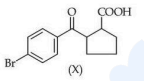
Statement II : Compound (Y), shown below, has two carbons with $\text{sp}^3$ hybridization, one carbon with $\text{sp}^2$ and one carbon with $\text{sp}$ hybridization
In the light of the above statements, choose the correct answer from the options given below :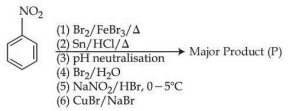
Consider the above sequence of reactions. The number of bromine atom(s) in the final product (P) will be :
Important Questions from Organic Chemistry
- In Dumas method for estimation of nitrogen, 0.50 g of an organic compound gave 70 mL of nitrogen collected at 300 K and 715 mm pressure. The percentage of nitrogen in the organic compound is ______ %.
(Aqueous tension at 300 K is 15 mm). - Given below are two statements:
Statement I: Cross aldol condensation between two different aldehydes will always produce four different products.
Statement II: When semicarbazide reacts with a mixture of benzaldehyde and acetophenone under optimum pH, it forms a condensation product with acetophenone only.
In the light of the above statements, choose the correct answer from the options given below - $0.25 \text{ g}$ of an organic compound "A" containing carbon, hydrogen and oxygen was analysed using the combustion method. There was an increase in mass of $\text{CaCl}_2$ tube and potash tube at the end of the experiment. The amount was found to be $0.15 \text{ g}$ and $0.1837 \text{ g}$, respectively. The percentage of oxygen in compound A is ______ %. (Nearest integer)
(Given: molar mass in $\text{g mol}^{-1}$ $\text{H} : 1, \text{C} : 12, \text{O} : 16$) - Grignard reagent $\text{RMgBr (P)}$ reacts with water and forms a gas $\text{(Q)}$. One gram of Q occupies $1.4 \text{ dm}^3$ at STP. (P) on reaction with dry ice in dry ether followed by $\text{H}_3\text{O}^+$ forms a compound $\text{(Z)}$. 0.1 mole of $\text{(Z)}$ will weigh _________ g. (Nearest integer)
- Given below are four compounds :
(a) n-propyl choride
(b) iso-propyl chloride
(c) sec-butyl chloride
(d) neo-pentyl chloride
Percentage of carbon in the one which exhibits optical isomerism is :



