
Statement I: Cross aldol condensation between two different aldehydes will always produce four different products.
Statement II: When semicarbazide reacts with a mixture of benzaldehyde and acetophenone under optimum pH, it forms a condensation product with acetophenone only.
In the light of the above statements, choose the correct answer from the options given below
Statement I Analysis: Cross Aldol Condensation
Statement I asserts that cross aldol condensation between two distinct aldehydes always yields four different products.
This statement is false. The number of possible products is contingent upon the presence of alpha-hydrogens in the reacting aldehydes.
- When two different aldehydes, both possessing alpha-hydrogens (let's denote them as Aldehyde A and Aldehyde B), undergo reaction, self-condensation can occur (A+A and B+B), as well as cross-condensation (A+B and B+A).
- However, the products from the cross-condensation pathways (A+B and B+A) are frequently identical after dehydration, leading to a maximum of three unique products: the two self-condensation products and the single cross-condensation product.
- Furthermore, if one aldehyde lacks alpha-hydrogens (like benzaldehyde), it cannot participate as the enolate source. In such cases, only two products might form: the self-condensation product of the other aldehyde and one cross-condensation product.
Because the number of products is variable and not consistently four, Statement I is false.
Statement II Analysis: Semicarbazide Reactivity
Statement II proposes that semicarbazide reacts exclusively with acetophenone, forming a product only with it, when mixed with benzaldehyde under optimal pH.
This statement is also false.
- Semicarbazide ($NH_2NHCONH_2$) is a reagent known to react with both aldehydes and ketones to form semicarbazones through a condensation reaction.
- This reaction typically proceeds efficiently under mildly acidic conditions (optimum pH range around 4-6).
- Both benzaldehyde (an aldehyde) and acetophenone (a ketone) possess carbonyl groups that are susceptible to nucleophilic attack by semicarbazide.
- In general reactivity trends, aldehydes tend to react more rapidly than ketones with reagents like semicarbazide.
Consequently, semicarbazide would be expected to react with both benzaldehyde and acetophenone, not solely with acetophenone. Therefore, Statement II is false.
Final Conclusion
Based on the analysis, both Statement I and Statement II are demonstrably false.
Similar Questions
- In Dumas method for estimation of nitrogen, 0.50 g of an organic compound gave 70 mL of nitrogen collected at 300 K and 715 mm pressure. The percentage of nitrogen in the organic compound is ______ %.
(Aqueous tension at 300 K is 15 mm). Given below are two statements:
Statement I: The dipole moment of R-CN is greater than R-NC and R-NC can undergo hydrolysis under acidic medium to produce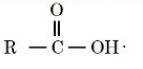
Statement II: R-CN hydrolyses under acidic medium to produce a compound which on treatment with $\text{SOCl}_2$, followed by the addition of $\text{NH}_3$ gives another compound(x). This compound (x) on treatment with $\text{NaOCl/NaOH}$ gives a product, that on treatment with $\text{CHCl}_3\text{/KOH/}\Delta$ produces R-NC
In the light of the above statements, choose the correct answer from the options given below- $0.25 \text{ g}$ of an organic compound "A" containing carbon, hydrogen and oxygen was analysed using the combustion method. There was an increase in mass of $\text{CaCl}_2$ tube and potash tube at the end of the experiment. The amount was found to be $0.15 \text{ g}$ and $0.1837 \text{ g}$, respectively. The percentage of oxygen in compound A is ______ %. (Nearest integer)
(Given: molar mass in $\text{g mol}^{-1}$ $\text{H} : 1, \text{C} : 12, \text{O} : 16$) - Grignard reagent $\text{RMgBr (P)}$ reacts with water and forms a gas $\text{(Q)}$. One gram of Q occupies $1.4 \text{ dm}^3$ at STP. (P) on reaction with dry ice in dry ether followed by $\text{H}_3\text{O}^+$ forms a compound $\text{(Z)}$. 0.1 mole of $\text{(Z)}$ will weigh _________ g. (Nearest integer)
- Given below are four compounds :
(a) n-propyl choride
(b) iso-propyl chloride
(c) sec-butyl chloride
(d) neo-pentyl chloride
Percentage of carbon in the one which exhibits optical isomerism is : - The correct statements are :
A. Activation energy for enzyme catalysed hydrolysis of sucrose is lower than that of acid catalysed hydrolysis.
B. During denaturation, secondary and tertiary structures of a protein are destroyed but primary structure remains intact.
C. Nucleotides are joined together by glycosidic linkage between $\text{C}_1$ and $\text{C}_4$ carbons of the pentose sugar.
D. Quaternary structure of proteins represents overall folding of the polypeptide chain.
Choose the correct answer from the options given below : - By usual analysis, $1.00\text{ g}$ of compound (X) gave $1.79\text{ g}$ of magnesium pyrophosphate. The percentage of phosphorus in compound (X) is : __________ (nearest integer)
(Given, molar mass in $\text{g\ mol}^{-1}$ : $\text{O} = 16, \text{Mg} = 24, \text{P} = 31$) - The correct order of the rate of the reaction for the following reaction with respect to nucleophiles is :
$\text{CH}_3\text{Br} + \text{Nu}^\ominus \longrightarrow \text{CH}_3\text{Nu} + \text{Br}^\ominus$ Given below are two statements :
Statement I : Compound (X), shown below, dissolves in $\text{NaHCO}_3$ solution and has two chiral carbon atoms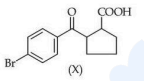
Statement II : Compound (Y), shown below, has two carbons with $\text{sp}^3$ hybridization, one carbon with $\text{sp}^2$ and one carbon with $\text{sp}$ hybridization
In the light of the above statements, choose the correct answer from the options given below :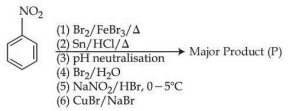
Consider the above sequence of reactions. The number of bromine atom(s) in the final product (P) will be :
Important Questions from Organic Chemistry
- In Dumas method for estimation of nitrogen, 0.50 g of an organic compound gave 70 mL of nitrogen collected at 300 K and 715 mm pressure. The percentage of nitrogen in the organic compound is ______ %.
(Aqueous tension at 300 K is 15 mm). Given below are two statements:
Statement I: The dipole moment of R-CN is greater than R-NC and R-NC can undergo hydrolysis under acidic medium to produce
Statement II: R-CN hydrolyses under acidic medium to produce a compound which on treatment with $\text{SOCl}_2$, followed by the addition of $\text{NH}_3$ gives another compound(x). This compound (x) on treatment with $\text{NaOCl/NaOH}$ gives a product, that on treatment with $\text{CHCl}_3\text{/KOH/}\Delta$ produces R-NC
In the light of the above statements, choose the correct answer from the options given below- $0.25 \text{ g}$ of an organic compound "A" containing carbon, hydrogen and oxygen was analysed using the combustion method. There was an increase in mass of $\text{CaCl}_2$ tube and potash tube at the end of the experiment. The amount was found to be $0.15 \text{ g}$ and $0.1837 \text{ g}$, respectively. The percentage of oxygen in compound A is ______ %. (Nearest integer)
(Given: molar mass in $\text{g mol}^{-1}$ $\text{H} : 1, \text{C} : 12, \text{O} : 16$) - Grignard reagent $\text{RMgBr (P)}$ reacts with water and forms a gas $\text{(Q)}$. One gram of Q occupies $1.4 \text{ dm}^3$ at STP. (P) on reaction with dry ice in dry ether followed by $\text{H}_3\text{O}^+$ forms a compound $\text{(Z)}$. 0.1 mole of $\text{(Z)}$ will weigh _________ g. (Nearest integer)
- Given below are four compounds :
(a) n-propyl choride
(b) iso-propyl chloride
(c) sec-butyl chloride
(d) neo-pentyl chloride
Percentage of carbon in the one which exhibits optical isomerism is :



