
For the given 4 × 1 MUX, the output y is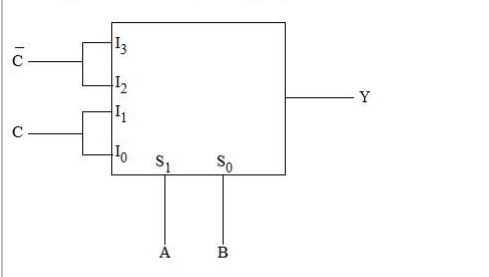
\(A\oplus C\)
How a 4×1 MUX works. It passes exactly one of four data inputs to the output, chosen by the two select lines; the general expression is a sum of the four minterms of the select variables, each ANDed with its data input:
\(Y=\overline{S_1}\,\overline{S_0}\,I_0+\overline{S_1}S_0 I_1+S_1\overline{S_0}I_2+S_1 S_0 I_3\)
Connections from the figure. Select lines \(S_1=A,\ S_0=B\); data inputs \(I_0=I_1=C\) and \(I_2=I_3=\overline{C}\). This is the standard trick of using a MUX as a function generator: two variables drive the selects, and the third variable (in true or complemented form) is applied to the data lines.
Substitute.
\(Y=\overline{A}\,\overline{B}\,C+\overline{A}B\,C+A\overline{B}\,\overline{C}+A B\,\overline{C}\)
Group and simplify. The first two terms share \(\overline{A}C\) and the last two share \(A\overline{C}\):
\(Y=\overline{A}C(\overline{B}+B)+A\overline{C}(\overline{B}+B)\)
Using the complement law \(B+\overline{B}=1\):
\(Y=\overline{A}C+A\overline{C}=A\oplus C\)
Why B disappears. Look at the pairing of the data inputs: I0 and I1 carry the same value, and so do I2 and I3. Those pairs differ only in S0 = B, so whichever way B goes the same value is selected — B has no influence on the output at all. Recognising this immediately reduces the 4×1 MUX to a 2×1 MUX selected by A, with C on one input and \(\overline{C}\) on the other, which is precisely an XOR of A and C.
Check the options. Options 3 and 4 involve B, which has just been shown to cancel, so both are impossible. Option 1, \(\overline{A\oplus C}\), is the XNOR — it would arise if the data inputs were swapped (\(I_0=I_1=\overline{C}\), \(I_2=I_3=C\)). The connections as given yield C when A = 0 and \(\overline{C}\) when A = 1, i.e. XOR.
Hence, the output is y = A ⊕ C.
Similar Questions
Consider the following statements :
A multiplexer :
1. selects one of the several inputs and transmits it to a single output.
2. routes the data from a single input to one of many outputs.
3. converts parallel data into serial data.
4. is a combinational circuit.Which of these statements are correct ?
Following multiplexers have to be designed by different MUX. Arrange the number of MUX required in descending order
A. Construct 4 : 1 MUX by using 2 : 1 MUX
B. Construct 16 : 1 MUX by using 4 : 1 MUX
C. Construct 64 : 1 MUX by using 4 : 1 MUX
D. Construct 64 : 1 MUX by using 8 : 1 MUX
E. Construct 256 : 1 MUX by using 8 : 1 MUX
Choose the correct answer from the options given below :
Consider the following statements :
(A) An 8-input MUX can be implemented using any 4 variable function
(B) A 3-line to 8-line DEMUX can be used to implement any 4 variable functions
(C) A 64-input MUX can be built using nine 8-input MUXs
(D) A 6-line to 64-line DEMUX can be built using nine 3-line DEMUXsChoose the most appropriate answer from the options given below :
Important Questions from Multiplexer
________ is used to carry digital data on analog lines.
_______ is a device that combines a large number of low speed transmission lines into a high speed line.
Which of the following can be used as a parallel to series converter?
Number of control lines required for 16 to 1 multiplexer is
In a multiplexer, if there are 4 input lines and 1 output line, then number of selection lines will be:



