
Consider the following statements : (A) An 8-input MUX can be implemented using any 4 variable function Choose the most appropriate answer from the options given below :
(B) A 3-line to 8-line DEMUX can be used to implement any 4 variable functions
(C) A 64-input MUX can be built using nine 8-input MUXs
(D) A 6-line to 64-line DEMUX can be built using nine 3-line DEMUXs
(C) and (D) Only
The two construction statements are correct and the two function-implementation statements are not — option 3.
(C) — building a 64-input MUX from 8-input MUXs. Two stages are needed:
| Stage | Count | Job |
|---|---|---|
| First | 8 | Each handles 8 of the 64 inputs, driven by the low three select bits |
| Second | 1 | Chooses among the eight first-stage outputs, driven by the high three select bits |
| Total | 9 |
The six select lines of the 64-input MUX split three-and-three between the stages, and \(8\times8=64\) inputs are covered exactly.
(D) — the demultiplexer is the mirror image. One 3-to-8 DEMUX in the first stage steers the incoming data to one of eight second-stage devices, and each of those eight fans out to eight outputs, giving \(8\times8=64\) outputs from nine devices. The counts are identical because a demultiplexer is a multiplexer with the signal flow reversed.
(B) is false on a straightforward count. A 3-line to 8-line demultiplexer has only three select inputs, so it can generate the eight minterms of three variables. Four variables need sixteen minterms and therefore a 4-to-16 device. The statement is short by a factor of two.
(A) is false as written, and this is worth separating carefully. There is a true statement close to it: a \(2^{n}\)-to-1 multiplexer can implement any function of n + 1 variables, so an 8-input MUX can implement any 4-variable function — wire three variables to the select lines and the fourth, its complement, 0 or 1 to each data input, following the Shannon expansion. But statement (A) reverses this, saying the MUX can be implemented using a function, which is not a meaningful claim about hardware. Since option 3 is the only choice excluding both (A) and (B), the reversal is evidently intended.
The general rule for cascading is worth carrying away: to build a \(2^{m}\)-input multiplexer from \(2^{k}\)-input ones takes
\(\dfrac{2^{m}-1}{2^{k}-1}\ \text{devices}\)
which for m = 6 and k = 3 gives \(63/7=9\) — confirming both (C) and (D) in one line.
Hence, the correct statements are (C) and (D).
Similar Questions
Consider the following statements :
A multiplexer :
1. selects one of the several inputs and transmits it to a single output.
2. routes the data from a single input to one of many outputs.
3. converts parallel data into serial data.
4. is a combinational circuit.Which of these statements are correct ?
For the given 4 × 1 MUX, the output y is
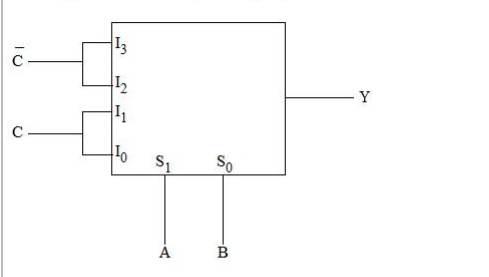
Following multiplexers have to be designed by different MUX. Arrange the number of MUX required in descending order
A. Construct 4 : 1 MUX by using 2 : 1 MUX
B. Construct 16 : 1 MUX by using 4 : 1 MUX
C. Construct 64 : 1 MUX by using 4 : 1 MUX
D. Construct 64 : 1 MUX by using 8 : 1 MUX
E. Construct 256 : 1 MUX by using 8 : 1 MUX
Choose the correct answer from the options given below :
Important Questions from Multiplexer
The number of control lines in a multiplexer is 5, identify the MUX.
Number of control lines required for 16 to 1 multiplexer is _____
________ is used to carry digital data on analog lines.
Consider the sentence below.
There is a country that borders both India and Pakistan.
Which of the following logical expressions express the above sentence correctly when the predicate Country(x) represents that x is a country and Borders(x, y) represents that the countries x and y share the border?
A digital computer has a common bus system for 8 registers 16 bits each. How many multiplexers are required to implement common bus? What size of multiplexers is required?



