
Consider the following statements : A multiplexer : 1. selects one of the several inputs and transmits it to a single output. Which of these statements are correct ?
2. routes the data from a single input to one of many outputs.
3. converts parallel data into serial data.
4. is a combinational circuit.
1, 3 and 4
Statement 2 describes a demultiplexer, not a multiplexer, so the correct set is 1, 3 and 4 — option 3.
| Statement | Verdict |
|---|---|
| 1. Many inputs to one output | ✓ The definition |
| 2. One input to many outputs | ✗ That is a demultiplexer |
| 3. Parallel to serial | ✓ With the select lines counting |
| 4. Combinational | ✓ |
Statement 1 — the definition. A \(2^{n}\)-to-1 multiplexer has \(2^{n}\) data inputs, n select lines and one output; the select code names which input reaches the output. For a 4-to-1:
\(Y=\overline{S_{1}}\,\overline{S_{0}}I_{0}+\overline{S_{1}}S_{0}I_{1}+S_{1}\overline{S_{0}}I_{2}+S_{1}S_{0}I_{3}\)
Statement 3 follows from statement 1. Drive the select lines from a binary counter and the inputs are visited one after another, so a word presented in parallel emerges as a serial stream on the single output line — parallel-to-serial conversion using nothing but a MUX and a counter. The demultiplexer at the far end, driven by a matching counter, reverses it. This is exactly how time-division multiplexing works.
Statement 4 — combinational. The output depends only on the present inputs and select code. There is no feedback path and no memory element, so the same inputs always give the same output, with no dependence on what came before. A multiplexer used inside a sequential circuit — as the input selector of a loadable flip-flop, for instance — does not make the multiplexer itself sequential.
One further use worth noting : because the expression above is a full sum of minterms, a \(2^{n}\)-to-1 multiplexer can implement any n-variable Boolean function directly — wire the variables to the select lines and the truth-table values to the data inputs. With the Shannon expansion, a function of n+1 variables can even be realised on a \(2^{n}\)-to-1 device. This makes the multiplexer a universal logic element, which is why FPGA logic blocks are built largely from them.
Hence, statements 1, 3 and 4 are correct.
Similar Questions
Consider the following statements :
(A) An 8-input MUX can be implemented using any 4 variable function
(B) A 3-line to 8-line DEMUX can be used to implement any 4 variable functions
(C) A 64-input MUX can be built using nine 8-input MUXs
(D) A 6-line to 64-line DEMUX can be built using nine 3-line DEMUXsChoose the most appropriate answer from the options given below :
For the given 4 × 1 MUX, the output y is
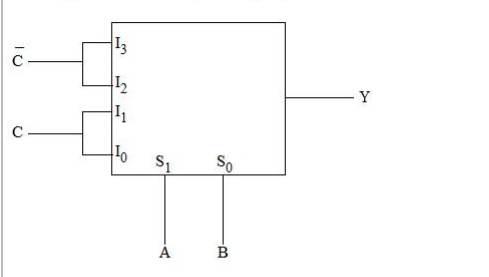
Following multiplexers have to be designed by different MUX. Arrange the number of MUX required in descending order
A. Construct 4 : 1 MUX by using 2 : 1 MUX
B. Construct 16 : 1 MUX by using 4 : 1 MUX
C. Construct 64 : 1 MUX by using 4 : 1 MUX
D. Construct 64 : 1 MUX by using 8 : 1 MUX
E. Construct 256 : 1 MUX by using 8 : 1 MUX
Choose the correct answer from the options given below :
Important Questions from Multiplexer
The number of control lines in a multiplexer is 5, identify the MUX.
Number of control lines required for 16 to 1 multiplexer is _____
________ is used to carry digital data on analog lines.
Consider the sentence below.
There is a country that borders both India and Pakistan.
Which of the following logical expressions express the above sentence correctly when the predicate Country(x) represents that x is a country and Borders(x, y) represents that the countries x and y share the border?
A digital computer has a common bus system for 8 registers 16 bits each. How many multiplexers are required to implement common bus? What size of multiplexers is required?



