
Following multiplexers have to be designed by different MUX. Arrange the number of MUX required in descending order A. Construct 4 : 1 MUX by using 2 : 1 MUX B. Construct 16 : 1 MUX by using 4 : 1 MUX C. Construct 64 : 1 MUX by using 4 : 1 MUX D. Construct 64 : 1 MUX by using 8 : 1 MUX E. Construct 256 : 1 MUX by using 8 : 1 MUX Choose the correct answer from the options given below :
\(E \gt C \gt D \gt B \gt A\)
How a large MUX is built from smaller ones. The small multiplexers are arranged as a tree. Each level reduces the number of lines by the factor of the building block, and the process repeats until a single output remains. For an N:1 MUX built from k:1 blocks the levels hold N/k, N/k², N/k³ … units, so the total is
\(\text{Total}=\dfrac{N}{k}+\dfrac{N}{k^{2}}+\ldots+1\)
Count each case.
| Item | Requirement | Levels | Total MUXes |
|---|---|---|---|
| A | 4:1 from 2:1 | 2 + 1 | 3 |
| B | 16:1 from 4:1 | 4 + 1 | 5 |
| C | 64:1 from 4:1 | 16 + 4 + 1 | 21 |
| D | 64:1 from 8:1 | 8 + 1 | 9 |
| E | 256:1 from 8:1 | 32 + 4 + 1 | 37 |
Worked illustration (case C). Sixteen 4:1 MUXes in the first level cover all 64 inputs and reduce them to 16 lines; four more reduce those to 4; one final MUX gives the single output — 16 + 4 + 1 = 21, using three levels of select decoding (2 bits per level, 6 select bits in all, as required for 64 inputs).
Arrange in descending order: 37 (E) > 21 (C) > 9 (D) > 5 (B) > 3 (A), i.e.
\(E \gt C \gt D \gt B \gt A\)
Design insight. Compare C and D — the same 64:1 function costs 21 blocks with 4:1 units but only 9 with 8:1 units. Larger building blocks mean fewer levels, hence fewer devices and less propagation delay, since delay scales with the number of levels, \(\log_k N\).
Hence, the descending order is E > C > D > B > A.
Similar Questions
Consider the following statements :
A multiplexer :
1. selects one of the several inputs and transmits it to a single output.
2. routes the data from a single input to one of many outputs.
3. converts parallel data into serial data.
4. is a combinational circuit.Which of these statements are correct ?
Consider the following statements :
(A) An 8-input MUX can be implemented using any 4 variable function
(B) A 3-line to 8-line DEMUX can be used to implement any 4 variable functions
(C) A 64-input MUX can be built using nine 8-input MUXs
(D) A 6-line to 64-line DEMUX can be built using nine 3-line DEMUXsChoose the most appropriate answer from the options given below :
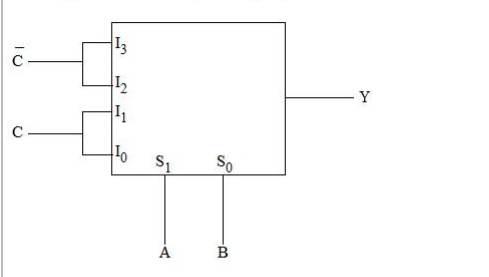
For the given 4 × 1 MUX, the output y is
Important Questions from Multiplexer
The number of control lines in a multiplexer is 5, identify the MUX.
Number of control lines required for 16 to 1 multiplexer is _____
________ is used to carry digital data on analog lines.
Consider the sentence below.
There is a country that borders both India and Pakistan.
Which of the following logical expressions express the above sentence correctly when the predicate Country(x) represents that x is a country and Borders(x, y) represents that the countries x and y share the border?
A digital computer has a common bus system for 8 registers 16 bits each. How many multiplexers are required to implement common bus? What size of multiplexers is required?



