In a multiplexer, if there are 4 input lines and 1 output line, then number of selection lines will be:
2
Multiplexer Selection Lines Calculation
A multiplexer, often abbreviated as MUX, is a digital switch that selects one of several input lines and forwards the selected input to a single output line. The selection of the input line is controlled by a set of selection lines, also known as control lines.
Understanding Multiplexer Operation
The core function of a multiplexer is to route data from one of its many input sources to a single destination. The number of input lines and the number of selection lines are directly related. If a multiplexer has \(N\) input lines, then the number of selection lines, \(S\), required to uniquely select one of these \(N\) inputs is determined by the formula:
\[ N = 2^S \]
Where:
- \(N\) represents the total number of input lines.
- \(S\) represents the number of selection lines.
This formula essentially means that with \(S\) selection lines, we can generate \(2^S\) unique combinations, each corresponding to one specific input line.
Determining Selection Lines for 4 Inputs
In this specific question, we are given that the multiplexer has 4 input lines and 1 output line. We need to find the number of selection lines. Using the formula \(N = 2^S\):
- Given, number of input lines (\(N\)) = 4.
- We need to find the number of selection lines (\(S\)).
Let's substitute the value of \(N\) into the formula:
\[ 4 = 2^S \]
To solve for \(S\), we need to determine what power of 2 equals 4. We know that:
- \(2^1 = 2\)
- \(2^2 = 4\)
From this, we can clearly see that if \(2^S = 4\), then \(S\) must be equal to 2.
Therefore, for a multiplexer with 4 input lines, 2 selection lines are required to control which input is directed to the output.
Summary of Multiplexer Lines
Here's a quick reference table showing the relationship between input lines and selection lines for common multiplexer configurations:
| Number of Input Lines (\(N\)) | Number of Selection Lines (\(S\)) |
|---|---|
| 2 | 1 (since \(2^1 = 2\)) |
| 4 | 2 (since \(2^2 = 4\)) |
| 8 | 3 (since \(2^3 = 8\)) |
| 16 | 4 (since \(2^4 = 16\)) |
Based on our calculation and the fundamental principle of multiplexers, if there are 4 input lines and 1 output line, the number of selection lines will be 2.
Important Questions from Multiplexer
________ is used to carry digital data on analog lines.
_______ is a device that combines a large number of low speed transmission lines into a high speed line.
Which of the following can be used as a parallel to series converter?
Number of control lines required for 16 to 1 multiplexer is
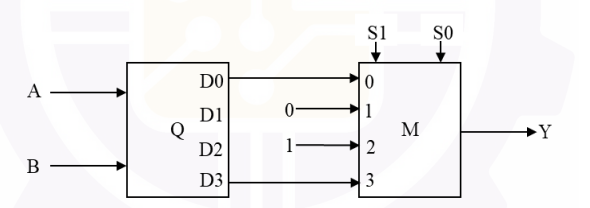
Consider the digital circuit shown below with two input lines A and B, two select lines S0 and S1, and an output line Y. The blocks Q and M represent active high 2:4 decoder and 4-to-1 multiplexer, respectively. Out of 16 possible input combinations, the number of combinations that produce Y=1 is ____________. (answer in integer)
Note: One input combination is an instance of [A B S1 S0].