
Consider the digital circuit shown below with two input lines A and B, two select lines S0 and S1, and an output line Y. The blocks Q and M represent active high 2:4 decoder and 4-to-1 multiplexer, respectively. Out of 16 possible input combinations, the number of combinations that produce Y=1 is ____________. (answer in integer)
Note: One input combination is an instance of [A B S1 S0].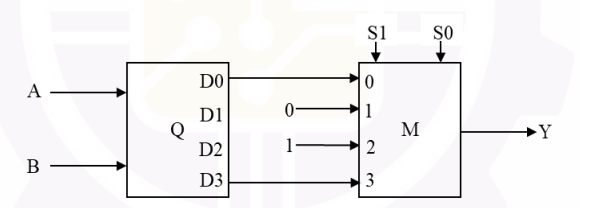
Problem Analysis
The circuit contains two main functional blocks: an active-high 2:4 decoder (Q) and a 4-to-1 multiplexer (M). We need to determine how many of the 16 possible combinations of the input vector \([A, B, S_1, S_0]\) result in the output \(Y = 1\).
1. Functional Logic of the Blocks
A. 2:4 Decoder (Block Q)
An active-high decoder activates a specific output line based on the binary input \((A, B)\). The standard boolean expressions for the relevant outputs are:
- \(D_0 = \overline{A} \cdot \overline{B}\) (High only when \(A=0, B=0\))
- \(D_3 = A \cdot B\) (High only when \(A=1, B=1\))
B. 4-to-1 Multiplexer (Block M)
The multiplexer selects one of its four data inputs based on the select lines \(S_1\) and \(S_0\). From the diagram, the inputs are:
- Input 0 (\(I_0\)) = \(D_0\)
- Input 1 (\(I_1\)) = \(0\) (Logic Low)
- Input 2 (\(I_2\)) = \(1\) (Logic High)
- Input 3 (\(I_3\)) = \(D_3\)
The boolean expression for the output \(Y\) is:
$$ Y = \overline{S_1}\overline{S_0} \cdot D_0 + \overline{S_1}S_0 \cdot 0 + S_1\overline{S_0} \cdot 1 + S_1S_0 \cdot D_3 $$
2. Case-by-Case Evaluation
To find when \(Y = 1\), we evaluate the output for each combination of the select lines \((S_1, S_0)\):
- Case 1: \((S_1, S_0) = (0, 0)\)
\(Y = D_0\). For \(Y\) to be 1, \(D_0\) must be 1. This occurs only when \((A, B) = (0, 0)\).
Combination: \([0, 0, 0, 0]\) → 1 combination
- Case 2: \((S_1, S_0) = (0, 1)\)
\(Y = 0\). Output is always low regardless of \(A\) and \(B\).
→ 0 combinations
- Case 3: \((S_1, S_0) = (1, 0)\)
\(Y = 1\). Output is tied to logic high, meaning \(Y=1\) for any value of \(A\) and \(B\).
Combinations: \([0,0,1,0], [0,1,1,0], [1,0,1,0], [1,1,1,0]\) → 4 combinations
- Case 4: \((S_1, S_0) = (1, 1)\)
\(Y = D_3\). For \(Y\) to be 1, \(D_3\) must be 1. This occurs only when \((A, B) = (1, 1)\).
Combination: \([1, 1, 1, 1]\) → 1 combination
3. Total Count
Summing the combinations from all cases:
$$ \text{Total Combinations} = 1 (\text{Case 1}) + 0 (\text{Case 2}) + 4 (\text{Case 3}) + 1 (\text{Case 4}) = 6 $$
Summarized Solution
The multiplexer output \(Y\) is logic high in three distinct scenarios based on the select lines \(S_1\) and \(S_0\). When \((S_1, S_0) = (0, 0)\), the output depends on the decoder's \(D_0\) pin (1 combination). When \((S_1, S_0) = (1, 0)\), the output is connected to a constant logic '1', which covers 4 combinations of \(A\) and \(B\). When \((S_1, S_0) = (1, 1)\), the output depends on the decoder's \(D_3\) pin (1 combination). Together, there are 6 input combinations that produce \(Y=1\).
Important Questions from Multiplexer
The number of control lines in a multiplexer is 5, identify the MUX.
Number of control lines required for 16 to 1 multiplexer is _____
In a multiplexer, the number of input lines is ‘n’ and the number of select lines is ‘m’. Which of the following is correct?
________ is used to carry digital data on analog lines.
Consider the sentence below.
There is a country that borders both India and Pakistan.
Which of the following logical expressions express the above sentence correctly when the predicate Country(x) represents that x is a country and Borders(x, y) represents that the countries x and y share the border?


