
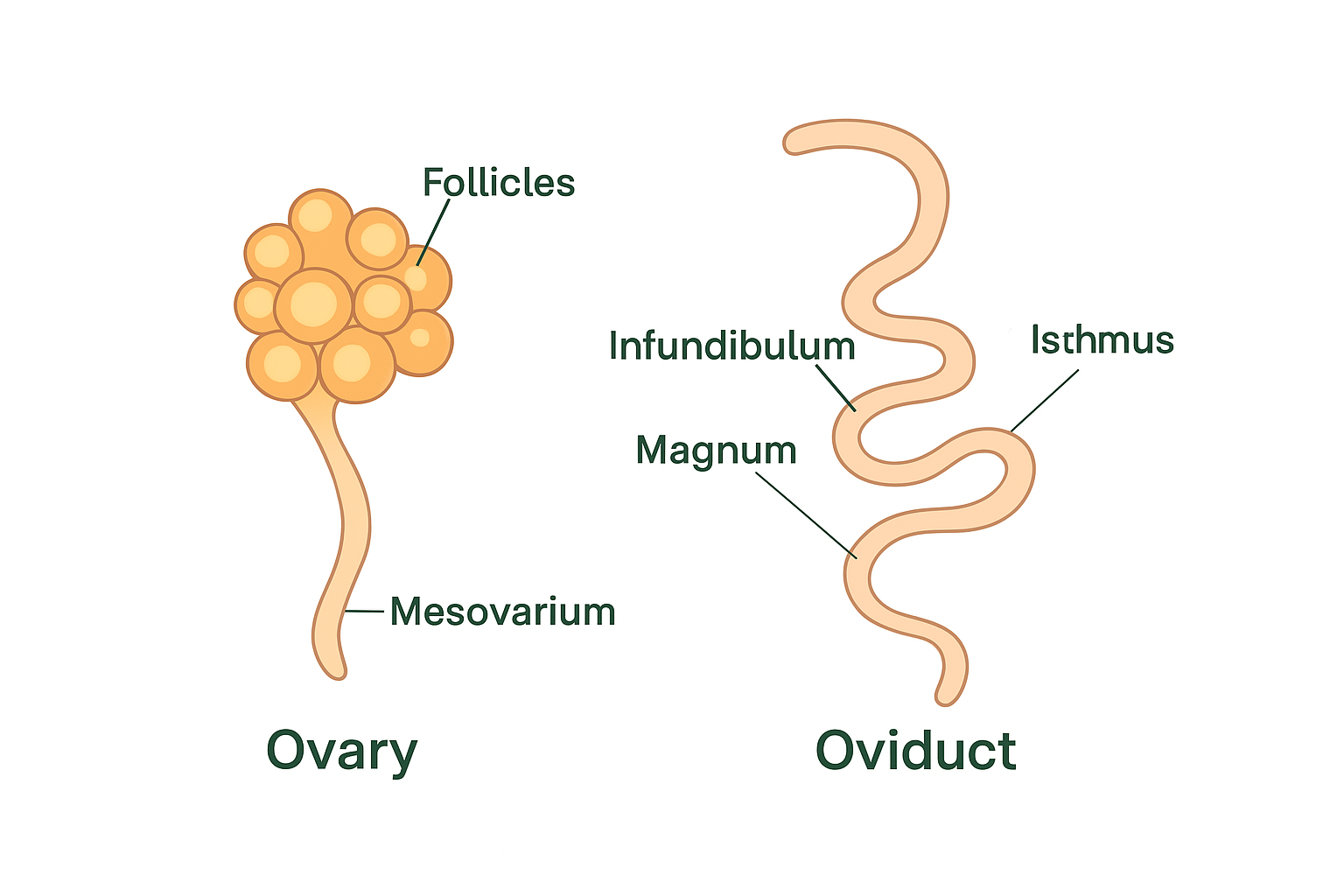
Explain gross anatomical features of ovary and oviduct of Fowl with the help of diagrams.
Here’s a structured explanation of the gross anatomical features of the ovary and oviduct of the fowl. I can also prepare labeled diagrams for you to visualize better.
Ovary (Left Functional Ovary)
- In adult hens, only the left ovary is functional; the right one regresses during embryonic life.
- It lies in the abdominal cavity, close to the left kidney and attached by the mesovarium.
- The ovary is cluster-like (bunch of grapes) in appearance, due to follicles of different sizes and stages of development.
- Each follicle contains an oocyte (yolk) surrounded by layers of granulosa and theca cells.
- At ovulation, the mature follicle ruptures, releasing the yolk into the infundibulum of the oviduct.
Oviduct (Left Functional Oviduct)
- Only the left oviduct develops fully and functions in egg formation.
- It is a long, coiled muscular tube (~60–70 cm in hens) suspended by the mesosalpinx.
- Divided into five main regions:
- Infundibulum – funnel-shaped, captures the ovulated yolk; site of fertilization.
- Magnum – secretes albumen (egg white).
- Isthmus – adds shell membranes.
- Uterus (Shell gland) – deposits calcium carbonate, forming the shell.
- Vagina – muscular part aiding in egg laying; also has sperm storage tubules.
Answered By:
Sakshi Negi
Sakshi Negi is a Delhi-based journalist and content specialist with expertise in educational content and digital media, focusing particularly on government exam preparation and career guidance. With a degree in Journalism and Mass Communication from NRAI School of Mass Communication and her background as a Kendriya Vidyalaya alumna, she brings unique insights into the Indian education system and government sector opportunities.

Similar Questions
Location of superficial lymph nodes of ox.
Write salient Histological Features of Basic tissues of the Body.
Write about the types of pollution. Also write about sources and signs of water pollution. How to measure the water Quality?
Write about the collection, methods of preservation and dispatch of samples from the carcass of suspected rabid dog for laboratory diagnosis.
Drugs acting on Fluid Balance.
Discuss the properties of an ideal antimicrobial agent. Write about the classification of antimicrobial agents.
Discuss in brief the housing requirements for pregnant cows and milking cows.
Explain the formation of Foetal membranes in mammals with the help of suitable diagrams.
Explain why dietary supplementation of Iodine is essential for Livestock.
Elucidate the etiology, pathogenesis, clinical findings and line of treatment of esophagitis in cow.
Important Questions from Miscellaneous
Write a note in 150 words
Mendelian and non-Mendelian traits.Write a note in 150 words
Theoretical significance of Purum kinship-system.Write a note in 150 words
Smell as a signal among non-human primates.Write a note in 150 words
Osteodontokeratik culture and its makers.Discuss the Miocene hominoid remains and their significance in evolution.



