Catalytic converters are used for reduction and oxidation reactions to reduce harmful emissions. The reduction of nitrogen oxides uses the following metal based catalyst :
Pt; Rh
A modern three-way catalytic converter performs three jobs at once, and the metals are chosen for their different specialities.
Reduction of NOx — rhodium. Rhodium is by far the most effective catalyst for dissociating the strong N-O bond and recombining the nitrogen atoms:
\(2\mathrm{NO} + 2\mathrm{CO} \rightarrow \mathrm{N_2} + 2\mathrm{CO_2}\)
It is used with platinum, which also contributes to the reduction step and provides the oxidation activity.
Oxidation of CO and unburnt hydrocarbons — platinum and palladium.
\(2\mathrm{CO} + \mathrm{O_2} \rightarrow 2\mathrm{CO_2}\) and hydrocarbons to CO2 and H2O.
So the Pt-Rh combination is the one associated with NOx reduction, and it is the answer.
Two practical points explain why these expensive metals are used rather than cheaper ones. First, base metals such as nickel, iron and cobalt are readily oxidised and sulphur-poisoned in the exhaust stream, whereas the platinum-group metals resist both and survive temperatures above 800°C. Second, the converter can only reduce and oxidise simultaneously if the engine runs very close to the stoichiometric air-fuel ratio of about 14.7 : 1 — too much oxygen and the reduction of NOx fails, too little and the oxidation fails. This is why an oxygen sensor upstream controls the fuelling so tightly.
It is also why leaded petrol had to be phased out: lead deposits irreversibly poison the catalyst surface.
Hence the reduction of nitrogen oxides uses Pt and Rh.
Similar Questions
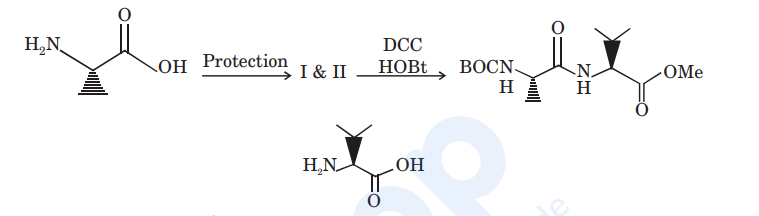
Complete the following reaction by suggesting the appropriate substrates (I & II) :
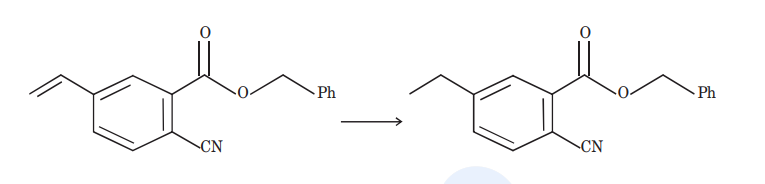
Suggest most suitable conditions for the following selective conversion :
What major product is isolated from the following reaction :
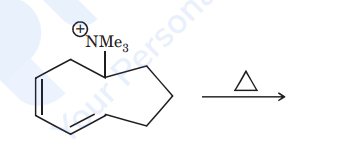
Predict stereochemical outcome of the following reaction :
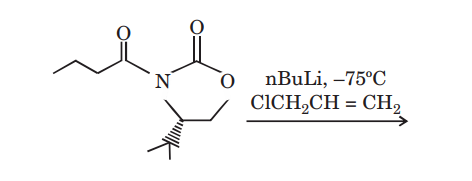
The major product of the following reaction is :
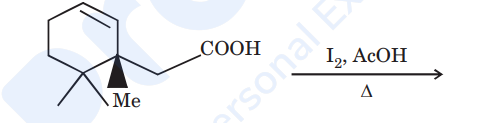
Predict the major product of the following reaction :
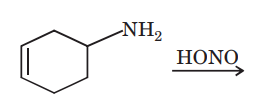
The major product of the following reaction is :
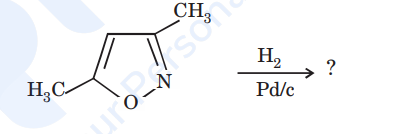
The major product of the following reaction is :
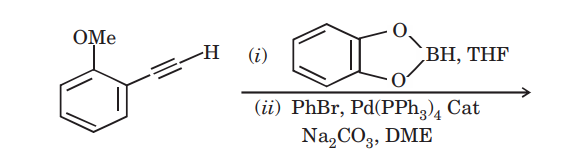
The major product formed in the following reaction is :
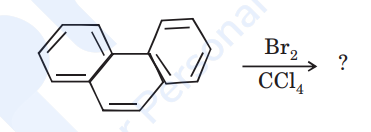
The major product formed in the following reaction is :
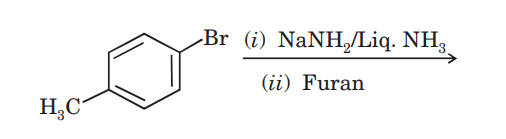
Important Questions from Chemistry in Everyday Life
Which of the following is a greenhouse gas?
I. Methane
II. Nitrous oxide
The gas which turns lime water milky is:
Liquefied Petroleum Gas (LPG) is mainly a mixture of:
Among the following, the conducting form of carbon is
Which of the following is NOT a Fossil Fuel?