
Assertion (A) : Signal multiplexing provides medium that allows large number of independent sources to share same physical channel. Reason (R) : It is an aggregate information sent through time division multiplexing.
(A) is true, but (R) is false.
Assertion — TRUE. That is precisely the definition of multiplexing: combining several independent signals so that they can share one transmission medium without interfering with each other. It is what makes a single cable, fibre or radio channel economically viable — the alternative would be one physical link per source.
Reason — FALSE as a general statement. It asserts that multiplexing is aggregation by time division, but TDM is only one of several methods, each sharing a different resource:
| Method | What is shared out | Typical use |
|---|---|---|
| FDM | frequency band | radio, analogue telephony |
| TDM | time slots | digital telephony (PCM) |
| WDM | optical wavelength | fibre systems |
| CDM | orthogonal codes | CDMA cellular |
| SDM | physical space / path | MIMO, multicore fibre |
Defining multiplexing by TDM alone is like defining "vehicle" as "car" — it names one instance and mistakes it for the category. In particular, FDM has all sources transmitting simultaneously in different frequency bands, which directly contradicts the reason's claim that the aggregate is formed by time division.
So the assertion stands while the reason does not.
The unifying idea. Every multiplexing scheme works by giving each source its own orthogonal slice of some resource — a frequency band, a time slot, a wavelength, a code — so that the receiver can separate the signals again. Orthogonality is what prevents crosstalk, and the guard bands or guard times in a practical system exist to protect it.
Hence, (A) is true, but (R) is false.
Similar Questions
Time division multiplexing of digital signal ( Where Ai, Bi, Ci, Di represents respective bits of different channels, i = 1 to 4) given in the figure:
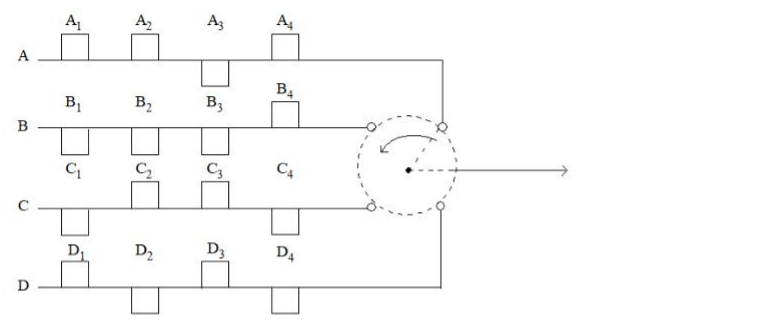
A. A1B1C1D1 (All channels have same bit rate)
B. A1A2B1B2C1D1C2D2 (All channels have same bit rate)
C. A1B1A2C1A3D1 (channel A bit rate is 3 times more than that of channels B, C, D)
D. A1B1C1A2D1 (channel A bit rate is 3-times more than that of channels B, C, D)
E. A1B1A2C1A3D1 (All channel have same bit rate)
Choose the correct answer from the options given below :
The sample and hold devices are used to perform :
Important Questions from Time Division Multiplexing (TDM)
Time division multiplexing of digital signal ( Where Ai, Bi, Ci, Di represents respective bits of different channels, i = 1 to 4) given in the figure:
A. A1B1C1D1 (All channels have same bit rate)
B. A1A2B1B2C1D1C2D2 (All channels have same bit rate)
C. A1B1A2C1A3D1 (channel A bit rate is 3 times more than that of channels B, C, D)
D. A1B1C1A2D1 (channel A bit rate is 3-times more than that of channels B, C, D)
E. A1B1A2C1A3D1 (All channel have same bit rate)
Choose the correct answer from the options given below :
The sample and hold devices are used to perform :
A voice signal band limited to 3.4 kHz is sampled at 8 kHz and pulse code modulated using 64 quantization levels. Ten such signals are time division multiplexed using on 5-bit synchronising word. The minimum channel band width will be
- A multiplexer combines four 100-Kbps channels using a time slot of 2 bits. What is the bit rate ?
- The main advantage of TDM over FDM is that it
TDM stands for Time Division Multiplexing
FDM stands for Frequency Division Multiplexing



