
Time division multiplexing of digital signal ( Where Ai, Bi, Ci, Di represents respective bits of different channels, i = 1 to 4) given in the figure: A. A1B1C1D1 (All channels have same bit rate) B. A1A2B1B2C1D1C2D2 (All channels have same bit rate) C. A1B1A2C1A3D1 (channel A bit rate is 3 times more than that of channels B, C, D) D. A1B1C1A2D1 (channel A bit rate is 3-times more than that of channels B, C, D) E. A1B1A2C1A3D1 (All channel have same bit rate) Choose the correct answer from the options given below :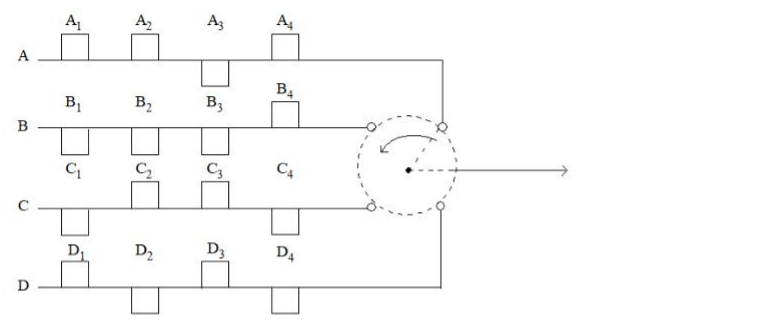
A, C only
How TDM works. A commutator visits the input channels in a fixed cyclic order and interleaves their bits onto a single high-rate line. The number of slots a channel receives per frame is proportional to its bit rate, so the composite (line) rate is the sum of the channel rates. Each statement pairs a bit sequence with a rate condition, and both halves must agree.
A — "A1B1C1D1, all channels at the same bit rate." CONSISTENT. Every channel gets exactly one slot per frame, so all four are sampled equally often and share the line rate equally:
\(R_{line} = 4R_{channel}\)
This is ordinary equal-rate TDM.
C — "A1B1A2C1A3D1, channel A at three times the rate of B, C, D." CONSISTENT. Count the slots in one frame: A appears three times (A1, A2, A3) while B, C and D appear once each. So
\(R_A = 3R_B = 3R_C = 3R_D\)
exactly as the statement claims. The A slots are also spread evenly through the frame, which is what a properly designed unequal-rate multiplexer does.
E — the same sequence A1B1A2C1A3D1 but claiming "all channels have the same bit rate." INCONSISTENT. A occupies three of the six slots, so it plainly cannot have the same rate as B, C and D. The sequence is fine; the rate claim contradicts it.
D — "A1B1C1A2D1, channel A three times faster." INCONSISTENT. Here A gets only two slots against one each for B, C and D, i.e. a ratio of 2, not 3.
B — "A1A2B1B2C1D1C2D2, all channels at the same rate." INCONSISTENT with proper interleaving. Although the slot counts come out equal (two each), the samples are bunched in pairs rather than interleaved in a uniform rotation, so it does not represent the commutator sequence shown.
The consistent descriptions are A and C.
Key idea. To check any TDM frame, count each channel's slots per frame — that ratio is the ratio of bit rates. A faster channel is served by giving it extra, evenly spaced slots in every rotation.
Hence, the correct answer is A and C only.
Similar Questions
Assertion (A) : Signal multiplexing provides medium that allows large number of independent sources to share same physical channel.
Reason (R) : It is an aggregate information sent through time division multiplexing.
The sample and hold devices are used to perform :
Important Questions from Time Division Multiplexing (TDM)
Assertion (A) : Signal multiplexing provides medium that allows large number of independent sources to share same physical channel.
Reason (R) : It is an aggregate information sent through time division multiplexing.
The sample and hold devices are used to perform :
A voice signal band limited to 3.4 kHz is sampled at 8 kHz and pulse code modulated using 64 quantization levels. Ten such signals are time division multiplexed using on 5-bit synchronising word. The minimum channel band width will be
- A multiplexer combines four 100-Kbps channels using a time slot of 2 bits. What is the bit rate ?
- The main advantage of TDM over FDM is that it
TDM stands for Time Division Multiplexing
FDM stands for Frequency Division Multiplexing



