
A voice signal band limited to 3.4 kHz is sampled at 8 kHz and pulse code modulated using 64 quantization levels. Ten such signals are time division multiplexed using on 5-bit synchronising word. The minimum channel band width will be
520 kHz
Calculating Minimum Channel Bandwidth for PCM TDM Signals
Let's break down the calculation step-by-step to find the minimum channel bandwidth required for the given Pulse Code Modulated (PCM) and Time Division Multiplexed (TDM) signals.
Step 1: Determine Bits per Sample
The number of quantization levels is given as 64. The number of bits required to represent each sample is found using the formula:
\( \text{Number of levels} = 2^{\text{bits per sample}} \)
So, \( 64 = 2^n \), where \( n \) is the number of bits per sample.
Taking the logarithm base 2:
\( n = \log_2(64) = 6 \text{ bits per sample} \)
Each voice signal sample is represented by 6 bits.
Step 2: Calculate Bit Rate per Signal
The sampling rate for each voice signal is 8 kHz, which means 8000 samples are taken per second from each signal.
The bit rate generated by one voice signal is:
\( \text{Bit rate per signal} = \text{Sampling rate} \times \text{Bits per sample} \)
\( \text{Bit rate per signal} = 8000 \text{ samples/second} \times 6 \text{ bits/sample} = 48000 \text{ bits/second} \)
Step 3: Understand Time Division Multiplexing (TDM) Framing
Ten such signals are time division multiplexed. In TDM, samples from different signals are combined into frames. Each frame contains one sample from each of the 10 signals, plus a synchronizing word.
The frame rate is equal to the sampling rate of the individual signals, which is 8 kHz (or 8000 frames per second).
Step 4: Calculate Bits per Frame
Each frame contains:
- A sample from each of the 10 signals. Since each sample is 6 bits, the total bits from the signals per frame is \( 10 \times 6 = 60 \) bits.
- A 5-bit synchronizing word.
Total bits per frame = (Bits from signals) + (Synchronizing word bits)
Total bits per frame = \( 60 \text{ bits} + 5 \text{ bits} = 65 \text{ bits} \)
| Component | Bits per Sample/Word | Number of Signals/Words per Frame | Total Bits per Frame |
|---|---|---|---|
| Each Voice Signal | 6 | 10 | \(10 \times 6 = 60\) |
| Synchronizing Word | 5 | 1 | \(1 \times 5 = 5\) |
| Total per Frame | - | - | 65 |
Step 5: Calculate Total Bit Rate
The total bit rate is the total number of bits transmitted per second. This is calculated by multiplying the bits per frame by the frame rate.
\( \text{Total bit rate} = \text{Bits per frame} \times \text{Frame rate} \)
\( \text{Total bit rate} = 65 \text{ bits/frame} \times 8000 \text{ frames/second} = 520,000 \text{ bits/second} \)
This can be written as 520 kbps (kilobits per second).
Step 6: Determine Minimum Channel Bandwidth
For a PCM signal, the minimum theoretical bandwidth required to transmit a bit rate of \( R_b \) bps using ideal Nyquist signaling is \( R_b/2 \) Hz. However, for common pulse shapes like Non-Return-to-Zero (NRZ), the bandwidth required up to the first null is equal to the bit rate \( R_b \). Given the options, the minimum channel bandwidth is typically considered equal to the total bit rate in such contexts, assuming a simple line coding scheme.
Minimum Channel Bandwidth \( \approx \) Total Bit Rate
Minimum Channel Bandwidth \( \approx 520,000 \text{ Hz} = 520 \text{ kHz} \)
Therefore, the minimum channel bandwidth will be 520 kHz.
Summary of Calculation
- Bits per sample = \( \log_2(64) = 6 \) bits
- Bit rate per signal = \( 8000 \times 6 = 48000 \) bps
- Bits per frame = \( (10 \times 6) + 5 = 65 \) bits
- Frame rate = 8000 frames/second
- Total bit rate = \( 65 \times 8000 = 520000 \) bps = 520 kbps
- Minimum channel bandwidth \( \approx \) Total bit rate = 520 kHz
Revision Table: PCM TDM Parameters
| Parameter | Value | Influence on Bandwidth |
|---|---|---|
| Voice Bandwidth | 3.4 kHz | Sets the minimum sampling rate (Nyquist rate is 2 * 3.4 = 6.8 kHz, but 8 kHz is used, which is sufficient). |
| Sampling Rate | 8 kHz | Determines the frame rate and samples per second. |
| Quantization Levels | 64 | Determines the number of bits per sample (6 bits). |
| Number of Signals | 10 | Multiplies the bit rate contributed by individual signals per frame. |
| Synchronizing Word | 5 bits | Adds overhead bits to each frame. |
| Total Bit Rate | 520 kbps | Directly related to the minimum channel bandwidth. |
Additional Information: PCM and TDM Basics
Pulse Code Modulation (PCM): This is a digital representation of an analog signal where the signal is sampled, quantized, and encoded. Key steps are:
- Sampling: Converting a continuous-time signal into a discrete-time signal by taking values at regular intervals. The sampling rate should be at least twice the maximum frequency component of the signal (Nyquist theorem).
- Quantization: Converting the continuous sample values into discrete levels.
- Encoding: Representing each quantized level by a digital code, usually a binary number.
Time Division Multiplexing (TDM): This technique combines multiple digital signals into one channel by dividing the transmission time into intervals, allowing each signal to use the channel sequentially for a short period. In the context of PCM, samples from different PCM signals are interleaved to form a single digital stream.
Channel Bandwidth: The range of frequencies that a communication channel can pass. For transmitting digital signals, the required bandwidth is related to the bit rate. Higher bit rates generally require wider bandwidths.
Important Questions from Time Division Multiplexing (TDM)
Time division multiplexing of digital signal ( Where Ai, Bi, Ci, Di represents respective bits of different channels, i = 1 to 4) given in the figure:
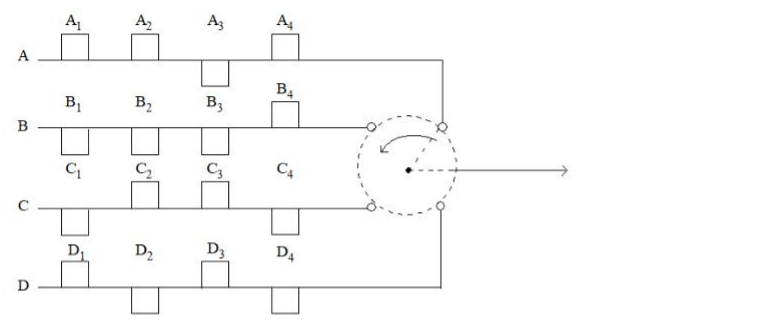
A. A1B1C1D1 (All channels have same bit rate)
B. A1A2B1B2C1D1C2D2 (All channels have same bit rate)
C. A1B1A2C1A3D1 (channel A bit rate is 3 times more than that of channels B, C, D)
D. A1B1C1A2D1 (channel A bit rate is 3-times more than that of channels B, C, D)
E. A1B1A2C1A3D1 (All channel have same bit rate)
Choose the correct answer from the options given below :
Assertion (A) : Signal multiplexing provides medium that allows large number of independent sources to share same physical channel.
Reason (R) : It is an aggregate information sent through time division multiplexing.
The sample and hold devices are used to perform :
- A multiplexer combines four 100-Kbps channels using a time slot of 2 bits. What is the bit rate ?
- The main advantage of TDM over FDM is that it
TDM stands for Time Division Multiplexing
FDM stands for Frequency Division Multiplexing


