
TDM stands for Time Division Multiplexing
FDM stands for Frequency Division Multiplexing
TDM vs FDM: Understanding the Key Advantage
The question asks for the primary benefit of Time Division Multiplexing (TDM) compared to Frequency Division Multiplexing (FDM).
Multiplexing Concepts
- TDM (Time Division Multiplexing): This technique divides access to a communication channel based on time. Each user or signal is allocated a specific, recurring time slot to transmit data. The entire channel bandwidth is available to the user during their assigned slot.
- FDM (Frequency Division Multiplexing): This method assigns a unique frequency band to each user or signal. Multiple signals can transmit simultaneously, but each occupies a different part of the frequency spectrum. Guard bands are needed between channels to prevent interference.
Signal-to-Noise Ratio (S/N Ratio) Advantage
The main advantage of TDM over FDM lies in its potential for a better signal-to-noise ratio (S/N ratio).
- In TDM, because a single signal utilizes the full channel bandwidth during its allocated time slot, it can potentially achieve a higher S/N ratio. The separation is in time, minimizing frequency-based crosstalk.
- In FDM, signals are always transmitting simultaneously in adjacent frequency bands. Imperfect filtering or signal degradation can lead to crosstalk (interference) between adjacent channels, which degrades the overall S/N ratio for those channels.
Therefore, TDM offers a better signal/noise ratio compared to FDM when implemented effectively.
Important Questions from Time Division Multiplexing (TDM)
Time division multiplexing of digital signal ( Where Ai, Bi, Ci, Di represents respective bits of different channels, i = 1 to 4) given in the figure:
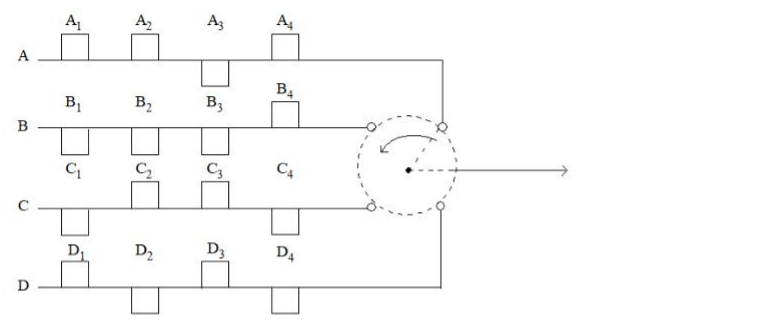
A. A1B1C1D1 (All channels have same bit rate)
B. A1A2B1B2C1D1C2D2 (All channels have same bit rate)
C. A1B1A2C1A3D1 (channel A bit rate is 3 times more than that of channels B, C, D)
D. A1B1C1A2D1 (channel A bit rate is 3-times more than that of channels B, C, D)
E. A1B1A2C1A3D1 (All channel have same bit rate)
Choose the correct answer from the options given below :
Assertion (A) : Signal multiplexing provides medium that allows large number of independent sources to share same physical channel.
Reason (R) : It is an aggregate information sent through time division multiplexing.
The sample and hold devices are used to perform :
A voice signal band limited to 3.4 kHz is sampled at 8 kHz and pulse code modulated using 64 quantization levels. Ten such signals are time division multiplexed using on 5-bit synchronising word. The minimum channel band width will be
- A multiplexer combines four 100-Kbps channels using a time slot of 2 bits. What is the bit rate ?


