
Multiplexer Bit Rate Calculation
A multiplexer combines multiple input data streams into a single, higher-speed output stream. To find the total bit rate, we sum the bit rates of all input channels.
Calculating Total Bit Rate
The total bit rate of the multiplexer's output is determined by the number of input channels and the bit rate of each channel.
- Number of input channels: 4
- Bit rate per channel: 100 Kbps
The time slot size (2 bits) is part of the multiplexing scheme but does not directly alter the calculation of the total output bit rate, which is the sum of the input rates.
The formula is:
$ \text{Total Bit Rate} = (\text{Number of Channels}) \times (\text{Bit Rate per Channel}) $
Plugging in the values:
$ \text{Total Bit Rate} = 4 \times 100 \text{ Kbps} $
$ \text{Total Bit Rate} = 400 \text{ Kbps} $
Therefore, the bit rate of the combined output channel is 400 Kbps.
Important Questions from Time Division Multiplexing (TDM)
Time division multiplexing of digital signal ( Where Ai, Bi, Ci, Di represents respective bits of different channels, i = 1 to 4) given in the figure:
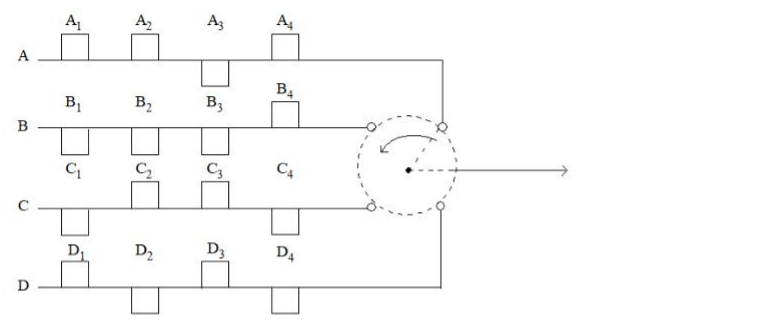
A. A1B1C1D1 (All channels have same bit rate)
B. A1A2B1B2C1D1C2D2 (All channels have same bit rate)
C. A1B1A2C1A3D1 (channel A bit rate is 3 times more than that of channels B, C, D)
D. A1B1C1A2D1 (channel A bit rate is 3-times more than that of channels B, C, D)
E. A1B1A2C1A3D1 (All channel have same bit rate)
Choose the correct answer from the options given below :
Assertion (A) : Signal multiplexing provides medium that allows large number of independent sources to share same physical channel.
Reason (R) : It is an aggregate information sent through time division multiplexing.
The sample and hold devices are used to perform :
A voice signal band limited to 3.4 kHz is sampled at 8 kHz and pulse code modulated using 64 quantization levels. Ten such signals are time division multiplexed using on 5-bit synchronising word. The minimum channel band width will be
- The main advantage of TDM over FDM is that it
TDM stands for Time Division Multiplexing
FDM stands for Frequency Division Multiplexing


