
A set (X) of 20 pipes can fill 70% of a tank in 14 minutes. Another set (Y) of 10 pipes fills 3/8 of the tank in 6 minutes. A third set (Z) of 16 pipes can empty half of the tank in 20 minutes. If half of the pipes of set X are closed and only half of the pipes of set Y are open, then how long will it take to fill 50% of the tank, if all pipes of set Z are open?
16 minutes
Solving the Pipe and Tank Problem
This problem involves calculating the combined work rate of different sets of pipes filling and emptying a tank. To find the time required to fill a certain portion of the tank under new conditions, we first need to determine the individual rate of each pipe type and then the combined rate of the pipes operating together in the specified scenario.
Calculating Individual Pipe Rates
Let's calculate the rate at which one pipe from each set fills or empties the tank per minute.
- Set X Pipes: 20 pipes fill 70% (0.7) of the tank in 14 minutes.
The work done by 20 pipes in 14 minutes is 0.7 tank.
The work done by 1 pipe in 14 minutes is $\frac{0.7}{20}$ tank.
The rate of 1 pipe from set X per minute is $\frac{0.7}{20 \times 14} = \frac{0.7}{280} = \frac{7}{2800} = \frac{1}{400}$ tank per minute. - Set Y Pipes: 10 pipes fill $\frac{3}{8}$ of the tank in 6 minutes.
The work done by 10 pipes in 6 minutes is $\frac{3}{8}$ tank.
The work done by 1 pipe in 6 minutes is $\frac{3/8}{10}$ tank.
The rate of 1 pipe from set Y per minute is $\frac{3/8}{10 \times 6} = \frac{3/8}{60} = \frac{3}{8 \times 60} = \frac{3}{480} = \frac{1}{160}$ tank per minute. - Set Z Pipes: 16 pipes empty half (0.5) of the tank in 20 minutes.
The work done by 16 pipes in 20 minutes is emptying 0.5 tank. This means the rate is negative.
The work done by 1 pipe in 20 minutes is emptying $\frac{0.5}{16}$ tank.
The rate of 1 pipe from set Z per minute is $-\frac{0.5}{16 \times 20} = -\frac{0.5}{320} = -\frac{5}{3200} = -\frac{1}{640}$ tank per minute.
Calculating Combined Rate in the New Scenario
In the new scenario, we have:
- Half of the pipes of set X: $\frac{20}{2} = 10$ pipes.
- Half of the pipes of set Y: $\frac{10}{2} = 5$ pipes.
- All pipes of set Z: 16 pipes (these are emptying pipes).
The total rate of the pipes filling the tank is the sum of the rates of the active pipes from set X and set Y, minus the rate of the pipes from set Z (since they are emptying).
Combined filling rate = (Rate of 10 pipes from X) + (Rate of 5 pipes from Y) - (Rate of 16 pipes from Z)
- Rate of 10 pipes from X = $10 \times \frac{1}{400} = \frac{10}{400} = \frac{1}{40}$ tank per minute.
- Rate of 5 pipes from Y = $5 \times \frac{1}{160} = \frac{5}{160} = \frac{1}{32}$ tank per minute.
- Rate of 16 pipes from Z = $16 \times \left(-\frac{1}{640}\right) = -\frac{16}{640} = -\frac{1}{40}$ tank per minute.
Net combined rate = $\frac{1}{40} + \frac{1}{32} - \frac{1}{40}$ tank per minute.
Net combined rate = $\frac{1}{32}$ tank per minute.
Calculating Time to Fill 50% of the Tank
We need to find the time it takes to fill 50% (0.5) of the tank at a net rate of $\frac{1}{32}$ tank per minute.
Time = $\frac{\text{Amount to fill}}{\text{Net combined rate}}$
Time = $\frac{0.5 \text{ tank}}{\frac{1}{32} \text{ tank/minute}} = 0.5 \times 32 \text{ minutes}$
Time = $\frac{1}{2} \times 32 \text{ minutes} = 16 \text{ minutes}$.
Therefore, it will take 16 minutes to fill 50% of the tank under the given conditions.
| Set | Total Pipes | Work Done | Time Taken | Rate per pipe per min | Pipes in New Scenario | Total Rate in New Scenario |
|---|---|---|---|---|---|---|
| X (Filling) | 20 | 70% (0.7) | 14 min | $\frac{1}{400}$ | 10 | $10 \times \frac{1}{400} = \frac{1}{40}$ |
| Y (Filling) | 10 | 3/8 | 6 min | $\frac{1}{160}$ | 5 | $5 \times \frac{1}{160} = \frac{1}{32}$ |
| Z (Emptying) | 16 | 50% (0.5) | 20 min | $-\frac{1}{640}$ | 16 | $16 \times \left(-\frac{1}{640}\right) = -\frac{1}{40}$ |
Net Rate = $\frac{1}{40} + \frac{1}{32} - \frac{1}{40} = \frac{1}{32}$ tank/minute.
Time to fill 50% (0.5 tank) = $\frac{0.5}{1/32} = 0.5 \times 32 = 16$ minutes.
Revision Table: Key Concepts for Pipe and Cistern Problems
| Concept | Explanation | Formula/Idea |
|---|---|---|
| Work Rate | The amount of work (filling or emptying a portion of the tank) done per unit of time by a single pipe or a group of pipes. | Rate = $\frac{\text{Amount of Work}}{\text{Time Taken}}$ |
| Filling Pipe Rate | Positive rate as it adds water to the tank. | Rate is usually represented as a positive value. |
| Emptying Pipe Rate | Negative rate as it removes water from the tank. | Rate is usually represented as a negative value. |
| Combined Rate | The net rate when multiple pipes (filling and emptying) work together. Sum of individual rates (filling rates are added, emptying rates are subtracted). | Net Rate = Sum of Filling Rates - Sum of Emptying Rates |
| Time Taken | The total time required to complete a certain amount of work at a given rate. | Time = $\frac{\text{Total Work}}{\text{Net Rate}}$ |
Additional Information: Understanding Pipe Work Problems
Pipe and cistern problems are a common type of time and work problem. The core idea is to treat the tank as a unit of work (1 tank) and pipes as workers. The rate of a pipe is the fraction of the tank it can fill or empty in one unit of time (usually a minute or hour).
When pipes work together, their rates are combined. Filling rates add up, and emptying rates subtract from the total filling rate. If the net combined rate is positive, the tank will fill. If it's negative, the tank will empty (assuming it had some water initially). If the net rate is zero, the water level remains constant.
It is often helpful to calculate the work done per minute or hour by a single pipe, as this standardizes the calculation across different sets of pipes.
Remember that if a pipe fills a fraction of the tank in a certain time, its rate is that fraction divided by the time. For example, filling 3/8 of a tank in 6 minutes means the rate is (3/8) / 6 per minute.
Similar Questions
Which one of the following statements best reflects the most logical and rational message conveyed by the author of the passage?
With reference to the above passage, the following assumptions have been made:
I. There is no need for the State to be involved in any manner in the handloom sector.
II. Handloom products are no longer appealing and attractive in the rapidly changing modern world.
Which of the above assumptions is/are valid?Which one of the following statements best reflects the central idea conveyed by the passage?
Which one of the following statements best reflects the central idea conveyed by the passage?
Which one of the following statements best reflects the critical message conveyed by the author of the passage?
With reference to the above passage, the following assumptions have been made:
I. Path-dependent green investments will eventually most likely benefit growth as well as public finances in a country like India.
II. If other green technologies follow the same pattern as that of solar energy, there will most likely be an easy green transition.
Which of the above assumptions is/are valid?A natural number N is such that it can be expressed as N = p + q + r, where p, q and r are distinct factors of N. How many numbers below 50 have this property?
Team X scored a total of N runs in 20 overs. Team Y tied the score in 10% less overs. Had Team Y’s average run rate (runs per over) been 50% higher, the scores would have been tied in 12 overs. How many runs were scored by Team X?
Consider the following statements:
I. If A ≤ B > C < D > E > F ≥ G = H; then B is always greater than E.
II. If P > Q = R ≥ S = T ≤ U = V > W; then S is always less than V.
Which of the statements given above is/are correct?Consider the first 100 natural numbers. How many of them are not divisible by any one of 2, 3, 5, 7 and 9?
Important Questions from Miscellaneous Topics
- In communication the word 'Haptics' signifies :
- Which of the following statements best defines the scope of semiotics?
The compound interest on Rs. 75,000 for three years, at successive interest rates of 4%, 6% and 9% for each year respectively is:
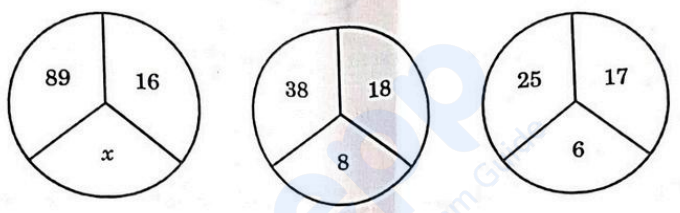
The value of x in the following figures is :
When a child reaches adolescence, there is apt to be a conflict between the parents and the child, since
the latter considers himself to be by now quite capable of managing his own affairs, while the former
are filled with parental solicitude, which is often a disguise for love of power. Parents consider, usually,
that the various moral problems which arise in adolescence are peculiarly their province. The options
they express, however, are so dogmatic that the young seldom confide in them, and usually go their
own way in secret.



