
When a child reaches adolescence, there is apt to be a conflict between the parents and the child, since
the latter considers himself to be by now quite capable of managing his own affairs, while the former
are filled with parental solicitude, which is often a disguise for love of power. Parents consider, usually,
that the various moral problems which arise in adolescence are peculiarly their province. The options
they express, however, are so dogmatic that the young seldom confide in them, and usually go their
own way in secret.
the latter considers himself to be by now quite capable of managing his own affairs, while the former
are filled with parental solicitude, which is often a disguise for love of power. Parents consider, usually,
that the various moral problems which arise in adolescence are peculiarly their province. The options
they express, however, are so dogmatic that the young seldom confide in them, and usually go their
own way in secret.
Based on the above passage, the following assumptions have been made :
1. The adolescent does not feel comfortable with his parents because they tend to be
dominating and assertive.
2. The adolescent of modern times does not have much respect for parents.
Which of the assumptions given above is/are valid?
1 only
Only assumption 1 is valid. The passage links parental desire for control and dogmatic views with adolescents' reluctance to confide in their parents. This supports discomfort caused by dominating behaviour. It neither singles out modern adolescents nor establishes that they lack respect for their parents, so assumption 2 is unsupported.
Parents in general may not be of much help when children are on their way to becoming
adults.
Understanding the Central Idea of the Passage
The passage describes the relationship between parents and a child when the child reaches adolescence. It highlights the conflict that often arises during this stage.
Analyzing the Passage Details
- Adolescence is a time when the child feels capable of managing their own affairs.
- Parents feel parental solicitude, which the passage suggests can be a disguise for a desire for power or control.
- Parents often see moral problems during adolescence as their specific area to address.
- However, the opinions parents express are described as "dogmatic," meaning strongly held and often inflexible or authoritarian.
- Due to this dogmatic approach, young people seldom confide in their parents.
- Consequently, adolescents often choose to handle their affairs and problems secretly, "going their own way in secret."
The core issue presented is that the parents' approach (solicitude masking power, dogmatic views) prevents open communication and trust, leading the adolescent to act independently and secretly rather than seeking parental guidance or help.
Evaluating the Options
Let's look at how well each option reflects this central idea:
-
When children reach adolescence, involvement of parents in their lives is unnecessary.
The passage does not state that parental involvement is unnecessary. It describes a *type* of involvement (dogmatic, power-driven) that causes conflict and lack of confiding. It implies that the *manner* of involvement is the problem, not involvement itself being unneeded.
-
In modern societies, adolescents tend to be stubborn, disobedient.
The passage does not specify "modern societies" or focus solely on adolescents being stubborn or disobedient. It describes the *dynamic* between parents and adolescents, where the adolescents' secret actions are a reaction to the parents' dogmatic approach, not simply inherent stubbornness.
-
Parents in general may not be of much help when children are on their way to becoming adults.
This option aligns well with the passage. The passage explains *why* parents might not be helpful: their dogmatic views discourage confiding, leading adolescents to go their own way secretly. This secretiveness means parents are effectively cut out of the adolescent's decision-making process, thus not being "of much help" in guiding them as they transition into adulthood ("becoming adults").
-
Modern-day nuclear families are not capable of bringing up children properly.
The passage does not mention "modern-day nuclear families" or make a broad judgment about their capability. It focuses on a specific dynamic during adolescence that can occur regardless of family structure or era.
Identifying the Best Fit
Based on the analysis, the passage primarily explains that the way parents often interact with adolescents (dogmatic views, lack of open communication, disguised power) makes them ineffective guides, leading the adolescents to handle their issues secretly. Option 3, stating that "Parents in general may not be of much help when children are on their way to becoming adults," best captures this central theme by highlighting the outcome of this ineffective interaction described in the passage.
Revision Table: Key Concepts
| Concept | Description in Passage | Impact on Relationship |
|---|---|---|
| Adolescence | Child considers self capable | Source of conflict with parents |
| Parental Solicitude | Often a disguise for love of power | Leads to controlling behaviour |
| Dogmatic Parental Views | Inflexible opinions on moral problems | Adolescents avoid confiding |
| Adolescent Secrecy | Going their own way in secret | Parents become ineffective guides/help |
Additional Information: Parent-Child Dynamics in Adolescence
Adolescence is a critical period for development and identity formation. The desire for independence is natural. Conflict with parents often arises as adolescents seek more autonomy and parents try to maintain guidance and control. The passage highlights how the *nature* of parental guidance—particularly if perceived as dogmatic or controlling—can push adolescents away, reducing parental influence when it might still be needed. Effective communication, mutual respect, and a willingness from parents to adapt their approach as the child matures are often key to navigating this stage successfully and remaining a source of support rather than conflict.
Important Questions from Miscellaneous Topics
- In communication the word 'Haptics' signifies :
- Which of the following statements best defines the scope of semiotics?
The compound interest on Rs. 75,000 for three years, at successive interest rates of 4%, 6% and 9% for each year respectively is:
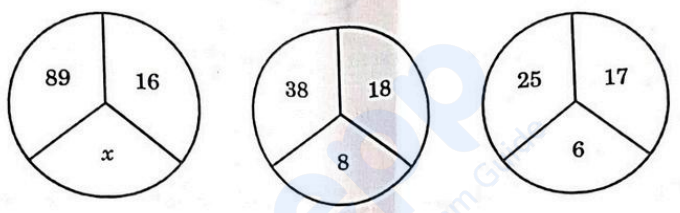
The value of x in the following figures is :
When an international team of pumped a carbon dioxide and water mix into underground basalt rocks,
basic chemistry took over. The acidic mixture dissolved rocks' calcium and magnesium and formed
limestone Basically carbon dioxide is converted into stone, exclaimed the scientists.


