
The correct answer is 4. Tactile communication.
In the field of communication, "haptics" refers to the sense of touch and the communication that occurs through physical touch. It encompasses various forms of nonverbal communication, such as handshakes, hugs, pats on the back, and other forms of physical contact used to convey emotions, messages, or meanings.
- Why option 4 is correct: Haptics directly relates to tactile communication, which involves the sense of touch. This is the core definition of the term.
- Why other options are incorrect:
- Option 1 (Staggered communication): This refers to communication that happens at intervals or in a delayed manner, not related to touch.
- Option 2 (Spatial communication): This involves communication related to physical space and distance, like proxemics.
- Option 3 (Temporal communication): This relates to communication across time, such as scheduling or delayed responses.
Important Questions from Miscellaneous Topics
- Which of the following statements best defines the scope of semiotics?
The compound interest on Rs. 75,000 for three years, at successive interest rates of 4%, 6% and 9% for each year respectively is:
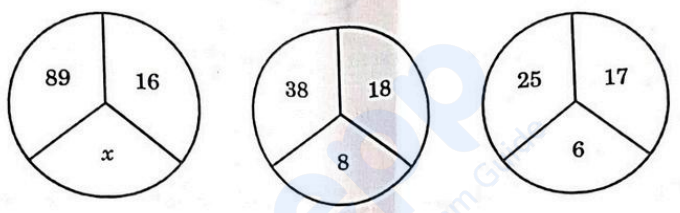
The value of x in the following figures is :
When a child reaches adolescence, there is apt to be a conflict between the parents and the child, since
the latter considers himself to be by now quite capable of managing his own affairs, while the former
are filled with parental solicitude, which is often a disguise for love of power. Parents consider, usually,
that the various moral problems which arise in adolescence are peculiarly their province. The options
they express, however, are so dogmatic that the young seldom confide in them, and usually go their
own way in secret.When an international team of pumped a carbon dioxide and water mix into underground basalt rocks,
basic chemistry took over. The acidic mixture dissolved rocks' calcium and magnesium and formed
limestone Basically carbon dioxide is converted into stone, exclaimed the scientists.


