
Read the following passage and answer the items that follow the passage. Your answers to these items should be based on the passage only. Passage-2 In our country, handlooms are equated with a culture that ensures a continuity of tradition. This idea has become part of the public policy-framing and provides a legitimate basis for the State to support the sector. But the notion of tradition as a single, linear entity is being strongly contested today. The narratives dominant in defining culture/tradition in a particular way are seen to have emerged as the identities and histories of large sections. The discounted and, at times, forcibly stifled identities are fighting for their rightful place in history. Against this backdrop, when we promote handloom as a traditional industry, it is not surprising that large sections of our population choose to ignore it.
Which one of the following statements best reflects the most logical and rational message conveyed by the author of the passage?
We need to free the handloom industry from the limited narrative linked to preserving cultural heritage.
Understanding the Handloom Passage and its Core Message
The passage discusses the handloom industry in India, focusing on how it is linked to 'tradition' and 'culture'. This link is used as a basis for state support. However, the author points out that the idea of tradition is not simple or unified; it is contested. The dominant narrative of tradition often excludes or suppresses other identities and histories.
Because the handloom industry is promoted based on this potentially exclusive and contested idea of tradition, the author observes that it is understandable why large sections of the population might ignore it.
Analyzing the Question: Identifying the Author's Main Point
The question asks for the most logical and rational message conveyed by the author. This means we need to find the option that best captures the author's central argument or conclusion based *only* on the text provided.
Evaluation of Options based on the Passage
- Option 1: We need to free the handloom industry from the limited narrative linked to preserving cultural heritage.
- The passage states that handlooms are "equated with a culture that ensures a continuity of tradition."
- It notes that this idea "has become part of the public policy-framing and provides a legitimate basis for the State to support the sector."
- However, the author immediately follows this by saying the "notion of tradition as a single, linear entity is being strongly contested today."
- The author highlights that the "dominant narratives" of culture/tradition often ignore or suppress other identities and histories.
- The consequence is that "large sections of our population choose to ignore" handlooms when promoted as a traditional industry based on this contested idea.
- Therefore, the author strongly implies that the problem lies in this specific, limited, and contested narrative of tradition/cultural heritage used to frame handlooms. Freeing the industry from this limiting narrative aligns perfectly with the author's critique and observation about public perception.
- Option 2: Continued State support to the handloom industry ensures the preservation of some of our glorious art forms and old traditions.
- The passage mentions State support based on the tradition idea, but it does not state that this support *ensures* the preservation of glorious art forms or traditions.
- Instead, the passage critiques the *basis* of this support (the contested notion of tradition) and its negative impact on public acceptance by large sections.
- This option reflects the common justification *for* State support but does not represent the author's critical message about the *problem* with the current framing.
- Option 3: Household units of the handloom sector should be modernized and made an economically viable organized industry.
- The passage focuses entirely on the cultural and traditional framing of the handloom industry and its effect on public perception and state policy.
- It does not discuss the economic structure, modernization, or organization of the industry (household units vs. organized).
- This option introduces ideas not present in the passage.
- Option 4: Handloom products need to be converted to machine-made designer products so as to make them more popular.
- The passage discusses the *perception* and *framing* of handlooms as traditional, not the nature of the products themselves or how they should be manufactured (hand vs. machine).
- Converting handloom products to machine-made ones goes against the very definition of 'handloom'.
- This option is completely outside the scope of the passage's discussion.
Conclusion
Based on the detailed analysis, Option 1 is the only statement that accurately reflects the author's logical and rational message. The author critiques the limited and contested narrative of tradition used to promote handlooms, arguing that this framing alienates sections of the population. The implied solution or message is to move beyond this problematic framing.
| Option | Alignment with Passage | Justification |
|---|---|---|
| 1. Free handloom from limited cultural narrative | Strong Alignment | Matches the author's critique of the contested 'tradition' idea and its negative impact on acceptance. |
| 2. State support ensures preservation | Weak Alignment | Mentions state support but ignores the author's critique of its underlying basis and consequences. |
| 3. Modernize and organize industry | No Alignment | Discusses economic/structural aspects not mentioned in the passage. |
| 4. Convert to machine-made products | No Alignment | Discusses product manufacturing, which is outside the passage's scope. |
Revision Table: Key Points from the Passage Analysis
| Concept | Author's View/Commentary |
|---|---|
| Handlooms & Tradition | Equated with a culture/tradition for policy basis. |
| Notion of Tradition | Contested, not a single, linear entity. |
| Dominant Narratives | Define culture/tradition in a specific way, often stifling other identities. |
| Promoting Handlooms as 'Traditional' | Leads large sections to ignore it due to the contested narrative basis. |
| Implicit Message | The current framing based on a limited, contested tradition is detrimental. |
Additional Information: Contested Narratives and Identity
The passage touches upon important concepts related to identity and historical narratives. When a particular version of history or tradition becomes dominant, it can marginalize or exclude the experiences and identities of other groups. This can lead to a feeling of non-representation or even rejection of things associated with that dominant narrative, such as the handloom industry in this context. Recognizing and addressing these contested narratives is crucial for inclusive public policy and cultural promotion.
The State's role in supporting industries like handlooms is often justified on cultural or traditional grounds. However, the passage suggests that the *way* tradition is defined and promoted is critical and can have unintended negative consequences on public acceptance if it is based on exclusive or contested historical narratives.
Similar Questions
With reference to the above passage, the following assumptions have been made:
I. There is no need for the State to be involved in any manner in the handloom sector.
II. Handloom products are no longer appealing and attractive in the rapidly changing modern world.
Which of the above assumptions is/are valid?Which one of the following statements best reflects the central idea conveyed by the passage?
Which one of the following statements best reflects the central idea conveyed by the passage?
Which one of the following statements best reflects the critical message conveyed by the author of the passage?
With reference to the above passage, the following assumptions have been made:
I. Path-dependent green investments will eventually most likely benefit growth as well as public finances in a country like India.
II. If other green technologies follow the same pattern as that of solar energy, there will most likely be an easy green transition.
Which of the above assumptions is/are valid?A natural number N is such that it can be expressed as N = p + q + r, where p, q and r are distinct factors of N. How many numbers below 50 have this property?
Team X scored a total of N runs in 20 overs. Team Y tied the score in 10% less overs. Had Team Y’s average run rate (runs per over) been 50% higher, the scores would have been tied in 12 overs. How many runs were scored by Team X?
Consider the following statements:
I. If A ≤ B > C < D > E > F ≥ G = H; then B is always greater than E.
II. If P > Q = R ≥ S = T ≤ U = V > W; then S is always less than V.
Which of the statements given above is/are correct?Consider the first 100 natural numbers. How many of them are not divisible by any one of 2, 3, 5, 7 and 9?
If 4 ≤ x ≤ 8 and 2 ≤ y ≤ 7, then what is the ratio of maximum value of (x + y) to minimum value of (x − y)?
Important Questions from Miscellaneous Topics
- In communication the word 'Haptics' signifies :
- Which of the following statements best defines the scope of semiotics?
The compound interest on Rs. 75,000 for three years, at successive interest rates of 4%, 6% and 9% for each year respectively is:
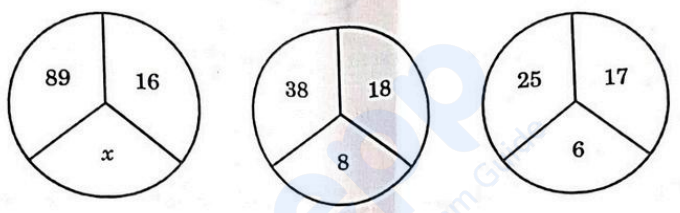
The value of x in the following figures is :
When a child reaches adolescence, there is apt to be a conflict between the parents and the child, since
the latter considers himself to be by now quite capable of managing his own affairs, while the former
are filled with parental solicitude, which is often a disguise for love of power. Parents consider, usually,
that the various moral problems which arise in adolescence are peculiarly their province. The options
they express, however, are so dogmatic that the young seldom confide in them, and usually go their
own way in secret.



