
Understanding Cost Variation
The problem states that the cost (C) of gold varies directly as the cube of its weight (w). This relationship is mathematically represented as:
$C = k \cdot w^3$
where k is the constant of proportionality.
Calculating the Proportionality Constant (k)
We are given that a gold piece weighing w = 20 decigrams costs C = ₹1,000. Substitute these values to find k:
$1000 = k \cdot (20)^3$
$1000 = k \cdot 8000$
Solving for k yields:
$k = \frac{1000}{8000} = \frac{1}{8}$
Determining the Weights of the Broken Pieces
The original gold piece, weighing 20 decigrams, is broken into two pieces whose weights are in the ratio 2:3.
Let the weights be $2x$ and $3x$. The total weight is:
$2x + 3x = 20 \implies 5x = 20$
Solving for x:
$x = \frac{20}{5} = 4$
Therefore, the weights of the two pieces are:
Weight 1 ($w_1$) = $2 \times 4 = 8$ decigrams
Weight 2 ($w_2$) = $3 \times 4 = 12$ decigrams
Calculating the Total Value of the Broken Pieces
Using the determined constant $k = \frac{1}{8}$ and the formula $C = \frac{1}{8} w^3$:
Value of the first piece ($C_1$) = $\frac{1}{8} \cdot (8)^3 = \frac{1}{8} \cdot 512 = 64$
Value of the second piece ($C_2$) = $\frac{1}{8} \cdot (12)^3 = \frac{1}{8} \cdot 1728 = 216$
The total value of the gold after breaking is the sum of these individual values:
Total Value = $C_1 + C_2 = 64 + 216 = 280$.
Final Profit Determination
The calculated total value of the two broken pieces is ₹280. As per the provided answer, this represents the profit incurred.
Important Questions from Miscellaneous Topics
- The average age of the boys in a class is 12 years. The average age of the girls in the class is 11 years. There are 50% more girls than boys in the class. Which one of the following is the average age of the class (in years)?
Consider the following figures :
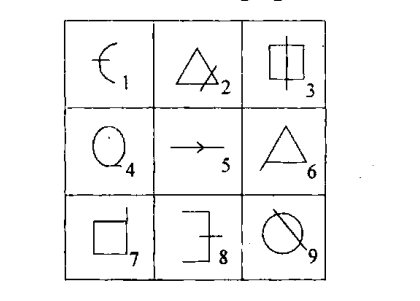
Which of the following group(s) of figures fit/fits into the same class?
1. (1,7,8)
2. (4, 5, 6)
3. (2, 3, 9)
Select the correct answer using the code given below :- What is clickjacking ?
- The National Council of Science Museums (NCSM), which is developing Science Centres/Museums/Innovation Hubs in India, works under
- Which one among the following cities was included as the 'City of Music' in the year 2023 in the UNESCO's Creative Cities Network?


