
Give an illustrated account of reproduction in sponges.
Sponges (Phylum Porifera) display remarkable versatility in their reproductive strategies, employing both asexual and sexual methods.
Asexual Reproduction:
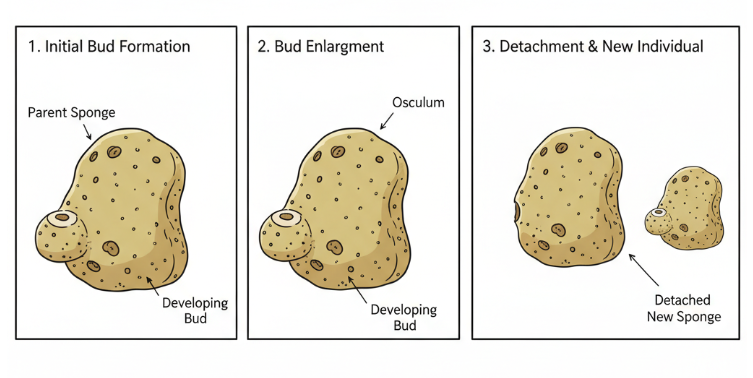
- Budding: Sponges can produce small outgrowths or buds on their body surface. These buds detach and grow into new, independent sponges genetically identical to the parent.
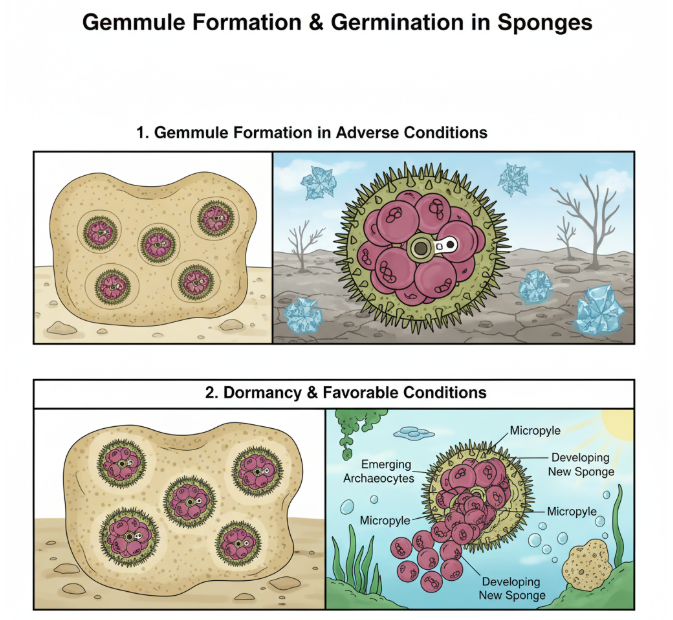
2. Gemmule Formation: This is a specialized form of asexual reproduction, particularly common in freshwater sponges and some marine species, acting as a survival strategy during harsh conditions (e.g., drought, cold). Gemmules are internal buds, resistant capsules containing archaeocytes (totipotent cells) protected by a thick, spicule-reinforced coat. When conditions improve, the archaeocytes emerge through an opening called the micropyle and develop into a new sponge.
Sexual Reproduction:
Most sponges are hermaphroditic, meaning they possess both male and female reproductive cells, though they often exhibit sequential hermaphroditism (producing eggs and sperm at different times to prevent self-fertilization).
- Gamete Formation: Sperm are formed from choanocytes (collar cells), while eggs develop from archaeocytes.
- Fertilization: Sperm are released into the water column and carried by currents. When sperm enters another sponge through its aquiferous system, it is captured by choanocytes, which then transform into carrier cells. These carrier cells transport the sperm to the eggs, where internal fertilization occurs.
- Larval Development: The zygote develops into a free-swimming larva within the parent sponge. Common larval forms include:
- Amphiblastula larva:
- Parenchymula larva:
- Settlement and Metamorphosis: The larva eventually leaves the parent, swims for a period, settles on a suitable substratum, and undergoes metamorphosis to develop into a new adult sponge. This larval stage is crucial for dispersal, allowing sponges to colonize new areas.
Answered By:
Harsh Raj
Harsh Raj is a successful government exam expert, having cleared multiple stages of SSC CGL, IBPS PO, CDS, RRB NTPC, and Delhi Police SI exams himself and mentored more than 5000 students through direct mentorship. His expertise is in creating well researched content, especially MCQs, which have been directly asked by relevant commissions in multiple exams.

Similar Questions
Write short notes in 150 words:
MetagenesisWrite short notes in 150 words:
Book lungsWrite short notes in 150 words:
PaedomorphosisWrite short notes in 150 words:
Torsion and detorsion in gastropodsWrite short notes in 150 words:
Draw a well-labelled diagram of human eye and write its functions.Describe the comparative anatomy of digestive system in vertebrates.
Describe the general features, distribution and social organization in termites.
Describe the mechanism of parental care in amphibians with suitable examples.
Describe the different stages of life cycle of Pheretima with the help of suitable diagrams.
Discuss the various modes of nutrition in protozoa.
Important Questions from Miscellaneous
How will you manage a case of misplaced copper-T (Cu-T)?
Describe the embryogenesis, clinical features and principles of management of cleft palate.
Write short notes in 150 words:
MetagenesisWrite short notes in 150 words:
Book lungsWrite short notes in 150 words:
Paedomorphosis



