
Describe the different stages of life cycle of Pheretima with the help of suitable diagrams.
The life cycle of Pheretima, commonly known as the earthworm, is quite fascinating, especially considering it’s a hermaphrodite, meaning each individual possesses both male and female reproductive organs. However, self-fertilization is usually avoided, and cross-fertilization is the norm.
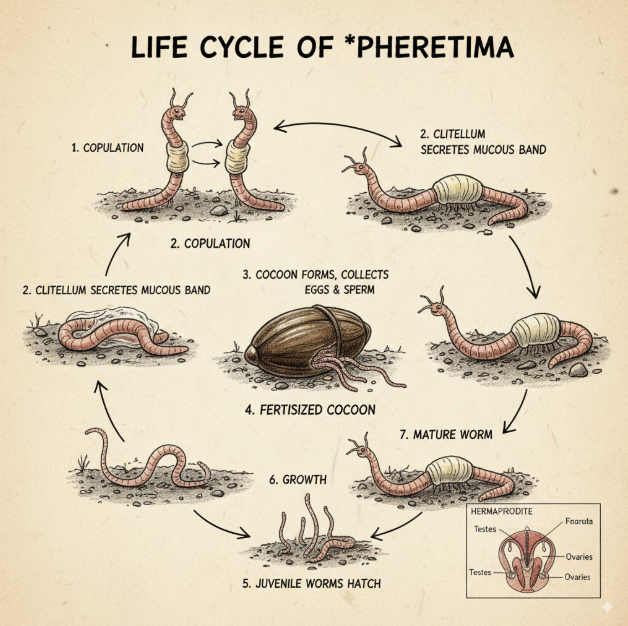
The process begins with copulation, where two earthworms align themselves in opposite directions, ventral surfaces together. They exchange sperm, which is stored in the spermathecae of each worm. Following this, the clitellum, a thickened glandular segment on the earthworm's body, becomes highly active. It secretes a mucoid band that hardens into a tough, protective structure known as a cocoon.
As the cocoon slides forward over the worm's body, it collects the worm's own eggs (from the ovaries) and the stored sperm from its partner. Fertilization thus occurs within the cocoon. Once the cocoon slips off the anterior end of the worm, its ends seal, forming a protective capsule. Inside this cocoon, the embryos develop, feeding on albumin secreted by the clitellum.
After a period of incubation, typically a few weeks to months depending on environmental conditions, several juvenile worms hatch from the cocoon. These young worms are miniature versions of the adults, lacking a clitellum initially. They grow and mature, eventually developing their own clitellum and reaching reproductive age, thus completing the cycle. The entire process is a remarkable adaptation for terrestrial life, ensuring the survival and propagation of these vital soil dwellers.
Here's a simplified diagram of the Pheretima life cycle:
Answered By:
Similar Questions
Write short notes in 150 words:
MetagenesisWrite short notes in 150 words:
Book lungsWrite short notes in 150 words:
PaedomorphosisWrite short notes in 150 words:
Torsion and detorsion in gastropodsWrite short notes in 150 words:
Draw a well-labelled diagram of human eye and write its functions.Describe the comparative anatomy of digestive system in vertebrates.
Give an illustrated account of reproduction in sponges.
Describe the general features, distribution and social organization in termites.
Describe the mechanism of parental care in amphibians with suitable examples.
Discuss the various modes of nutrition in protozoa.
Important Questions from Miscellaneous
How will you manage a case of misplaced copper-T (Cu-T)?
Describe the embryogenesis, clinical features and principles of management of cleft palate.
Write short notes in 150 words:
MetagenesisWrite short notes in 150 words:
Book lungsWrite short notes in 150 words:
Paedomorphosis



