
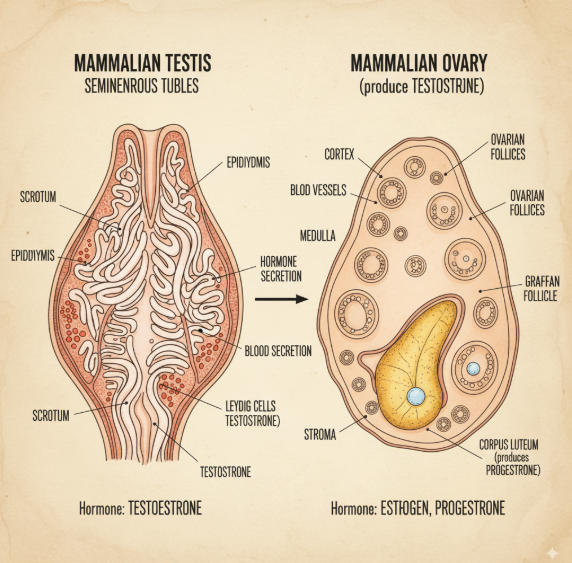
Draw a well-labelled diagram of testis and ovary in mammals, and discuss the functions of their hormones.
The gonads—testes in males and ovaries in females—are central to mammalian reproduction, performing the dual functions of gamete production and hormone secretion. These hormones are indispensable not only for reproductive activity but also for the development and maintenance of secondary sexual characteristics that distinguish the sexes.
Testis: The testes are paired, oval-shaped organs housed in the scrotum. Their two major functions are the production of sperm (spermatogenesis) and the secretion of male sex hormones. Internally, each testis contains numerous seminiferous tubules, the site of sperm formation. Scattered between these tubules are Leydig cells, which produce androgens, primarily testosterone.
- Spermatogenesis: Testosterone regulates the initiation and maintenance of sperm production.
- Secondary sexual traits: It promotes the growth of facial and body hair, deepening of the voice, increased muscle mass, and development of male genitalia during puberty.
- Sex drive (libido): Testosterone is essential in maintaining male sexual behavior.
- Bone and muscle growth: Its anabolic effects enhance bone density and muscle strength.
Ovary: The ovaries are small, almond-shaped organs located in the pelvic cavity. They are responsible for producing eggs (oogenesis) as well as female sex hormones. The outer cortex contains follicles at different stages of maturation, each surrounding an oocyte. After ovulation, the ruptured follicle develops into the corpus luteum, which secretes hormones.
- Estrogens (e.g., estradiol): Stimulate follicle maturation, promote female secondary sexual traits such as breast development, fat distribution, and widening of the hips, and induce proliferation of the uterine lining in preparation for implantation.
- Progesterone: Prepares and maintains the endometrium, prevents uterine contractions during pregnancy, and supports mammary gland development for lactation.
Both estrogen and progesterone exert negative feedback on the hypothalamus and pituitary to regulate gonadotropins (FSH, LH), maintaining reproductive balance.
Together, testes and ovaries coordinate reproduction, sexual development, and species continuity.
Answered By:
Similar Questions
Write short notes in 150 words:
MetagenesisWrite short notes in 150 words:
Book lungsWrite short notes in 150 words:
PaedomorphosisWrite short notes in 150 words:
Torsion and detorsion in gastropodsWrite short notes in 150 words:
Draw a well-labelled diagram of human eye and write its functions.Describe the comparative anatomy of digestive system in vertebrates.
Give an illustrated account of reproduction in sponges.
Describe the general features, distribution and social organization in termites.
Describe the mechanism of parental care in amphibians with suitable examples.
Describe the different stages of life cycle of Pheretima with the help of suitable diagrams.
Important Questions from Miscellaneous
How will you manage a case of misplaced copper-T (Cu-T)?
Describe the embryogenesis, clinical features and principles of management of cleft palate.
Write short notes in 150 words:
MetagenesisWrite short notes in 150 words:
Book lungsWrite short notes in 150 words:
Paedomorphosis



