
Read the following passage and answer the items that follow the passage. Your answers to these items should be based on the passage only. Passage-2 “A good statesman, like any other sensible human being, learns more from his opponents than from his fervent supporters. For his supporters will push him to disaster unless his opponents show him where the dangers are. So if he is wise he will often pray to be delivered from his friends, because they will ruin him. But, though it hurts, he ought also to pray never to be left without opponents; for they keep him on the path of reason and good sense. The national unity of free people depends upon a sufficiently even balance of political power to make it impracticable for the administration to be arbitrary and for opposition to be revolutionary and irreconcilable.”
Which one of the following statements best reflects the critical message conveyed by the author of the passage?
In a democracy, the opposition is indispensable for the balance of political power and good governance.
Analyzing the Passage on the Importance of Opposition in a Democracy
The passage discusses the crucial role of opponents, particularly in the context of a statesman or ruler. It argues that a wise statesman learns more from opponents than from fervent supporters. Supporters, the author suggests, might lead one to disaster unless checked by opponents who reveal potential dangers. The passage emphasizes that opponents keep the statesman "on the path of reason and good sense."
Furthermore, the passage connects this idea to the national unity of free people, stating it depends on a "sufficiently even balance of political power." This balance prevents the administration from becoming arbitrary and the opposition from becoming revolutionary or irreconcilable. Essentially, the presence of effective opposition ensures a necessary check on power and promotes sensible decision-making.
Evaluating the Options based on the Passage
Let's examine each option in light of the passage's message:
- Option 1: "Without opposition parties, the administration in a democracy gets to become more responsible." This contradicts the passage. The passage argues that opponents (opposition) help keep the statesman/administration responsible and on the path of reason, implying that *without* opposition, they are *less* likely to be responsible and could become arbitrary.
- Option 2: "Democracy needs to have revolutionaries in opposition to keep the government alert." The passage explicitly states that a balance of power makes it "impracticable... for opposition to be revolutionary and irreconcilable." This means the passage advocates *against* revolutionary opposition, not for it.
- Option 3: "Rulers in a democracy need the support of opposition for their political survival." The passage talks about learning from and being kept in check by opponents, not needing their *support* for survival. The relationship described is one of constructive criticism and checks and balances, not support.
- Option 4: "In a democracy, the opposition is indispensable for the balance of political power and good governance." This option aligns perfectly with the passage. The passage states that opponents keep the statesman "on the path of reason and good sense" (which is essential for good governance) and that national unity relies on a "balance of political power" which is maintained by the interaction between administration and opposition, preventing arbitrary rule and revolutionary opposition. The passage implies the opposition is indispensable by suggesting a statesman should pray never to be without opponents.
Conclusion: Identifying the Critical Message
Based on the analysis, the passage's core message is that a strong and effective opposition is not just beneficial, but necessary (indispensable) in a democracy. It serves to balance political power, prevent the government from becoming arbitrary, guide the administration towards reason and good sense, and ultimately contributes to good governance and national unity. Option 4 best encapsulates this critical message.
Revision Table: Key Concepts
| Concept | Passage's View | Why it matters for Democracy |
|---|---|---|
| Supporters | Can lead to disaster if unchecked | Blind support lacks critical feedback |
| Opponents (Opposition) | Show dangers, keep on path of reason & good sense | Provide checks & balances, ensure accountability |
| Balance of Power | Ensured by interaction of administration & opposition | Prevents arbitrary rule & revolutionary opposition, maintains unity |
| Good Governance | Achieved through learning from opponents & staying on path of reason | Requires diverse perspectives & accountability |
Additional Information: Role of Opposition in Governance
The concept highlighted in the passage is fundamental to the functioning of a healthy democracy. The opposition plays several vital roles:
- Accountability: The opposition scrutinizes the government's actions and policies, holding them accountable to the public.
- Alternative Perspectives: They offer different viewpoints and policy alternatives, enriching public debate and providing choices to citizens.
- Preventing Tyranny: By checking the power of the ruling party, the opposition helps prevent the concentration of power and potential for authoritarianism.
- Voice for Minorities: The opposition often represents the interests of groups or regions not aligned with the ruling party.
- Policy Improvement: Constructive criticism from the opposition can lead to the refinement and improvement of government policies.
An effective opposition is thus considered a cornerstone of good governance and a robust democratic system, ensuring that the government remains responsive, responsible, and reflective of the diverse needs and opinions of the populace. The passage strongly advocates for the indispensable nature of this opposition role.
Similar Questions
Which one of the following statements best reflects the most logical and rational message conveyed by the author of the passage?
With reference to the above passage, the following assumptions have been made:
I. There is no need for the State to be involved in any manner in the handloom sector.
II. Handloom products are no longer appealing and attractive in the rapidly changing modern world.
Which of the above assumptions is/are valid?Which one of the following statements best reflects the central idea conveyed by the passage?
Which one of the following statements best reflects the central idea conveyed by the passage?
With reference to the above passage, the following assumptions have been made:
I. Path-dependent green investments will eventually most likely benefit growth as well as public finances in a country like India.
II. If other green technologies follow the same pattern as that of solar energy, there will most likely be an easy green transition.
Which of the above assumptions is/are valid?A natural number N is such that it can be expressed as N = p + q + r, where p, q and r are distinct factors of N. How many numbers below 50 have this property?
Team X scored a total of N runs in 20 overs. Team Y tied the score in 10% less overs. Had Team Y’s average run rate (runs per over) been 50% higher, the scores would have been tied in 12 overs. How many runs were scored by Team X?
Consider the following statements:
I. If A ≤ B > C < D > E > F ≥ G = H; then B is always greater than E.
II. If P > Q = R ≥ S = T ≤ U = V > W; then S is always less than V.
Which of the statements given above is/are correct?Consider the first 100 natural numbers. How many of them are not divisible by any one of 2, 3, 5, 7 and 9?
If 4 ≤ x ≤ 8 and 2 ≤ y ≤ 7, then what is the ratio of maximum value of (x + y) to minimum value of (x − y)?
Important Questions from Miscellaneous Topics
- In communication the word 'Haptics' signifies :
- Which of the following statements best defines the scope of semiotics?
The compound interest on Rs. 75,000 for three years, at successive interest rates of 4%, 6% and 9% for each year respectively is:
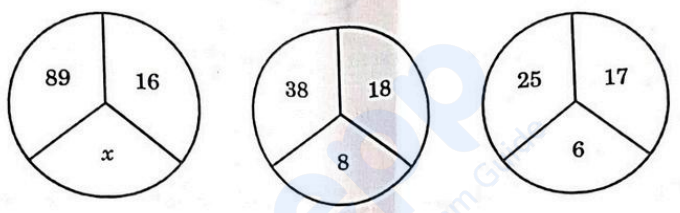
The value of x in the following figures is :
When a child reaches adolescence, there is apt to be a conflict between the parents and the child, since
the latter considers himself to be by now quite capable of managing his own affairs, while the former
are filled with parental solicitude, which is often a disguise for love of power. Parents consider, usually,
that the various moral problems which arise in adolescence are peculiarly their province. The options
they express, however, are so dogmatic that the young seldom confide in them, and usually go their
own way in secret.



