
Read the following passage and answer the items that follow the passage. Your answers to these items should be based on the passage only. Passage-1 Over the next 30 years, many countries are promising to move to net-zero carbon, implying that household emissions will have to be cut to close to nothing. A leading climate scientist reckons that, at best, half the reduction might be achieved through demand-side measures, such as behavioural changes by individuals and households. And even that would require companies and governments to provide more incentives to change through supply-side investments to make low-carbon options cheaper and more widely available.
Which one of the following statements best reflects the central idea conveyed by the passage?
Low-carbon behaviour in people can be brought about by incentivising them.
Understanding the Passage on Net-Zero Carbon and Emissions
The passage discusses the commitment of many countries to achieve net-zero carbon emissions in the next 30 years. It highlights that a significant reduction in household emissions will be necessary for this goal. A climate scientist suggests that behavioural changes by individuals and households could contribute up to half of the required reduction (demand-side measures).
However, the passage also clearly states that achieving this level of behavioural change requires external support. It explicitly mentions that companies and governments need to take action through supply-side investments. These investments are intended to make low-carbon options cheaper and more widely available, thereby providing incentives for individuals and households to adopt low-carbon behaviours.
Analyzing the Options for the Central Idea
We need to identify the statement that best captures the main point the passage is trying to convey. Let's examine each option based on the information presented in the passage:
- Option 1: Moving to net-zero carbon is possible only by the reduction in household emissions.
This statement is too strong. The passage mentions that household emission reduction is a significant part (potentially half) but also emphasizes the need for supply-side investments and incentives from companies and governments. It doesn't state that household reduction *alone* is sufficient or the *only* way to achieve net-zero.
- Option 2: Low-carbon behaviour in people can be brought about by incentivising them.
The passage explicitly states that achieving the potential reduction through behavioural changes (low-carbon behaviour) requires companies and governments "to provide more incentives to change" through supply-side investments that make low-carbon options "cheaper and more widely available". This option directly reflects the mechanism the passage describes for enabling individual behaviour change.
- Option 3: Cheaper goods and services can be made available to people by using low-carbon technologies.
The passage mentions making low-carbon options "cheaper and more widely available" through supply-side investments. While this might imply cheaper goods and services using low-carbon technologies, the central focus of this statement in the passage is on how this contributes to *incentivizing* behavioural change, not just the availability of cheaper items in isolation. It's a supporting detail for the incentive mechanism, not the central idea itself.
- Option 4: Manufacturing industries that use low-carbon technologies should be provided with subsidies.
Subsidies are a form of incentive and supply-side investment. However, the passage talks more broadly about "incentives" and making options "cheaper and more widely available" through supply-side investments. It doesn't specifically narrow it down to subsidies for manufacturing industries. This is a possible *method* under supply-side investments but not the central idea of the passage, which is about how behaviour change is facilitated.
Identifying the Best Reflection of the Central Idea
Based on the analysis, the passage clearly articulates that individual and household behavioural changes (adopting low-carbon behaviour) are crucial for meeting net-zero goals but that these changes are dependent on external factors, particularly incentives provided by companies and governments making low-carbon options more accessible and affordable. Option 2 directly captures this central relationship explained in the passage.
Revision Table: Key Concepts
| Concept | Description in Passage |
|---|---|
| Net-zero carbon | Goal for many countries over 30 years; implies significant emissions cuts. |
| Household emissions | Need to be cut significantly; reduction is part of the solution. |
| Demand-side measures | Behavioural changes by individuals/households; could achieve half the reduction. |
| Supply-side investments | Actions by companies/governments to make low-carbon options cheaper/available. |
| Incentives | Provided by supply-side investments to encourage behavioural change (low-carbon behaviour). |
Additional Information: Driving Low-Carbon Behaviour
Transitioning to a low-carbon society requires changes at multiple levels. While technological advancements and infrastructure development (supply-side) are vital for providing low-carbon alternatives, encouraging widespread adoption of these alternatives by individuals and households (demand-side behaviour) is equally important. The passage highlights the crucial role of incentives in bridging this gap. Incentives can take various forms, such as:
- Financial incentives (e.g., rebates for electric vehicles, subsidies for solar panels, carbon pricing mechanisms).
- Making low-carbon options more convenient and accessible (e.g., better public transport, charging infrastructure for EVs).
- Information and awareness campaigns.
- Regulations that phase out high-carbon options.
Effective climate action requires a combination of these supply-side and demand-side strategies, with incentives acting as a key link to drive necessary behavioural shifts towards a low-carbon future.
Similar Questions
Which one of the following statements best reflects the most logical and rational message conveyed by the author of the passage?
With reference to the above passage, the following assumptions have been made:
I. There is no need for the State to be involved in any manner in the handloom sector.
II. Handloom products are no longer appealing and attractive in the rapidly changing modern world.
Which of the above assumptions is/are valid?Which one of the following statements best reflects the central idea conveyed by the passage?
Which one of the following statements best reflects the critical message conveyed by the author of the passage?
With reference to the above passage, the following assumptions have been made:
I. Path-dependent green investments will eventually most likely benefit growth as well as public finances in a country like India.
II. If other green technologies follow the same pattern as that of solar energy, there will most likely be an easy green transition.
Which of the above assumptions is/are valid?A natural number N is such that it can be expressed as N = p + q + r, where p, q and r are distinct factors of N. How many numbers below 50 have this property?
Team X scored a total of N runs in 20 overs. Team Y tied the score in 10% less overs. Had Team Y’s average run rate (runs per over) been 50% higher, the scores would have been tied in 12 overs. How many runs were scored by Team X?
Consider the following statements:
I. If A ≤ B > C < D > E > F ≥ G = H; then B is always greater than E.
II. If P > Q = R ≥ S = T ≤ U = V > W; then S is always less than V.
Which of the statements given above is/are correct?Consider the first 100 natural numbers. How many of them are not divisible by any one of 2, 3, 5, 7 and 9?
If 4 ≤ x ≤ 8 and 2 ≤ y ≤ 7, then what is the ratio of maximum value of (x + y) to minimum value of (x − y)?
Important Questions from Miscellaneous Topics
- In communication the word 'Haptics' signifies :
- Which of the following statements best defines the scope of semiotics?
The compound interest on Rs. 75,000 for three years, at successive interest rates of 4%, 6% and 9% for each year respectively is:
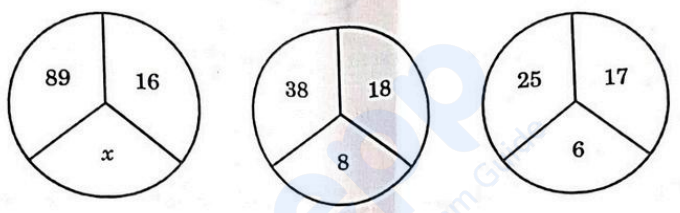
The value of x in the following figures is :
When a child reaches adolescence, there is apt to be a conflict between the parents and the child, since
the latter considers himself to be by now quite capable of managing his own affairs, while the former
are filled with parental solicitude, which is often a disguise for love of power. Parents consider, usually,
that the various moral problems which arise in adolescence are peculiarly their province. The options
they express, however, are so dogmatic that the young seldom confide in them, and usually go their
own way in secret.



