
Read the following passage and answer the items that follow the passage. Your answers to these items should be based on the passage only. Passage-1 It is hard to predict how changes in the climate and the atmosphere’s chemistry will affect the prevalence and virulence of agricultural diseases. But there is a risk that such changes will make some plant infections more common in all climatic zones, perhaps catastrophically so. Part of the problem is that centuries of selective breeding have refined the genomes of most high-value crops. They are spectacular at growing in today’s conditions but genetic variations that are not immediately useful to them have been bred out. This is good for yields but bad for coping with changes. A minor disease or even an unknown one could suddenly rampage through a genetically honed crop.
Which one of the following statements best reflects the central idea conveyed by the passage?
Our total dependence on genetically honed crops entails possible food insecurity.
Finding the Central Idea of the Passage
The question asks us to identify the central idea conveyed by the provided passage. To do this, we need to read the passage carefully and understand its main topic and the primary point the author is trying to make.
Let's examine the passage:
| Passage-1 |
| It is hard to predict how changes in the climate and the atmosphere’s chemistry will affect the prevalence and virulence of agricultural diseases. But there is a risk that such changes will make some plant infections more common in all climatic zones, perhaps catastrophically so. Part of the problem is that centuries of selective breeding have refined the genomes of most high-value crops. They are spectacular at growing in today’s conditions but genetic variations that are not immediately useful to them have been bred out. This is good for yields but bad for coping with changes. A minor disease or even an unknown one could suddenly rampage through a genetically honed crop. |
The passage starts by mentioning the uncertainty of climate change impacts on agricultural diseases but highlights a risk: increased commonality and severity of plant infections. It then focuses on the vulnerability of 'genetically honed crops'. It explains that these crops, optimized for current conditions through selective breeding, have lost genetic variation. This loss, while boosting yields in stable conditions, makes them poor at adapting to changes, specifically new or minor diseases that could spread rapidly through such uniform crops.
The core message is about the danger associated with relying heavily on these genetically uniform crops, especially in a changing environment where new diseases can emerge or existing ones can become more potent. This vulnerability directly relates to the potential for significant crop failure, which impacts food availability.
Analyzing the Options
Let's evaluate each option in light of this understanding:
- Option 1: Global climate change adversely affects the productivity of crops.
The passage mentions climate change as a factor that *might* increase plant diseases, which *could* affect productivity. However, the central focus is not just on the general adverse effect of climate change on productivity. It's more specific about *how* this interacts with a particular type of crop (genetically honed) and the vulnerability it creates.
- Option 2: Our total dependence on genetically honed crops entails possible food insecurity.
This statement directly reflects the passage's main point. The passage explains that 'genetically honed crops' lack genetic variation, making them susceptible to diseases in changing climates. The phrase "rampage through a genetically honed crop" implies widespread failure. Dependence on such vulnerable crops clearly leads to a risk of food insecurity.
- Option 3: Our food security should not depend on agricultural productivity alone.
While true in a broader sense, this statement is a general principle about food security. The passage is focused on a specific risk factor (genetically honed crops) that threatens agricultural productivity and, consequently, food security. The passage doesn't discuss other factors food security might depend on; its scope is limited to the risk from uniform crops and diseases.
- Option 4: Genetically honed crops should be replaced with their wild varieties in our present cultivation practices.
The passage implies that wild varieties might have the genetic variation that honed crops lack, making them potentially more resilient. However, the passage describes the problem; it does not explicitly propose replacing genetically honed crops with wild varieties as the central idea or solution. It focuses on highlighting the *risk* of current practices.
Conclusion
Based on the analysis, Option 2 best captures the central idea of the passage. The passage explains the vulnerability of genetically honed crops due to lack of genetic diversity and highlights the risk of diseases under changing climatic conditions, directly linking this dependence to a potential threat to food security.
Therefore, the statement that best reflects the central idea is that our reliance on genetically honed crops carries a risk of food insecurity.
Revision Table: Key Concepts
| Concept | Explanation from Passage | Relevance to Central Idea |
|---|---|---|
| Climate Change & Atmospheric Chemistry | Potential to increase prevalence and virulence of agricultural diseases. | Creates a challenging environment for vulnerable crops. |
| Agricultural Diseases (Plant Infections) | Risk of becoming more common and severe. | The primary threat to crops, especially vulnerable ones. |
| Genetically Honed Crops | Refined genomes for high yields in current conditions; genetic variation bred out. | Highly productive but lack adaptability; core subject of vulnerability. |
| Lack of Genetic Variation | Consequence of selective breeding; makes crops 'bad for coping with changes'. | The reason why honed crops are vulnerable to new/minor diseases. |
| Minor/Unknown Disease Risk | Can 'rampage through' a uniform, vulnerable crop. | Illustrates the potential for catastrophic failure. |
| Food Insecurity | Implied consequence of widespread crop failure due to disease. | The significant risk stemming from dependence on vulnerable crops. |
Additional Information: Genetic Diversity and Crop Resilience
Genetic diversity within a crop species, or within an agricultural system (like growing multiple varieties), is crucial for resilience. Here's why:
- Disease Resistance: Different varieties or individuals within a population may have genes that confer resistance to specific pests or diseases. If a disease emerges, some individuals will survive, preventing total crop failure. A genetically uniform crop lacks this variability, meaning if one plant is susceptible, likely all plants are.
- Adaptation to Environment: Genetic variation allows populations to adapt to changing environmental conditions, such as shifts in temperature, rainfall patterns, or soil composition. Without variation, adaptation is impossible.
- Response to Stress: Diverse populations are better equipped to handle various stresses, including drought, heat, cold, or nutrient deficiencies.
Selective breeding for uniformity, while excellent for predictable yield and quality in specific conditions, inadvertently removes this critical diversity, making the crop a single, large target for threats like new or evolving diseases, particularly in unpredictable environments influenced by climate change. This vulnerability is the core concern raised by the passage regarding genetically honed crops and their link to potential food insecurity.
Similar Questions
Which one of the following statements best reflects the most logical and rational message conveyed by the author of the passage?
With reference to the above passage, the following assumptions have been made:
I. There is no need for the State to be involved in any manner in the handloom sector.
II. Handloom products are no longer appealing and attractive in the rapidly changing modern world.
Which of the above assumptions is/are valid?Which one of the following statements best reflects the central idea conveyed by the passage?
Which one of the following statements best reflects the critical message conveyed by the author of the passage?
With reference to the above passage, the following assumptions have been made:
I. Path-dependent green investments will eventually most likely benefit growth as well as public finances in a country like India.
II. If other green technologies follow the same pattern as that of solar energy, there will most likely be an easy green transition.
Which of the above assumptions is/are valid?A natural number N is such that it can be expressed as N = p + q + r, where p, q and r are distinct factors of N. How many numbers below 50 have this property?
Team X scored a total of N runs in 20 overs. Team Y tied the score in 10% less overs. Had Team Y’s average run rate (runs per over) been 50% higher, the scores would have been tied in 12 overs. How many runs were scored by Team X?
Consider the following statements:
I. If A ≤ B > C < D > E > F ≥ G = H; then B is always greater than E.
II. If P > Q = R ≥ S = T ≤ U = V > W; then S is always less than V.
Which of the statements given above is/are correct?Consider the first 100 natural numbers. How many of them are not divisible by any one of 2, 3, 5, 7 and 9?
If 4 ≤ x ≤ 8 and 2 ≤ y ≤ 7, then what is the ratio of maximum value of (x + y) to minimum value of (x − y)?
Important Questions from Miscellaneous Topics
- In communication the word 'Haptics' signifies :
- Which of the following statements best defines the scope of semiotics?
The compound interest on Rs. 75,000 for three years, at successive interest rates of 4%, 6% and 9% for each year respectively is:
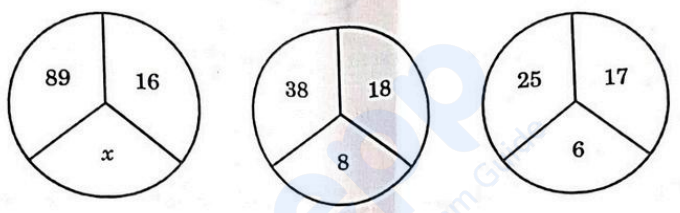
The value of x in the following figures is :
When a child reaches adolescence, there is apt to be a conflict between the parents and the child, since
the latter considers himself to be by now quite capable of managing his own affairs, while the former
are filled with parental solicitude, which is often a disguise for love of power. Parents consider, usually,
that the various moral problems which arise in adolescence are peculiarly their province. The options
they express, however, are so dogmatic that the young seldom confide in them, and usually go their
own way in secret.



