
A semicircle has been drawn on the length of a rectangle. The area of the shaded region in the figure is: 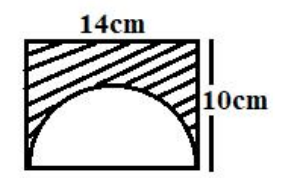
To find the area of the shaded region, we first determine the areas of the rectangle and the semicircle, then subtract the area of the semicircle from the area of the rectangle.
- Calculate the area of the rectangle:
The rectangle's length is 14 cm, and its width is 10 cm.
Area of rectangle = \(14 \, \text{cm} \times 10 \, \text{cm} = 140 \, \text{cm}^2\)
- Calculate the area of the semicircle:
The diameter of the semicircle is equal to the length of the rectangle, which is 14 cm. Therefore, the radius is half of the diameter.
Radius = \(\frac{14}{2} = 7 \, \text{cm}\)
Area of semicircle = \(\frac{1}{2} \pi r^2 = \frac{1}{2} \times \frac{22}{7} \times 7^2 = 77 \, \text{cm}^2\)
- Find the area of the shaded region:
Area of shaded region = Area of rectangle - Area of semicircle
= \(140 \, \text{cm}^2 - 77 \, \text{cm}^2 = 63 \, \text{cm}^2\)
Thus, the area of the shaded region is 63 cm².
Similar Questions
- A square is inscribed in a circle which is inscribed in an equilateral triangle. If one side of the triangle is $x$, then the area of square is:
- A path around the inner side of a rectangular park measuring $37\text{ m} \times 30\text{ m}$ occupies $570\text{ m}^{2}$. What is the width of the path?
- The two unequal sides of a rectangle are in the ratio of 3 : 4. If the perimeter is 42 cm, then the length of diagonal will be:
- Four cows are tethered to the four corners of a square field of length 28 m so that each cow can just touch the two cows in the adjacent corners. If the grass in the area inside the square field that was accessible to the cows was enough to feed them for 22 days, for how many days would the grass that is beyond the reach of these cows be able to feed them if someone cuts it and leaves it inside the grazable parts? [Use $\pi = 22/7$]
- What is the area of a rhombus, whose sides are 25 cm and one of the diagonals is 14 cm?
- A sector of a circle has a radius of $18\text{ cm}$ and a central angle of $125^\circ$. What will be its approximate perimeter?
(Use $\pi = \frac{22}{7}$) - 30 ml paint is required to paint a circular plate of 20 cm radius. How much paint is required to paint a similar plate of radius 80 cm?
- If the length and the perimeter of a rectangle are in the ratio of 3 : 20, then its length and breadth will be in the ratio of:
- A wire in the form of a circle of radius 56 m is cut and again bent in the form of a square. What is the measure of the diagonal of the square?
- There is a regular hexagon of side 5 cm. Find its area.
Important Questions from 2-D Mensuration
- The length of a rectangular plot is $(x^2 + xy + y^2)$ m and its breadth is $(x^2 - 5xy - y^2)$ m.
Find its perimeter, when $x = 1$ and $y = -1$. - The ratio between the perimeter and breadth of a rectangle is 3: 1. If the area of the rectangle is $98 \text{ cm}^2$, find the perimeter (in cm) of the rectangle.
The shorter side of a rectangle is 15 cm less than the longer side. The numerical value of its area is equal to 5 times the numerical value of its perimeter. What is the length (in cm) of its longer side?
- In a circle of radius 10.5 cm, if the angle of a sector is $\frac{2\pi}{3}$, then the perimeter of the sector is (in cm):
(Take $\pi = \frac{22}{7}$) - Find the circumference (in m) of the largest circle that can be inscribed in a rectangle whose dimensions are given as 114 m and 63 m.
Take $\pi = \frac{22}{7}$



