
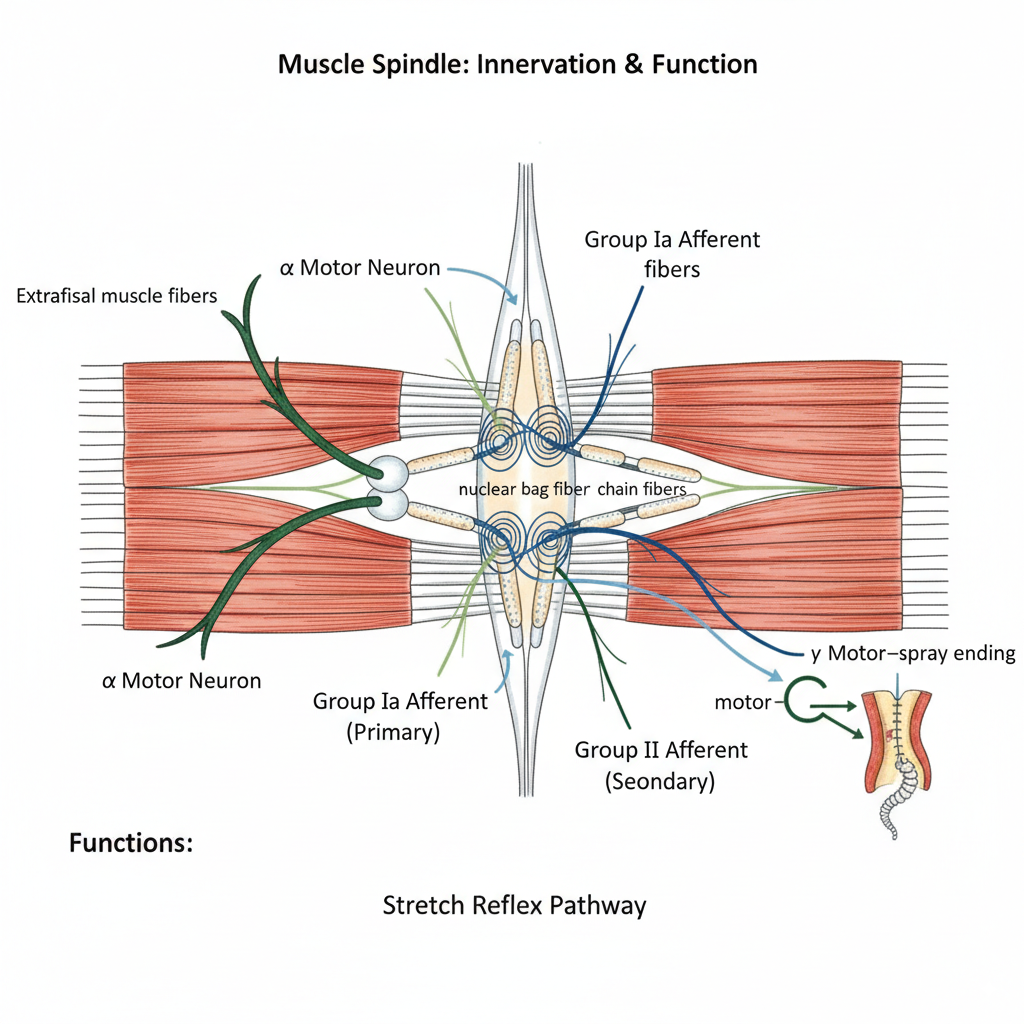
With the help of a suitable diagram, explain the innervation and functions of muscle spindle.
The muscle spindle is a specialized sensory receptor within skeletal muscle that plays a central role in proprioception by detecting muscle length and its rate of change. It contains intrafusal fibers, which are small modified muscle fibers enclosed in a connective tissue capsule, and these run in parallel with ordinary extrafusal fibers. Motor control of the spindle is provided by gamma motor neurons, which innervate the contractile ends of intrafusal fibers, adjusting spindle sensitivity during muscle shortening. Alpha motor neurons supply extrafusal fibers and generate the main force of contraction. Sensory input arises from two groups. Primary Ia afferents coil around the central regions of both nuclear bag and nuclear chain fibers, responding to both static length and dynamic stretch. Secondary II afferents primarily innervate nuclear chain fibers, monitoring static length. Functionally, spindles drive the stretch reflex, ensuring that stretched muscles contract, thereby stabilizing posture, preserving tone, and supporting coordinated movement.
Answered By:
Sarvesh Jha
Sarvesh Jha is a seasoned government exam mentor with firsthand success in top exams like IBPS PO, SBI PO, CDS, RRB JE, SSC CGL, BPSC, and CTET. Known for his deep conceptual clarity and strategic approach, he has guided over 5000 students through personalized mentorship. He has been creating well researched content for last 5 years.

Similar Questions
Describe the formation, course and branches of ulnar nerve. Which muscles do each of the branches supply? Why is ulnar nerve called the "musician's nerve"?
Name the nerves and their branches that supply the sole of the foot stating the specific area of their distribution. Explain in brief what is Morton's metatarsalgia.
Classify jaundice according to its aetiology. Make a tabular representation of the blood, urinary and stool findings observed in different types ofjaundice.
Describe the process of generation and conduction of nerve impulses in humans. Add a note on saltatory conduction.
Using a well labelled diagram, trace the taste pathway from circumvallate papillae of tongue to the cerebral cortex.
Enumerate any five tests for the assessment of renal tubular functions. Explain the underlying principle and their interpretation.
Explain the role of biotin in intermediary metabolism with suitable examples. Add a note on the mechanism of action of any biotin-antagonist with its application in medicine.
Define cardiac output and describe the regulation of cardiac output in normal adults. Add a note on Cardiac Index and Cardiac Reserve.
Define Systemic Vascular Resistance and list its determinants. Briefly explain the role of its determinants.
Describe Selenium under the headings of 'its dietary sources', 'its biochemical roles' and 'its deficiency diseases' with their clinical manifestations.
Important Questions from Miscellaneous
How will you manage a case of misplaced copper-T (Cu-T)?
Describe the embryogenesis, clinical features and principles of management of cleft palate.
Write short notes in 150 words:
MetagenesisWrite short notes in 150 words:
Book lungsWrite short notes in 150 words:
Paedomorphosis



