
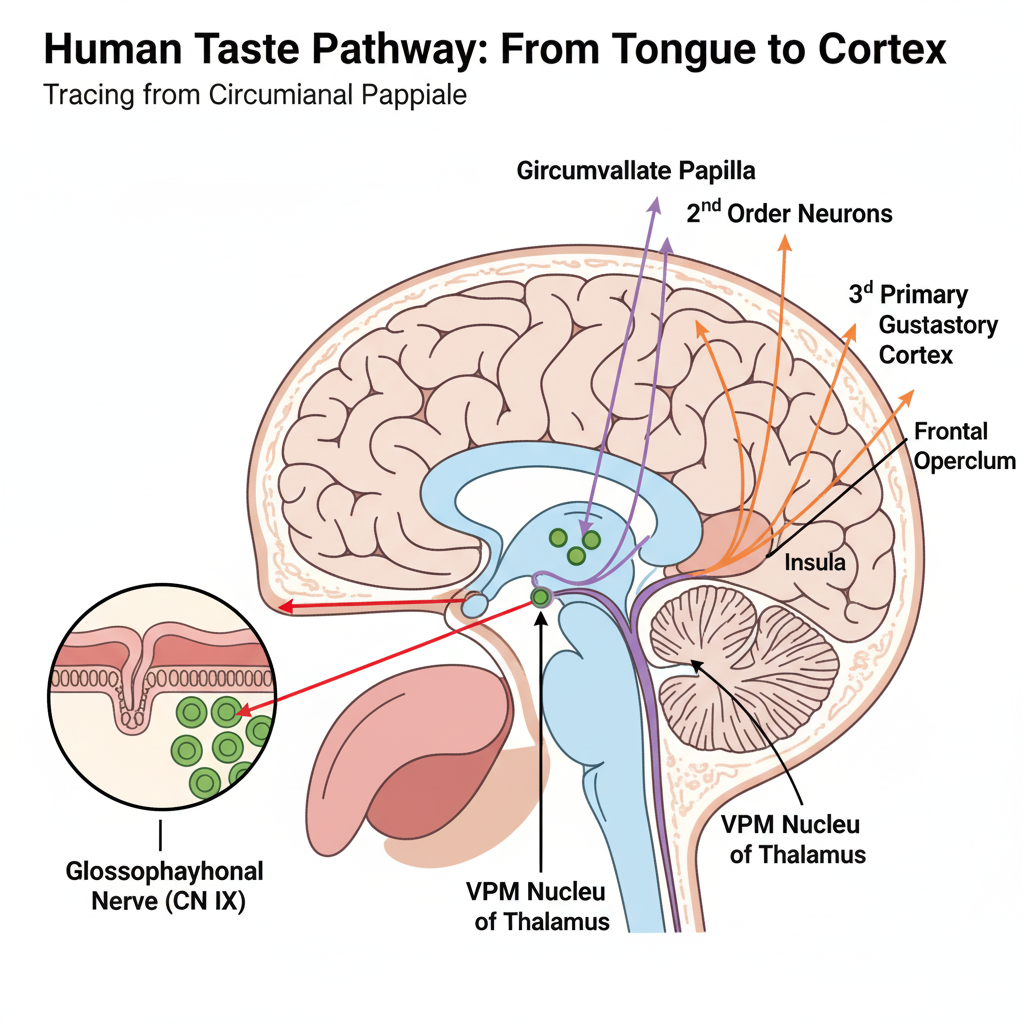
Using a well labelled diagram, trace the taste pathway from circumvallate papillae of tongue to the cerebral cortex.
Taste (gustatory) sensations from the tongue initiate at taste buds located within specialized papillae. The circumvallate papillae, situated at the back of the tongue, contribute significantly to this pathway. From these papillae, taste signals are primarily carried by the glossopharyngeal nerve (CN IX). The anterior two-thirds of the tongue transmit taste via the chorda tympani branch of the facial nerve (CN VII), while the epiglottis and pharynx use the vagus nerve (CN X).
The first-order neurons, whose cell bodies are in the geniculate, petrosal, and nodose ganglia for CN VII, IX, and X respectively, project centrally. Their axons enter the brainstem and synapse in the nucleus of the solitary tract (NTS), specifically its gustatory portion, located in the medulla. This is the first relay station in the brainstem for all taste afferents.
From the NTS, second-order neurons ascend to the ventral posteromedial (VPM) nucleus of the thalamus. This nucleus acts as a crucial sensory relay station for taste, filtering and processing information before it reaches higher cortical areas.
Finally, third-order neurons originate in the VPM nucleus of the thalamus and project to the primary gustatory cortex, which is predominantly located in the anterior insula and frontal operculum of the cerebral cortex. This cortical region is responsible for conscious perception and discrimination of different taste qualities (sweet, sour, salty, bitter, umami). The integration of taste with smell, texture, and temperature occurs in association cortices, contributing to the complex perception of flavor.
Answered By:
Sakshi Negi
Sakshi Negi is a Delhi-based journalist and content specialist with expertise in educational content and digital media, focusing particularly on government exam preparation and career guidance. With a degree in Journalism and Mass Communication from NRAI School of Mass Communication and her background as a Kendriya Vidyalaya alumna, she brings unique insights into the Indian education system and government sector opportunities.

Similar Questions
Describe the formation, course and branches of ulnar nerve. Which muscles do each of the branches supply? Why is ulnar nerve called the "musician's nerve"?
Name the nerves and their branches that supply the sole of the foot stating the specific area of their distribution. Explain in brief what is Morton's metatarsalgia.
Classify jaundice according to its aetiology. Make a tabular representation of the blood, urinary and stool findings observed in different types ofjaundice.
Describe the process of generation and conduction of nerve impulses in humans. Add a note on saltatory conduction.
With the help of a suitable diagram, explain the innervation and functions of muscle spindle.
Enumerate any five tests for the assessment of renal tubular functions. Explain the underlying principle and their interpretation.
Explain the role of biotin in intermediary metabolism with suitable examples. Add a note on the mechanism of action of any biotin-antagonist with its application in medicine.
Define cardiac output and describe the regulation of cardiac output in normal adults. Add a note on Cardiac Index and Cardiac Reserve.
Define Systemic Vascular Resistance and list its determinants. Briefly explain the role of its determinants.
Describe Selenium under the headings of 'its dietary sources', 'its biochemical roles' and 'its deficiency diseases' with their clinical manifestations.
Important Questions from Miscellaneous
How will you manage a case of misplaced copper-T (Cu-T)?
Describe the embryogenesis, clinical features and principles of management of cleft palate.
Write short notes in 150 words:
MetagenesisWrite short notes in 150 words:
Book lungsWrite short notes in 150 words:
Paedomorphosis



